

The Social Commerce Revolution: How TikTok Shop and Popunder Traffic Drove $110,000 in Profits
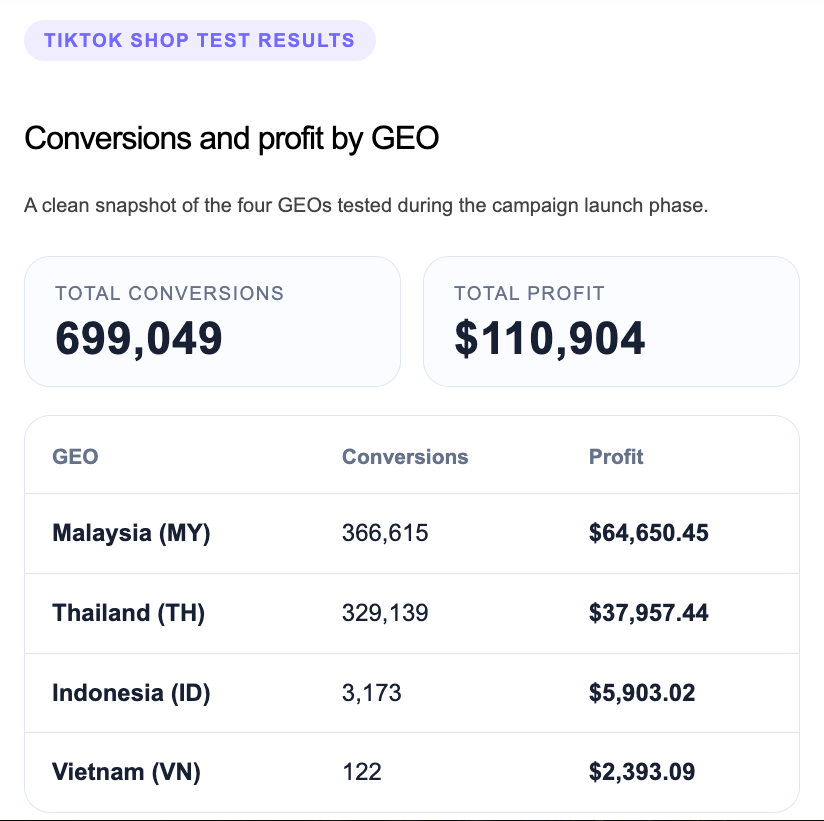
The convergence of social media influence and direct-response advertising has created a new frontier for ecommerce affiliates. As platforms like TikTok evolve from discovery engines into full-scale retail ecosystems, the mechanics of how products reach consumers are shifting. A groundbreaking case study released by PropellerAds for Q1 2026 highlights this transformation, revealing how a single advertiser leveraged TikTok Shop offers combined with unconventional traffic sources to generate over 699,000 conversions and a staggering $110,000 in profit.
This report examines the mechanics behind this campaign, the evolving strategy of Asian social commerce, and what this means for the future of digital performance marketing.
Main Facts: The Intersection of Traffic and Impulse Buying
In the rapidly maturing digital landscape of Southeast Asia, TikTok Shop has emerged as a powerhouse. Unlike traditional ecommerce platforms that require users to navigate through multiple pages, TikTok Shop facilitates an "in-app" ecosystem where discovery, consideration, and purchase occur in a single, frictionless flow.
The PropellerAds case study provides a rare, transparent look at a high-performance campaign. By utilizing Popunder traffic—an ad format that appears behind the active browser window—the advertiser managed to drive massive volume to TikTok Shop offers. The results were significant:
- Total Conversions: 699,000+
- Total Profit: Over $110,000
- CPA (Cost Per Action) Range: $0.04 to $0.20
- Peak Conversion Rates: Up to 10%
These metrics underscore the efficacy of matching high-intent social commerce offers with aggressive, high-volume ad traffic.
Chronology of the Campaign Strategy
The success of the campaign was not the result of a "lucky break" but rather a disciplined, multi-phase methodology. The advertiser’s strategy followed a distinct chronological arc designed to minimize risk while maximizing data collection.
Phase 1: The Broad Testing Period (The "RON" Foundation)
The campaign began with a Run-On-Network (RON) approach. Instead of attempting to guess which specific demographic or device would convert, the advertiser cast a wide net across Malaysia, Thailand, Indonesia, and Vietnam. This allowed the campaign algorithms to collect "conversion signals" in a raw state. By monitoring which traffic sources triggered engagement, the team established a baseline for performance.
Phase 2: Data Synthesis
Once the initial data pool reached a statistically significant volume, the advertiser ceased broad testing. This phase involved cross-referencing conversion data against variables like device type (iOS vs. Android), internet connection speed, and browser behavior.

Phase 3: Targeted Optimization
With the data in hand, the advertiser transitioned from broad bidding to specific strategies. They utilized a mix of bidding methods—CPA Goal, SmartCPM, and High Intent CPM—to refine the traffic flow. By focusing on the regions that showed the highest return on ad spend (ROAS), the advertiser effectively doubled down on the most profitable segments, specifically Malaysia and Thailand.
Supporting Data: Regional Performance Analysis
The campaign’s success was highly dependent on the GEO (geographic) targeting. The Asian market is not a monolith; each country presented unique challenges and opportunities.
| Campaign GEO | Primary Traffic Method | Performance Insight |
|---|---|---|
| Malaysia | Popunder / CPA Goal | High conversion efficiency; strong middle-class consumer demand. |
| Thailand | SmartCPM | Highly responsive to lifestyle and fashion-focused creatives. |
| Indonesia | High Intent CPM | Massive volume; requires careful bid management to maintain margins. |
| Vietnam | Popunder / RON | Emerging growth; low entry cost for competitive products. |
The data revealed a crucial insight: when the conversion rate reached its peak of 10%, it was almost always tied to high-intent traffic sources that were already conditioned to engage with video-based commerce. The cost per action (CPA) was kept exceptionally low, averaging between $0.04 and $0.20, which is significantly more cost-effective than standard search or social ad bidding in Western markets.
The Mechanics of Social Commerce: Why It Works
TikTok Shop’s effectiveness lies in the reduction of "cognitive load." In traditional ecommerce, a customer clicks an ad, lands on a website, waits for it to load, adds to cart, enters payment info, and checks out. At every step, the risk of abandonment increases.
TikTok Shop eliminates these hurdles. By keeping the user within the app, the "impulse loop" remains intact. For categories like beauty, fashion, and consumer gadgets—which were the primary focus of this campaign—the "click-to-buy" timeframe is seconds, not minutes. This friction-free environment is why affiliates are increasingly pivoting away from traditional landing pages in favor of direct-to-app conversion funnels.
Implications for the Affiliate Marketing Industry
The success of this campaign carries significant implications for the future of the affiliate space.
1. The Resilience of "Alternative" Traffic
For years, many digital marketers dismissed Popunder and Push notifications as "secondary" traffic sources. This case study proves that when these formats are paired with high-conversion offers like TikTok Shop, they can outperform mainstream channels in terms of pure volume and CPA efficiency.
2. The Shift toward Regional Specialization
The rapid growth of the Asian ecommerce market suggests that affiliates should stop viewing "global" markets as a single entity. The nuance of consumer behavior in Vietnam versus Indonesia is stark. Future campaigns will likely require even more granular regional testing to sustain profitability.
3. The "In-App" Requirement
The era of the complex, multi-page sales funnel is being challenged. Affiliates must now learn to optimize for environments they do not own. Because the advertiser cannot control the TikTok Shop interface, the focus shifts entirely to the "pre-sell" phase—the ad creative and the initial engagement hook that drives the user into the shop.
Expert Perspective: Adapting to the New Ecosystem
Bogdan Rancea, co-founder of Ecommerce-Platforms.com, notes that the digital commerce space is undergoing a permanent shift toward creator-led discovery.
"We are seeing a total dissolution of the line between entertainment and retail," Rancea observes. "When a user is scrolling through their feed and sees a product that fits their lifestyle, the barrier to purchase is almost zero. Affiliates who understand that they are no longer just selling a product, but rather facilitating a seamless user experience, are the ones who are winning."
For those looking to enter this space, the recommendation is clear:
- Start with broad testing: Do not jump into niche targeting until you have enough data to support your assumptions.
- Leverage automation: Use smart-bidding tools provided by networks like PropellerAds to adjust your bids in real-time as market conditions change.
- Focus on impulse categories: TikTok Shop thrives on products that are visually appealing and priced for impulse purchasing. Avoid high-ticket items that require long deliberation cycles.
Conclusion: A New Standard for Performance
The $110,000 profit generated in just one quarter is a testament to the power of combining modern social commerce platforms with aggressive, data-driven traffic strategies. As TikTok continues to roll out shop features globally, the blueprint established in this Asian market study will likely become the standard for performance marketers worldwide.
For affiliates and media buyers, the message is simple: The future of ecommerce is not on a standalone website—it is where the users are already spending their time. By embracing in-app purchasing and testing traffic sources that go beyond the traditional "walled gardens" of major search engines, marketers can tap into a massive, highly responsive audience ready to convert with a single tap.
