
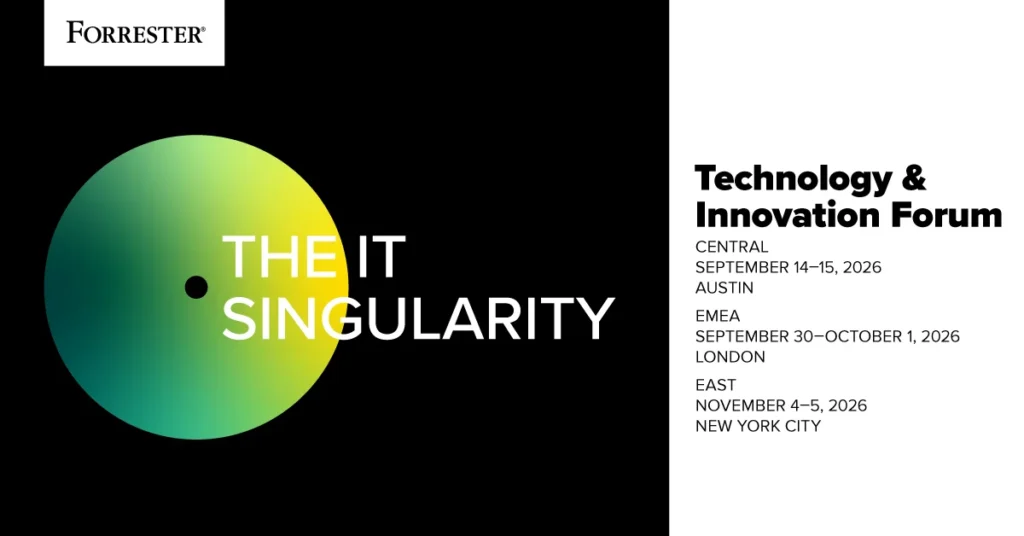
The IT Singularity: Why the Old Rules of Business Technology Have Expired
In the lexicon of modern technology, the word "singularity" has long been reserved for two looming, high-stakes milestones. First, there is the arrival of Artificial General Intelligence (AGI)—the theoretical point where machines transcend human cognition. Second, there is "Q-Day," the moment when quantum computing reaches sufficient maturity to render current public-key encryption obsolete.
While these concepts dominate headlines, a more immediate and disruptive singularity is already unfolding. We have entered the era of the IT Singularity: the moment when traditional IT operating models—designed for deterministic systems, human-led decisioning, and linear automation—no longer scale, nor do they make economic sense. This is not a future projection; it is the current reality. AI is no longer a "differentiator" or a project on the horizon; it is an ambient, always-on utility that has fundamentally rewritten the rules of corporate infrastructure.
The Chronology of Disruption: From Linear to Cognitive
To understand the IT Singularity, one must look at the evolution of the enterprise technology stack. For the past three decades, IT was defined by stability and predictability. We built systems that performed specific tasks in specific sequences.
- The Era of Determinism (1995–2015): IT departments functioned as service centers. Success was measured by uptime, cost containment, and the successful implementation of ERP or CRM systems. Processes were linear; if a task required an output, a developer wrote code to execute that precise task.
- The Era of Digital Transformation (2015–2022): Cloud adoption and mobile-first strategies shifted the focus toward agility. However, the underlying operating model remained largely human-centric. Decision-making still relied on executive oversight and manual governance.
- The IT Singularity (2023–Present): With the proliferation of generative AI and autonomous agents, the "human-in-the-loop" model has become a bottleneck. We are currently witnessing a shift where the cost of maintaining legacy, human-heavy IT infrastructure is beginning to outweigh the value it creates. The "Singularity" is reached when the complexity of managing AI-driven workflows exceeds the capacity of traditional, top-down management structures.
Supporting Data: The Case for a Structural Pivot
The urgency of this shift is underscored by the current market landscape. According to recent research from Forrester and the 4As, the competitive advantage is no longer found in standalone AI tools, but in the orchestration of integrated ecosystems.
Data indicates that:
- Platform Consolidation: Agencies and enterprises are rapidly moving away from "best-of-breed" point solutions toward integrated platforms. Google, for instance, has recently surged past OpenAI in preference among agencies, not because of superior model performance alone, but because of its ability to connect data, creative, media, and commerce at scale.
- The Productivity Gap: Many organizations are overinvesting in "AI experiments" that fail to yield ROI. The difference between leaders and laggards is not the volume of AI tools deployed, but the maturity of the underlying data governance and the agility of the operating model.
- The Looming Q-Day: While organizations fret over the IT Singularity, they must simultaneously prepare for the quantum threat. With Q-Day projected for roughly 2030, the "crypto-agility" of a firm’s infrastructure is now a prerequisite for long-term survival. Those failing to modernize their security architecture today are effectively building their future on sand.
Official Perspectives: The Need for a Cognitive Operating Model
Forrester’s upcoming 2026 Technology & Innovation Forums are built around the premise that the old IT playbook is not just outdated—it is actively hindering growth.
"Too many organizations are still chasing use cases and scaling without the foundations to sustain them," notes a lead analyst at Forrester. "The leaders pulling ahead are doing something fundamentally different: they are redesigning the operating model itself."
The "Cognitive Operating Model" is the proposed successor to the legacy IT model. It prioritizes:
- AI Governance as an Accelerator, Not a Guardrail: Moving from reactive compliance to proactive, automated policy enforcement.
- Infrastructure Modernization: Moving away from fragmented, siloed data centers to unified, AI-ready architectures that can handle the massive compute requirements of autonomous agents.
- Skill Shift: Investing in a workforce that acts as an "architect of systems" rather than an "operator of tasks."
Implications: The New Competitive Landscape
The IT Singularity forces a redesign of every business function. Marketing, for example, is currently in the eye of the storm. CMOs are increasingly responsible for AI-driven outcomes, which is exposing a severe gap between what traditional agencies provide—execution—and what businesses actually need—transformation.
1. The Death of the "Service-Oriented" IT Model
Traditional IT models were built to be "service-oriented," where business units placed orders for technology and IT fulfilled them. In the era of the IT Singularity, this is too slow. IT must become a "platform-oriented" entity, providing the sandbox, the data, and the guardrails for business units to innovate autonomously.
2. The Rise of the "Integrated Ecosystem"
As seen in the shift toward Google’s ecosystem, the ability to orchestrate end-to-end workflows is the new competitive edge. Companies that rely on disparate, disconnected AI tools will struggle with data latency and "hallucination management." The winners will be those who treat AI as an operating system, not an application.
3. The Governance Imperative
Governance is often viewed as a hindrance to speed, but in an era where AI can make decisions at machine speed, bad governance is a liability that can sink a company in minutes. "AI Governance for the GOOOOOAL" is a shift toward embedding ethics, security, and performance monitoring into the very fabric of the software lifecycle.
Preparing for the Road Ahead: 2026 and Beyond
As we look toward 2026, the mandate for technology leaders is clear: stop treating AI as a "project" and start treating it as the foundation of your future business.
The upcoming Forrester Forums in Austin, London, and New York are designed to guide leaders through this transition. These sessions are not merely informative; they are functional, providing:
- Practical Frameworks: How to build an AI-ready data architecture from scratch.
- Strategic Roadmaps: Aligning IT investment with long-term business value rather than short-term productivity gains.
- Real-World Guidance: Case studies on how to transition from legacy, human-heavy IT to a cognitive, autonomous operating model.
The IT Singularity is not a crisis to be managed; it is an environment to be mastered. Organizations that cling to the "old ways"—the reactive, service-oriented, and manual processes of the last two decades—will find themselves marginalized. Conversely, those that embrace the shift toward a cognitive, automated, and integrated operating model will be the ones that define the next decade of commerce.
The question for every leader today is no longer "How do we implement AI?" but rather "How do we redesign our organization to ensure that AI serves us, and not the other way around?" The answers to that question will determine which companies remain relevant as we head toward the horizon of 2030 and beyond.
The disruption is here. The question remains: are you prepared to turn it into your greatest advantage?
