
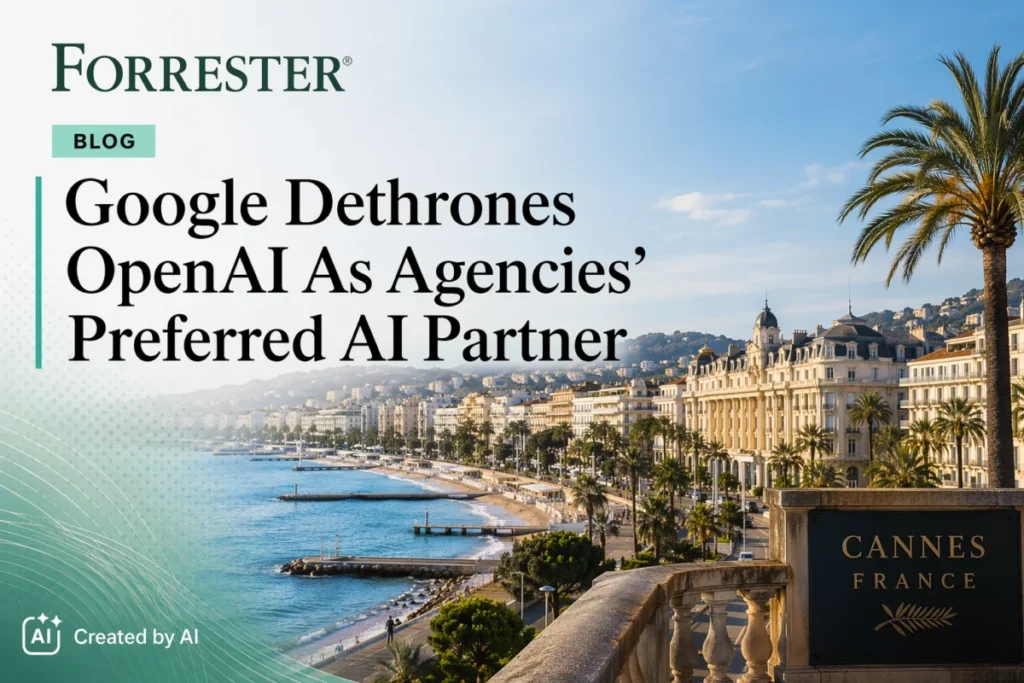
The Orchestration Era: Why Google Has Toppled the AI Giants in Agency Rankings
The landscape of professional marketing has undergone a tectonic shift. For years, the conversation surrounding Artificial Intelligence was dominated by a "model-first" mentality—a pursuit of the most sophisticated, high-parameter large language models (LLMs) capable of writing the best copy or generating the most stunning visuals. However, as of 2026, the narrative has fundamentally changed. According to new research from Forrester and the 4As, US marketing agencies have officially pivoted.
For the first time since the generative AI explosion of 2024, Google has emerged as the preferred AI partner for major US agencies, successfully leapfrogging industry heavyweights including Adobe, Anthropic, Microsoft, and OpenAI. This isn’t just a change in vendor preference; it is a signal that the era of the standalone AI tool is ending, replaced by the age of the integrated marketing operating system.
The Shift: From Isolated Models to Holistic Ecosystems
The findings, highlighted amidst the high-energy backdrop of the 2026 Cannes Lions International Festival of Creativity, reveal that agency leaders are no longer prioritizing the "smartest" model. Instead, they are prioritizing the "most connected" ecosystem.
In an industry where fragmentation has historically plagued productivity, the primary pain point is no longer generating content—it is managing the workflow that carries content from data-backed insight to final media activation. Agency executives have realized that even the most advanced AI model is a liability if it exists in a vacuum.
"We aren’t just buying AI models anymore," says one agency partner. "We are buying and building marketing operating systems. The goal is to move beyond optimizing isolated tasks—like writing a headline or resizing an image—to orchestrating end-to-end systems that unify data, creative, activation, and measurement."
Chronology: The Evolution of Agency-AI Integration
To understand how Google claimed the top spot, we must look at the progression of AI adoption in the agency world:
- 2023: The Novelty Phase. Agencies experimented with ChatGPT and Midjourney. AI was viewed as a productivity booster for creative brainstorming.
- 2024: The Tooling Phase. Agencies began formalizing partnerships with OpenAI and Microsoft, focusing on "smarter" models to accelerate content production. Competition between vendors was defined by benchmark scores and model accuracy.
- 2025: The Integration Phase. Agencies realized that having a great model was insufficient if it couldn’t talk to their CRM, their media buying platforms, or their analytics dashboards. The race to build "martech stacks" began.
- 2026: The Orchestration Phase. The market has reached a maturity point where the winner is determined by breadth. Agencies are favoring providers that allow them to collapse the distance between data insights and market execution.
The Google Advantage: A Unified Stack
Google’s ascent to the top of the Forrester rankings is a direct result of its unique ability to provide a "full-stack" solution. While competitors offer specialized AI or creative software, Google offers a cohesive environment that spans the entire marketing lifecycle.
Their ecosystem advantage is built on several key pillars:
- Audience Intelligence: Google Analytics 360 provides the bedrock of consumer behavioral data.
- Measurement & Optimization: Tools like Meridian allow agencies to track the efficacy of their campaigns in real-time.
- Creative Production: Asset Studio, coupled with Gemini, Imagen, and Veo, allows for rapid creative iteration.
- Activation: The seamless transition from creative development to activation on Search, YouTube, and Display minimizes latency.
For agency holding companies—such as Dentsu (dentsu.Connect), Omnicom (Omni), Publicis Groupe (Marcel), and WPP (Open)—relying on a single, massive, integrated provider like Google simplifies the "plumbing" of their own proprietary technology stacks. As one executive noted, "I feel like, in the future, I’ll be buying Google the same way I buy Adobe—as a non-negotiable utility for my business."
Supporting Data: Why "Orchestration" Wins
The Forrester research underscores a critical finding: agencies are choosing Google because it has successfully transitioned from being an "ads platform that uses AI" to an "AI-enabled marketing operating system."
The data indicates that when agencies choose a partner, they are now scoring them based on:
- Interoperability: How easily the AI can pull data from existing client stacks.
- Governance: The ability to manage brand safety at scale.
- Workflow Integration: The reduction in "context switching" between platforms.
In the current market, the cost of switching between a creative tool, a data platform, and a media buying tool is significant. Google’s ability to keep the agency inside a single ecosystem for the majority of the workflow creates a "gravity" that smaller, more specialized AI providers struggle to overcome.

Official Responses and Industry Sentiment
While the industry celebrates the gains in efficiency, there is a palpable undercurrent of caution regarding the "walled garden" approach. At the Cannes Lions festival, the mood was mixed between enthusiasm for these integrated workflows and fear of vendor lock-in.
"Why should I believe any tech company’s agents won’t make biased, self-serving recommendations in their automated ad programs?" asked one agency lead during a roundtable discussion. This sentiment reflects a growing anxiety regarding the power dynamics between global tech giants and the agencies that rely on them.
The AI tech market is being warned that while agencies want integration, they do not want to be entirely beholden to a single entity. The demand for "brand-agnostic" alternatives remains high. Agencies are actively seeking ways to maintain a balance, ensuring that their proprietary operating systems—like WPP’s Converged or DEPT’s Machine Agency—don’t become mere appendages of a single tech giant’s ecosystem.
Implications: The Future of the Client-Agency Relationship
The shift toward AI-orchestrated ecosystems has profound implications for how agencies will be compensated and how they will provide value to their clients.
1. From Labor-Based to Outcome-Based Models
As AI automates the "grunt work" of marketing, agencies are moving away from hourly billing. With Google’s tools collapsing the time between insight and execution, agencies will increasingly be remunerated based on the business outcomes (ROAS, market share, conversion rates) rather than the labor hours invested.
2. The Rise of the "Agentic" Agency
The next frontier is "agentic" AI. We are moving from AI that assists a human to AI that executes autonomous tasks. As agencies deploy these agents within the Google ecosystem, they will essentially act as managers of digital workforces. The agency of 2027 will look less like a creative shop and more like a high-tech operations center.
3. A New Requirement for Transparency
With the dominance of integrated systems, the "black box" of AI becomes a major concern. Agencies will need to demand greater transparency from their tech partners. They will need to prove to their clients that the media recommendations generated by these AI operating systems are truly in the client’s best interest, rather than being skewed to benefit the platform provider’s own inventory.
Conclusion: Preparing for the State of AI 2026
The research from Forrester and the 4As serves as a wake-up call to the broader tech industry. The "model wars" of 2024 and 2025 have been replaced by the "ecosystem wars." To remain competitive, other providers must focus on how they integrate into the complex, multi-layered workflows of modern agencies.
For agencies, the path forward is clear: success will be defined by their ability to harness these massive, AI-powered ecosystems to create value for their clients, while simultaneously maintaining enough technical independence to ensure their recommendations remain objective and client-centric.
As the industry looks ahead to the second half of 2026, the question is no longer who has the best AI model, but who has the most effective marketing operating system. For now, Google holds the crown, but as the technology evolves, the race to own the workflow is only just beginning.
For a deeper dive into these findings, industry leaders are encouraged to review the full report: "The State Of AI Inside US Marketing Agencies, 2026." The report provides a comprehensive analysis of the adoption of generative and agentic AI, offering a blueprint for how brands can navigate the emerging landscape of AI-powered agency partnerships.
