
The Architecture of Impact: Why Causality Reporting is the Future of Business Intelligence
In the modern corporate ecosystem, data is abundant, but meaning is scarce. Every day, marketing departments, product teams, and executive suites are flooded with dashboards tracking thousands of variables: impressions, click-through rates, conversion funnels, and churn metrics. Yet, a fundamental question remains elusive, often debated in the dim lighting of boardroom post-mortems: “Did that specific initiative actually move the needle, or was it merely noise?”
For years, organizations have been content with correlation—observing that metrics rose while an event occurred—without ever proving causation. This era of ambiguity is drawing to a close. The emergence of the Causality Report represents a paradigm shift in how companies interpret the ripple effects of real-world business actions on digital performance.
The Problem: The Disconnect Between Action and Outcome
The historical divide between "business operations" and "digital marketing" has created a massive blind spot. When a company launches a high-profile exhibition, announces a new product line, or initiates a disruptive PR campaign, the impact is rarely instantaneous or linear. However, most analytical tools are designed to track performance in isolation, stripping away the context of the why behind the numbers.
When businesses fail to link external events to internal data, they operate in a state of perpetual guesswork. Was the spike in website traffic due to the viral social media post, or was it a seasonal trend? Did the exhibition in April generate long-term brand equity, or did it just provide a temporary vanity metric boost? Without the ability to map business actions onto performance data, organizations leave a wealth of intelligence on the table.
What is a Causality Report?
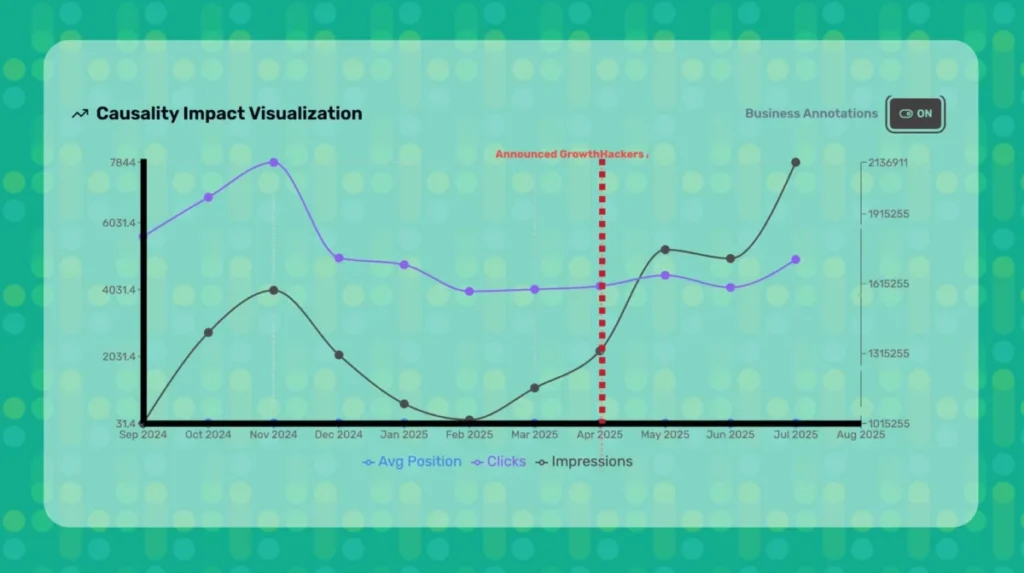
At its core, a Causality Report is a diagnostic tool that visualizes the "before-and-after" impact of a specific business event. It moves beyond simple line charts by integrating an "annotation layer" that anchors digital performance to tangible, real-world milestones.
Whether it is a product launch, a retail store opening, a change in pricing structure, or a strategic partnership, the Causality Report allows stakeholders to pinpoint the exact date of an action and observe the subsequent trajectory of key performance indicators (KPIs). By treating these events as "signals" rather than background noise, the report transforms raw data into a chronological narrative of business effectiveness.
The Mechanics of Annotation
The methodology is deceptively simple but profoundly powerful. By applying a temporal tag to a chart, the report recalibrates the user’s perspective. It forces the data to speak to the event. For instance, in a visualization tracking April 2025, the annotation acts as a watershed moment. Before this date, a business might see flat performance; after this date, the slope of the curve shifts. When this shift is sustained, it ceases to be a statistical coincidence—it becomes evidentiary proof of impact.
Chronology: Building the Case for Causality
To understand the evolution of this reporting style, one must look at how businesses have historically measured success.
- The Pre-Digital Era: Success was measured by quarterly revenue and anecdotal feedback. If sales went up after a trade show, the show was deemed a success. There was no granular data to dispute or confirm this.
- The Early Digital Era: With the advent of web analytics, companies could track every click. However, this led to "Data Paralysis." Teams were overwhelmed by metrics but lacked the strategic context to understand what drove them.
- The Causality Era: We are currently witnessing the maturation of data visualization. The integration of "Business Annotations" allows teams to overlay their strategic roadmap onto their data stream.
By mapping events chronologically—from the initial announcement of an initiative to the post-event data cooling-off period—companies can now perform "Post-Mortem Analysis" with surgical precision. This chronological tracking is essential for isolating the variables that contribute to long-term growth versus those that provide only temporary excitement.
Supporting Data: Moving from Vanity Metrics to Strategic Signals
Critics often argue that causality is impossible to prove in a complex, multi-channel environment. While it is true that many factors influence consumer behavior, the Causality Report does not claim to be a perfect laboratory experiment. Instead, it provides a "weight of evidence" approach.
Consider a scenario where a company initiates a high-impact PR push. A standard dashboard shows a spike in traffic. A Causality Report, however, shows the spike, the decay rate, and the "new baseline" established after the event. If the new baseline is higher than the pre-event baseline, the data suggests that the PR push didn’t just create a temporary wave—it elevated the brand’s floor.
This level of insight is critical for budgeting. When a CFO asks for the ROI of a specific exhibition, the Causality Report provides the visual evidence needed to justify the expenditure. It turns subjective storytelling into objective, data-driven narrative intelligence.
Official Perspectives: The Strategic Value of "Annotations ON"
Industry leaders are increasingly adopting "Business Annotations ON" as a standard UI feature. This is not merely a cosmetic change; it is a strategic layer that enables teams to communicate the why of their data to stakeholders who may not be data scientists.
By toggling these annotations, executives can instantly see the context behind a data trend. This empowers teams to:
- Validate Hypotheses: "Did the marketing campaign drive sales?"
- Identify Bottlenecks: "Did the website update in May cause a drop in conversion?"
- Optimize Resource Allocation: "Which initiatives actually move the needle for the long term?"
The "Narrative Intelligence" provided by these reports is the bridge between the boardroom and the front-line execution team. It creates a common language for success, where everyone understands that the data isn’t just a number—it is the result of a deliberate, calculated action.
Implications: Changing the Corporate Culture
The adoption of causality-based reporting will have far-reaching implications for corporate culture.
1. The Death of the "Vanity Metric"
When teams are forced to align their metrics with specific business actions, they can no longer hide behind inflated impression counts. If an event doesn’t produce a sustained shift in the data, it is exposed. This fosters a culture of accountability where only high-impact activities are prioritized.
2. Democratizing Data Literacy
The beauty of the Causality Report lies in its accessibility. By simplifying the connection between events and outcomes, it makes data-driven decision-making accessible to non-technical stakeholders. Marketing, HR, Product, and Sales can all look at the same chart and understand the outcome of their efforts.
3. Precision Agility
In an increasingly volatile market, agility is not just about moving fast—it’s about moving in the right direction. Causality reporting allows companies to iterate quickly. If an initiative fails to move the needle after a week, the team can pivot, armed with the evidence that their previous strategy lacked impact.
Conclusion: Turning Data into Storytelling
In the final analysis, the Causality Report is a tool for professional maturity. As organizations continue to collect more data, the value of that data decreases unless it can be contextualized. We are no longer living in a world where we can simply track the "what." We are entering an era where the "why" is the ultimate competitive advantage.
By integrating business annotations into the heart of our reporting, we move from being passive observers of our business metrics to active architects of our business outcomes. We stop reporting numbers, and we start telling the story of our success. The question, “Did that move the needle?” is no longer a source of anxiety—it is the starting point of our next strategic evolution. The Causality Report is the definitive answer, providing the evidence, the context, and the narrative needed to navigate the complexities of the modern digital landscape.
