
The New Frontline: How Latin American News Publishers Are Transforming Through Social Video
In the rapidly evolving digital landscape of Latin America (LATAM), the traditional morning newspaper and the evening broadcast news are no longer the primary arbiters of public discourse. Instead, the epicenter of news consumption has migrated to the palm of the hand. According to the Reuters Institute Digital News Report 2025, a staggering 58–64% of respondents across Argentina, Chile, Colombia, Mexico, and Peru now rely on social media platforms as their primary source of information.
This seismic shift has forced a reckoning for legacy media houses. As social-first creators and independent voices capture the attention of younger, mobile-native demographics, established publishers are finding that their survival depends on more than just content quality—it depends on platform-specific strategy. Leveraging 2025 performance data from Tubular Labs, this analysis explores the critical trends shaping the LATAM news ecosystem and provides a roadmap for publishers to reclaim their relevance in 2026.
The State of Play: A Region Defined by Social Consumption
The sheer scale of social video consumption in Latin America is difficult to overstate. Between January 1 and July 31, 2025, social video content across all categories generated a monumental 4.05 trillion views in the region. Within this massive ecosystem, the "News & Politics" category emerged as a powerhouse, accounting for 27.1 billion views across 293,000 individual uploads.

However, despite these numbers, the data reveals a significant "whitespace" opportunity. News and Politics content currently represents only 0.67% of total video uploads in the region. For legacy publishers, this is a clarion call: the audience is there, hungry for reliable, engaging content, yet the space is vastly underserved compared to entertainment or gaming. By aligning production strategies with real-time audience behavior rather than legacy broadcasting assumptions, publishers can bridge this gap.
YouTube: The Evolution of Long-Form vs. Short-Form Dynamics
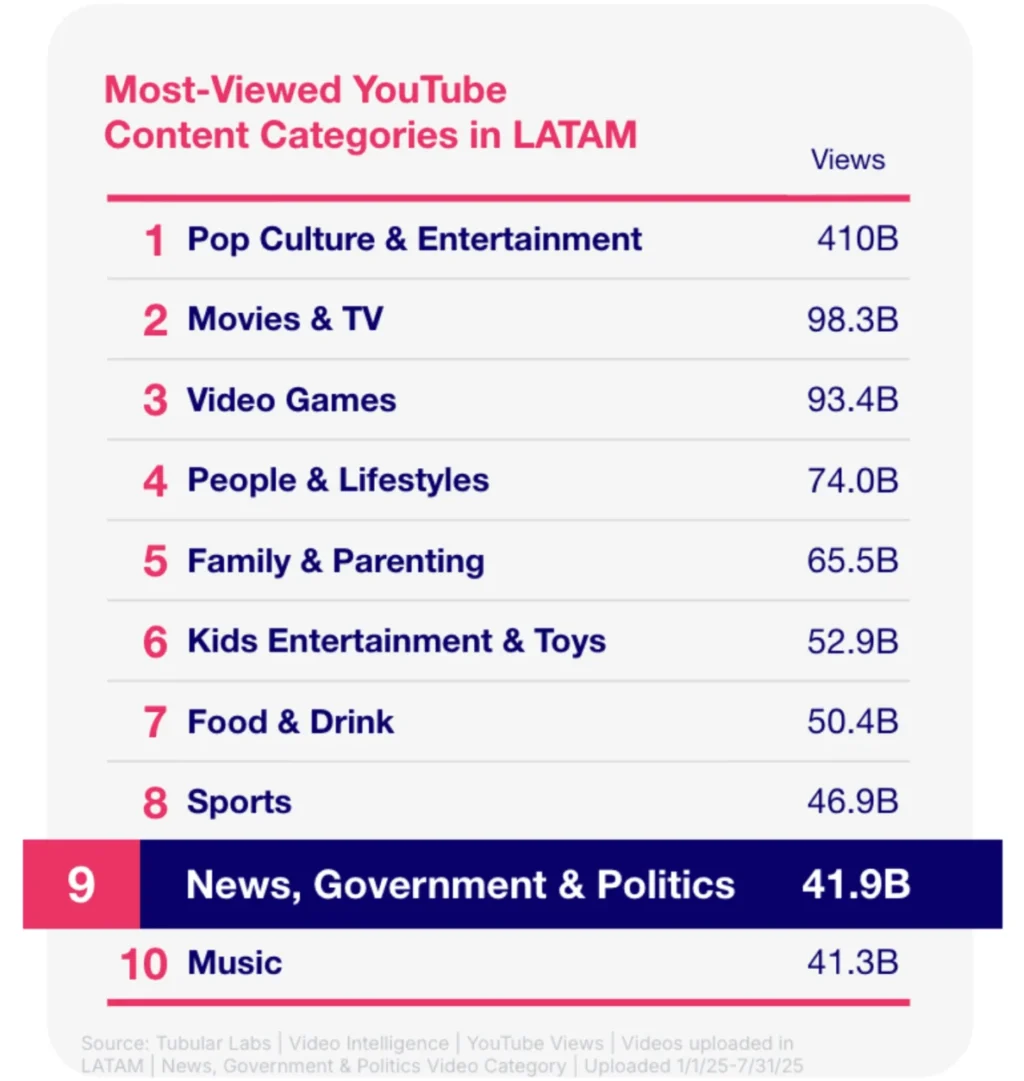
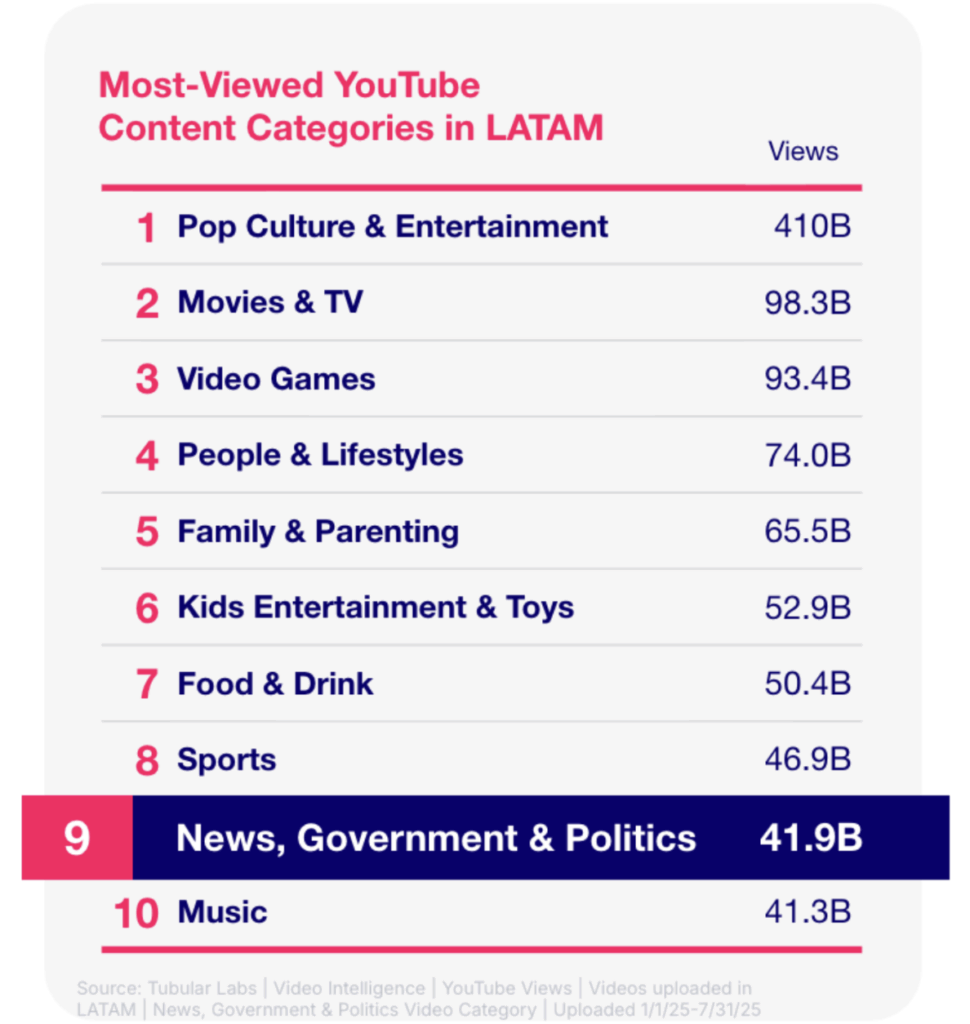
YouTube remains the bedrock of video consumption in LATAM, with News, Government & Politics securing the #9 spot as the most-viewed category on the platform, amassing 41.9 billion views. It has officially surpassed music in terms of category dominance, despite a lower volume of uploads.
The Duration Dilemma
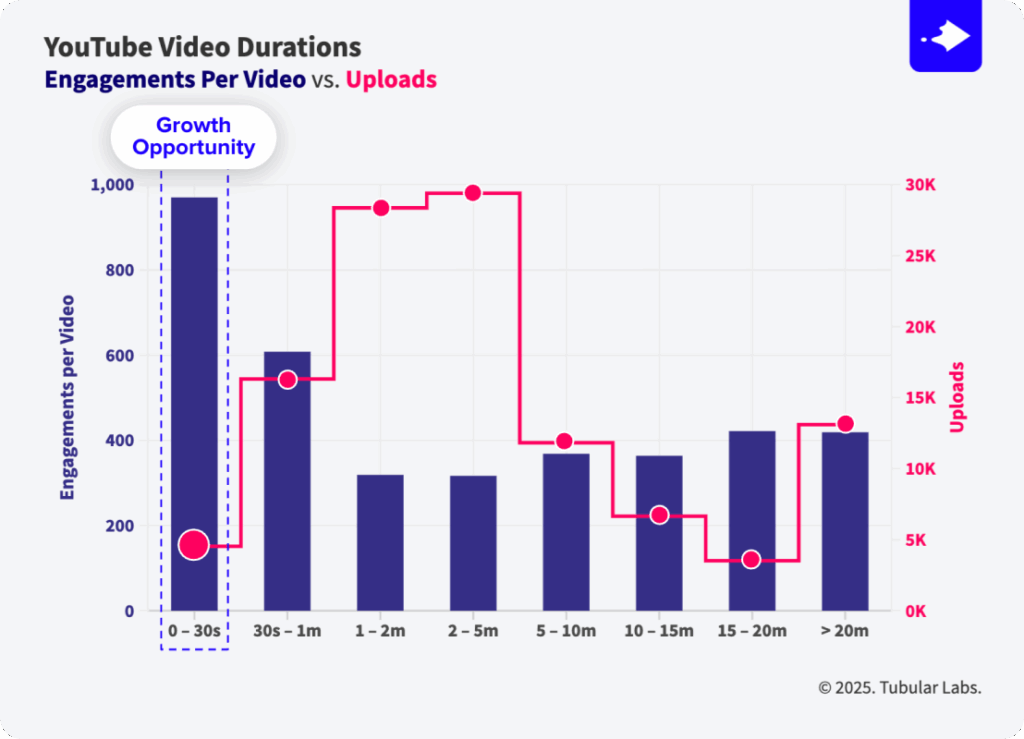
One of the most profound insights from the 2025 data is the disconnect between current production habits and audience engagement. Many LATAM newsrooms continue to prioritize 1–5 minute videos, which, according to the analytics, deliver the lowest engagement per video.
Conversely, videos under 30 seconds are delivering the highest engagement metrics. This indicates that while newsrooms are conditioned to produce mid-length segments, the audience is actively voting for "snackable," high-impact content. The implication is clear: to capture the fleeting attention of the modern viewer, publishers must pivot toward micro-reporting and vertical storytelling.
Device-Specific Consumption
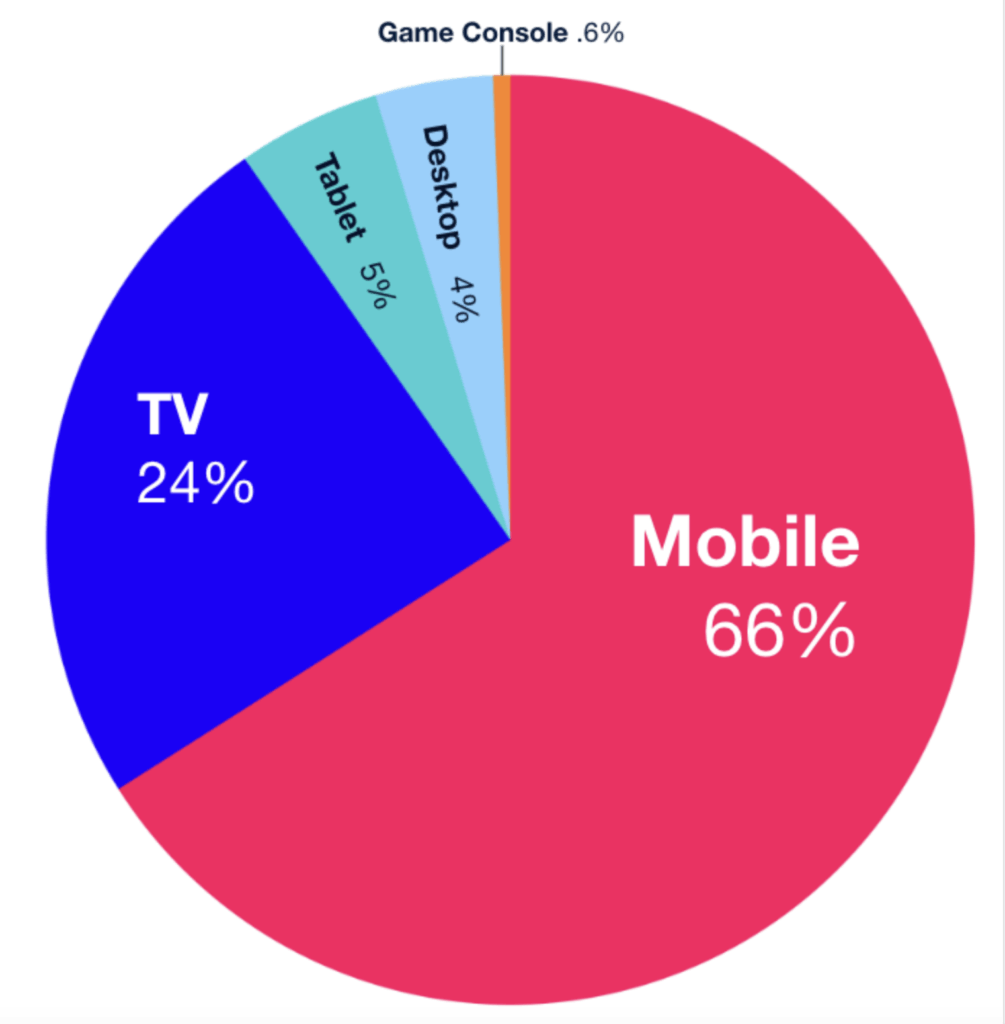
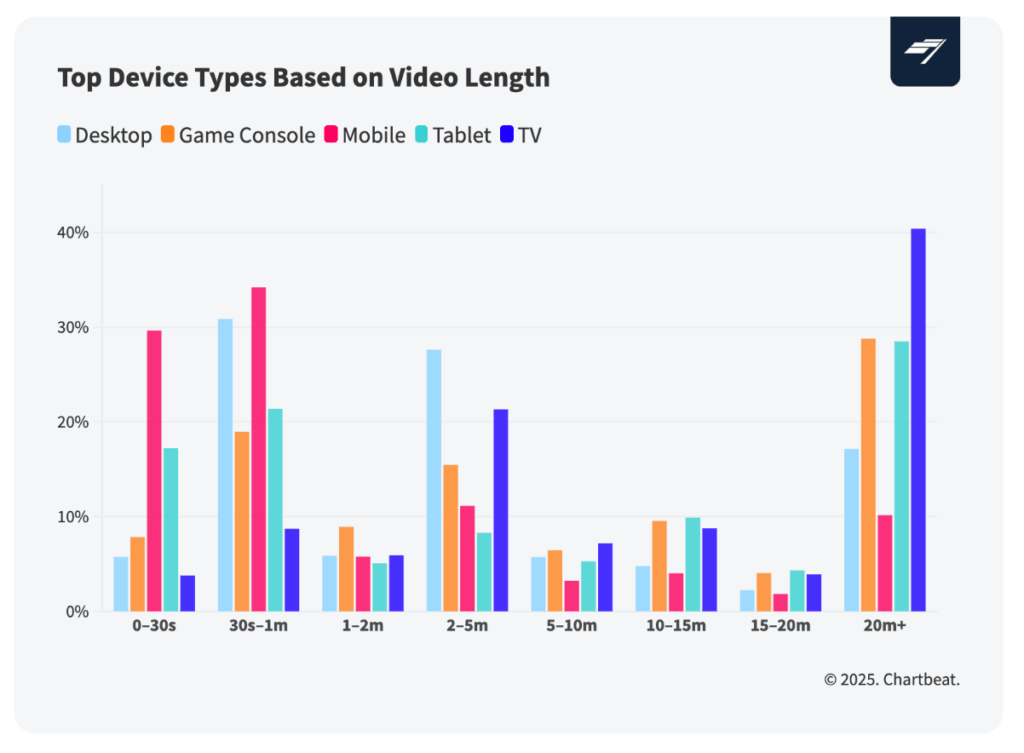
The platform is also witnessing a divergence in how content is consumed based on hardware. Mobile devices account for 66% of YouTube news views, while TV-based consumption sits at a distant 24%. This is not merely a preference for convenience—it is a functional necessity for the viewer. Data provided by Chartbeat highlights that audiences on TVs, tablets, and gaming consoles gravitate toward deep-dive content (20+ minutes), whereas mobile and desktop users overwhelmingly prefer content under one minute. Publishers who fail to tailor their editing style—vertical for mobile, cinematic for living room screens—are essentially ignoring two distinct segments of their own audience.
The "Shorts" Effect: Case Studies in Efficiency
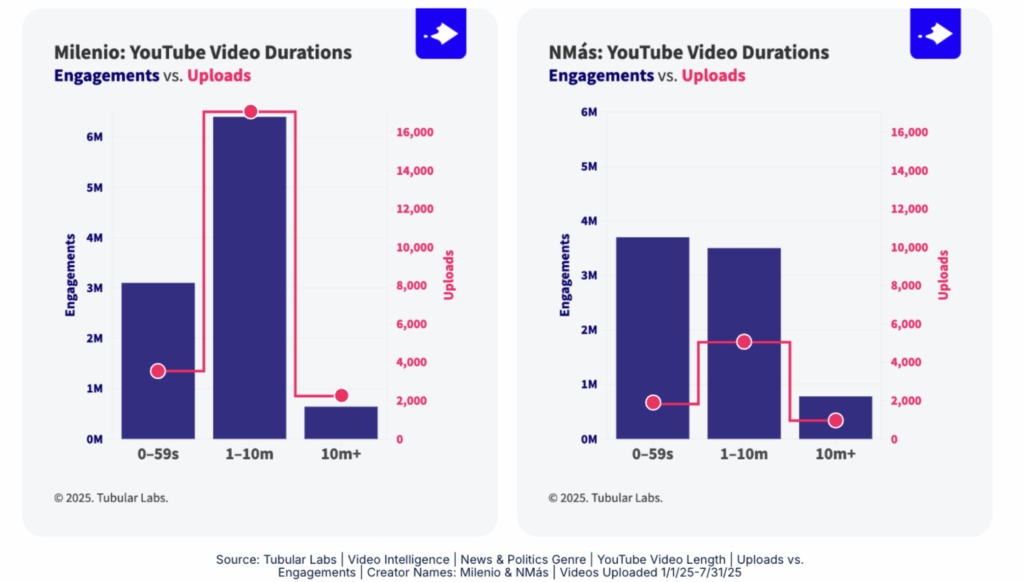
The transition to short-form video is not just a trend; it is a vital engine for growth. The performance of two regional giants—Milenio and NMás—serves as a masterclass in platform optimization.
- Milenio: By integrating YouTube Shorts into their strategy, Milenio found that while Shorts comprised only 15% of their total uploads, they generated a staggering 31% of the publisher’s total cross-platform engagements.
- NMás: This publisher demonstrated the power of diversifying formats. Even while producing 2.8 times more mid-length content, NMás saw nearly half of their total engagement originate from Shorts.
The lesson for digital teams is simple: stop viewing long-form content as a finished product. Instead, view it as a source library. By splicing high-impact clips, key soundbites, and critical updates into Shorts, publishers can exponentially increase their reach without increasing their total production load.
TikTok: The Undisputed Engagement Engine
If YouTube is the library of news, TikTok is the town square. Despite representing a smaller share of total content uploads, TikTok accounts for 71% of all cross-platform social interactions regarding news media in Latin America.
The News, Government & Politics category on TikTok secured the #6 position overall with 92 billion views, and the top 10 news publishers on the platform saw a 55% year-over-year growth in viewership. A primary example of this velocity is the Argentine publisher C5N, where TikTok content represented only 25% of their total cross-platform uploads but captured 71% of their total engagements.
For newsrooms still treating TikTok as an experimental playground, the data suggests it is time to formalize these efforts. The platform rewards authenticity and immediacy, two traits that, when paired with professional journalistic integrity, create a high-trust, high-engagement environment.
Strategic Implications: How to Win in 2026
The data-backed reality of 2025 dictates a new set of rules for media strategists. To remain competitive in 2026, publishers must adopt a more nuanced, data-driven approach to their social video operations.
1. Optimize for the "Sunday Surge"
The analytics identify Sunday as a high-engagement day for news content. This challenges the traditional "work-week" news cycle. Publishers should automate and schedule high-quality content to hit social feeds on weekends, capturing the audience that is actively seeking updates during their leisure time.
2. Platform-Specific Topic Mapping
Not all news is created equal, and not all platforms treat topics the same way. The data suggests that audience interests vary by platform. For example, sensitive social issues like immigration or human rights often perform well on Instagram and TikTok, while more traditional topics like law enforcement or governance may find a more receptive audience on Facebook. Publishers must segment their content strategies to align with the specific "vibe" and audience expectation of each channel.
3. Embrace the "Creator-Publisher" Hybrid Model
The line between a traditional news organization and a social creator is blurring. To compete, media companies must adopt the production aesthetics of creators—faster cuts, on-screen text, and host-led narratives—while maintaining the editorial rigor of a professional newsroom.
Conclusion: The Path Forward
The 2025 performance insights provide a clear directive: the audience is already on social media, and they are already looking for news. The "news" of the future will not be delivered solely through a traditional broadcast or a paywalled website; it will be consumed in 30-second bursts, vertical swipes, and community-driven debates.
For LATAM news publishers, the opportunity to capture this massive, underserved market is unprecedented. By moving away from assumptions and embracing the empirical reality of how users engage with video—prioritizing mobile-first formats, diversifying video length, and leveraging the engagement power of TikTok and YouTube Shorts—publishers can secure their legacy in the digital age. The technology to reach the audience is present; the remaining task is to match the velocity and creativity of the platforms they inhabit.
