
Unlocking Recourse: What the Landmark Google Antitrust Rulings Mean for Digital Paid Advertisers and Search Campaign Managers
This in-depth special report is sponsored by Silver Arbitration Law, PLLC. The opinions, legal interpretations, and analytical perspectives expressed herein are those of the sponsor.
If you have spent any time managing Google Search campaigns over the past decade, you have likely found yourself in the familiar position of explaining away rising Cost-Per-Click (CPC) metrics to stakeholders. The culprits usually trotted out are comfortably routine: a sudden influx of aggressive competitors, broader keyword match types diluting intent, a sliding Quality Score, or an account structure that has grown bloated and requires immediate restructuring.
For years, these explanations have felt plausible, routine, and, above all, unavoidable. Digital advertising was universally understood as a dynamic, free-market auction where prices fluctuated organically based on supply and demand.
However, recent landmark federal antitrust rulings have fundamentally shattered that assumption.
Having worked in arbitration as both legal counsel and a neutral arbitrator since well before Google’s corporate inception, I have spent decades reviewing evidentiary records, corporate disclosures, and economic models. What the judicial record for United States v. Google LLC now demonstrates is staggering. Federal courts have found that Google systematically manipulated its text ad auctions behind closed doors, artificially inflating prices well beyond what a competitive market would naturally bear.
For digital paid marketers, CMOs, and enterprise financial officers, this is not merely a fascinating piece of legal history. It represents a potential multi-million-dollar financial recovery opportunity. This article details what the court actually found, the specific mechanics of the auction adjustments, how to audit your historical ad spend, and the concrete steps required to determine if your enterprise is owed a substantial payout.
Main Facts: The Monopolization of Search Text Ads and the Mechanics of Auction Manipulation
The legal landscape shifted dramatically in August 2024. Following a grueling, ten-week federal antitrust trial, the U.S. District Court delivered a definitive verdict: Google “has exercised its monopoly power by charging supracompetitive prices for general search text ads” (Mem. Op. at 4).
In economic and legal terms, "supracompetitive" refers to prices that sit artificially high—well above the equilibrium price that would be produced in a genuinely competitive, open market.
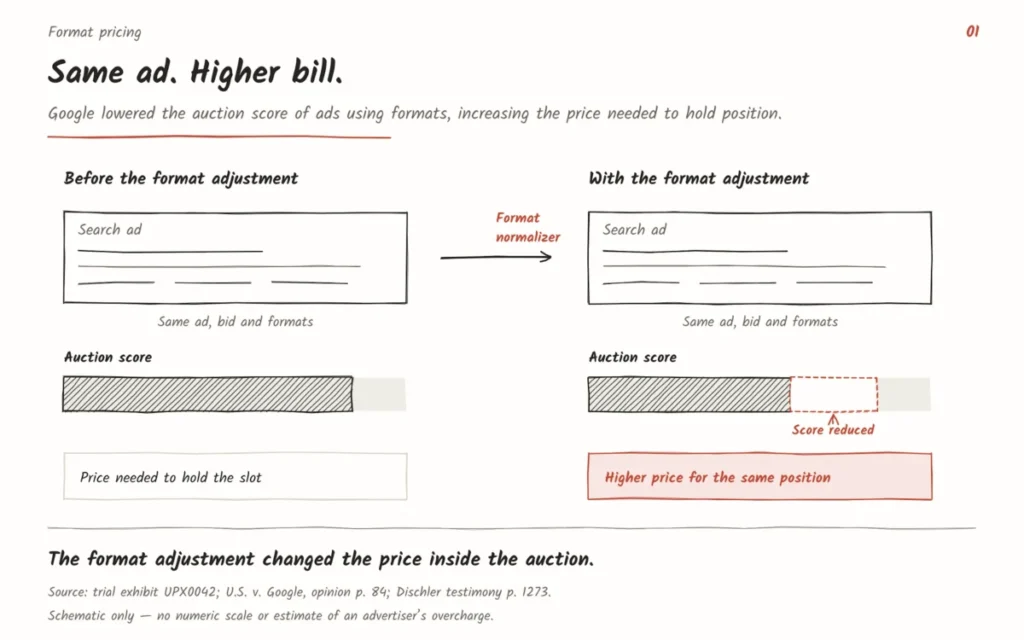
How was this achieved? The trial record uncovered that Google’s dedicated ads team utilized internal, unpublicized mechanisms referred to in corporate documents as “pricing knobs” (Mem. Op. at 86). These knobs enabled the platform to actively raise the final price a winning advertiser paid without requiring any corresponding improvement in ad quality, any increase in organic competition, or any elevation in bidding aggression from the advertiser.

This was primarily accomplished by artificially inflating the score of the runner-up bidder. Because Google’s second-price auction mechanics dictate that the winner pays the cost necessary to beat the runner-up, artificially boosting the runner-up’s score directly inflated the winning bidder’s CPC.
The Scale of the Overcharge
Economic models and expert testimonies submitted during and following the proceedings estimate that Google’s hidden auction adjustments resulted in an estimated overcharge ranging between 5% and 10% of total eligible search spend.
When translated into the framework of federal antitrust law—where proven damages are routinely subject to mandatory trebling—the financial implications for large-scale advertisers are profound. For an enterprise that channeled $10 million into eligible search text ads during the relevant historical windows, the baseline claim value could realistically land between $1.5 million and $3 million, exclusive of legal fees and individualized case adjustments.
Chronology of the Auction Changes and Judicial Milestones
To understand whether your enterprise was directly impacted by these practices, you must cross-reference your historical account data against specific timelines unearthed during discovery.
The trial record revealed multiple discrete instances where internal pricing knobs were adjusted or deployed. While advertisers operated under the assumption that the auction was reacting purely to external market forces, internal communications and executive testimony confirmed a culture of nondisclosure.
Most damningly, Google’s Vice President of Ads testified candidly under oath: “We tend not to tell advertisers about pricing changes” (Tr. 1226, Dischler). The presiding judge underscored this dynamic in the final opinion, noting explicitly that “[m]any advertisers do not even realize that Google is responsible for the changes in price” (Mem. Op. at 91–93, 260).
The Display Ad Expansion: A Second Front
While the initial August 2024 ruling centered exclusively on general search text ads, a subsequent judicial shoe dropped on April 17, 2025. Judge Leonie Brinkema of the U.S. District Court for the Eastern District of Virginia issued a ruling finding that Google had similarly monopolized two critical segments of the digital display advertising technology chain.
Although the display case focused heavily on web publishers and yielded a more nuanced assessment of government market claims, it establishes that enterprises deploying capital across Google’s broader ad tech stack must evaluate their exposures across multiple product categories.
Supporting Data: Dissecting Your Enterprise Spend and Eligibility
Before any legal claim can be formulated, rigorous forensic accounting must be applied to your historical digital marketing expenditures. Not every dollar spent within the Google Ads ecosystem falls under the umbrella of these antitrust rulings.

1. General Search Text Ads vs. Shopping and Performance Max
The search antitrust ruling is narrowly tailored to general search text ads. It did not establish a monopoly in the broader, aggregate market for all search advertising—a category that incorporates retail media networks and product listings sold by platforms such as Amazon and Walmart.
Consequently, if a significant portion of your historical budget was allocated to Google Shopping, YouTube campaigns, or automated Performance Max campaigns, you must surgically isolate and extract the pure search text ad portion before drawing conclusions about your total account exposure. Specialized AI-driven research prompts and legal intake tools can assist teams in rapidly categorizing ad types and eligible historical years.
2. Legal Entity and Agency Verification
Another foundational prerequisite is identifying the precise corporate entities involved. Counsel will immediately request answers to two administrative questions:
- Which specific legal entity formally accepted Google’s advertising terms and paid the underlying invoices?
- Which internal business units, marketing agencies, or third-party manager accounts actually operated the campaigns during the contested timeframes?
These details dictate not only who possesses the legal standing to bring a claim, but also where the financial recovery must be directed. If your enterprise funded the campaigns while an external agency managed the daily execution, the legal claim—and any resulting payout—belongs firmly to your business. The agency’s role is simply to assist in pulling historical spend reports and campaign configurations.
Official Responses, Appeals, and the Regulatory Horizon
Unsurprisingly, Google strongly disagrees with the judicial findings and has publicly confirmed its intention to pursue a comprehensive appeals process (SEC Form 10-K / Annual Report).
However, corporate appeals do not freeze the immediate practical realities for advertisers. In September 2025, the court issued its sweeping remedies decision, which legally mandates that Google publicly disclose material changes to its ad auction architecture moving forward. This regulatory enforcement means that modern digital marketers will finally enjoy unprecedented transparency regarding auction adjustments that directly influence their bottom lines.
It is also vital to distinguish clearly between verified judicial findings and unverified evidentiary claims. Throughout legal reporting on this case, statements cited with page references to opinions represent definitive judicial conclusions. Conversely, citations pointing to exhibit numbers (such as UPX or DX) or deposition transcripts represent raw evidence, sworn testimony, or internal corporate documents introduced during trial. The two carry vastly different legal weight.
Implications for Advertisers: Practical Steps and Arbitration Realities
For corporate leadership teams, marketing directors, and in-house general counsels, the central question is no longer whether Google manipulated its auctions, but how to act on that knowledge without disrupting ongoing business operations.
Understanding the Arbitration Clause and Class Action Waivers
Google’s standard online advertising terms of service contain a mandatory arbitration clause. This means that advertisers bound by these terms must pursue any covered disputes through individual binding arbitration rather than joining traditional class-action lawsuits.

Every individual claim is filed and administered through the American Arbitration Association (AAA). While court findings establish the baseline liability, transitioning those findings into an individual recovery requires a structured, account-specific evaluation.
Addressing Practical Fears: Will Filing Retaliate Against Your Account?
The single most frequent question posed by enterprise advertisers is whether initiating an arbitration claim will trigger automated or manual retaliation from Google against active accounts.
Thousands of U.S. businesses and enterprises are currently pursuing individual claims. To date, there are no credible reports of platform retaliation against active claimants. Furthermore, retaliating against a massive cohort of active litigants while the company remains under intense scrutiny from two federal courts and the Department of Justice would introduce catastrophic legal, regulatory, and reputational liabilities that Google has no incentive to court. The practical risk of operational retaliation is considered exceedingly low.
Minimizing Internal Workload
For most marketing departments, undertaking a legal review sounds like a resource-heavy distraction. In reality, the operational burden is remarkably low.
For a standard enterprise claim, gathering the necessary account records and historical spend data typically requires roughly one hour of total staff time. This is generally split between an account administrator with deep access to the Google Ads billing history and an authorized corporate signatory. Once the baseline data is compiled, experienced arbitration counsel handles the complex assessments, filings, and institutional coordination, engaging internal stakeholders only when vital strategic decisions are required.
Conclusion: How to Proceed
The revelations from United States v. Google LLC have fundamentally rewritten the relationship between digital advertisers and dominant tech platforms. What was once accepted as organic market volatility has been unmasked in a court of law as a series of deliberate, supracompetitive price inflations.
For enterprises that spent millions on Google search text ads over the past decade, leaving potential financial recoveries unclaimed is no longer an option rooted in prudence—it is an oversight of corporate assets.
The first step is education and forensic account evaluation. Whether you choose to utilize specialized AI research tools to audit your historical spend profiles or schedule a direct, confidential consultation with qualified arbitration counsel, understanding your precise exposure is the imperative next step for modern digital marketers.
Disclosure & Disclaimer
Attorney Advertising. Mark Beckett is an attorney admitted to practice in the State of New York. This sponsored article is provided by Silver Arbitration Law, PLLC for general informational and educational purposes only and does not constitute formal legal advice or establish an attorney-client relationship. Prior legal results do not guarantee or predict a similar outcome in future matters. All claims against Google LLC are pursued through individual arbitration proceedings pursuant to Google’s governing Terms of Service, rather than through public class-action court trials. Quotations from judicial opinions are reproduced verbatim from published decisions in United States v. Google LLC (D.D.C., Aug. 5, 2024) and United States v. Google LLC (E.D. Va., Apr. 17, 2025). Silver Arbitration Law, PLLC is not affiliated with, funded by, or officially endorsed by Google LLC.
