
The Retainer Reckoning: Why Content Intelligence is the Only Survival Strategy for Agencies in 2026
Main Facts: The Existential Crisis of the Modern Agency
The marketing agency landscape is currently navigating a period of unprecedented volatility. As we move through the mid-2020s, the "Retainer Reckoning" has shifted from a theoretical threat to a balance-sheet reality. Data from late 2025 and the first half of 2026 reveals a stark trend: traditional agencies, particularly those focused on content execution and distribution, are seeing a significant erosion in client retention.
For decades, agencies justified their monthly retainers through two primary pillars: capacity and distribution. They provided the "arms and legs" to produce content and the expertise to ensure that content reached "eyeballs." However, the mass adoption of Large Language Models (LLMs) and the democratization of instant publishing have effectively commoditized both pillars.
The core issue is not simply that AI is "eating" agency work, but that it has fundamentally replaced the tasks for which agencies traditionally charged. When a client can input a brief into a tool like ChatGPT and receive a serviceable draft in seconds, the value of a "deliverable-based" retainer vanishes. To survive, agencies must pivot from being an "execution layer" to becoming a "source layer"—a transformation defined by deep industry intelligence and the ability to provide insights that AI cannot replicate.
Chronology: From Distribution to the "Sea of Sameness"
To understand the current crisis, one must look at the evolution of digital marketing over the last decade.

- The Distribution Era (2010–2020): Agencies were the gatekeepers of visibility. Success was measured by the ability to navigate complex SEO algorithms and manage multi-channel distribution. Content was a means to an end; the "value" was the traffic.
- The Content Bloat Era (2021–2023): As publishing tools became easier to use, the internet became saturated. Audiences began to experience "content fatigue," favoring quality and specificity over sheer volume.
- The Generative Explosion (2024–2025): The mainstreaming of AI allowed brands to bring content production in-house with minimal overhead. This led to what industry analysts call the "Sea of Sameness"—a flood of generic, AI-generated "slop" that, while grammatically correct, lacks original insight, bleeding-edge data, or unique brand perspective.
- The Intelligence Pivot (2026 and Beyond): Clients have realized that volume is no longer a competitive advantage. The focus has shifted toward "Content Intelligence"—the ability to stay ahead of industry trends and provide "E-E-A-T" (Experience, Expertise, Authoritativeness, and Trustworthiness) that AI systems use to rank and recommend content.
Supporting Data: The commoditization of Execution
The numbers supporting this shift are difficult for traditional agency owners to ignore. Recent surveys of B2B and B2C marketing directors indicate that over 65% of clients have questioned their agency’s retainer value in the last twelve months. The primary catalyst is the perceived "gap" between agency output and AI output.
AI’s infinite capacity and instantaneous availability have set a new baseline. Because LLMs sound like experts, the "fuzzy" concept of a client-agency relationship—built on "being there when the client calls"—is no longer enough. The tangible advantage of a relationship must now be proven through institutional knowledge. If an agency requires the client to "clue them in" on industry developments, the agency is no longer an asset; they are a bottleneck.
Furthermore, the "Sea of Sameness" has created a new metric for success: the Source Layer. Most AI content strategies fail because they treat AI as a writer rather than a researcher. When every agency uses the same prompts on the same public-facing data, the output is indistinguishable. True market differentiation now requires "bleeding-edge" knowledge—information that hasn’t yet been codified into the training sets of major LLMs.
Official Responses and Strategic Frameworks
In response to these market pressures, industry leaders and specialized platforms like Chatter have proposed a fundamental restructuring of the agency workflow. The consensus is that agencies must treat content ideation not as "prep work," but as a core, billable deliverable.

The Source Layer vs. The Execution Layer
The most successful agencies in 2026 are those that have moved "upstream" in the content process. While general LLMs are proficient at synthesizing existing information, they often hallucinate citations and lack a "pulse" on live industry conversations.
"AI should serve as a connector, not just a drafter," states a recent analysis from Chatter. By using AI to monitor industry updates, competitor movements, and social listening in real-time, agencies can identify "Content Gaps" before the client even realizes they exist. This proactive stance justifies the retainer by proving the agency knows more about the market than the client does.
The Return of Thought Leadership
There is a renewed appetite for high-level thought leadership. In an era of generative search optimization, LLMs and AI search engines prioritize content that carries high-trust signals. When a specific person with verified authority publishes consistent, insightful content, AI systems learn that this individual "owns" a subject. Generic AI output, owned by no one, is increasingly being de-prioritized by both algorithms and human readers.
Implications: The 6-Step Methodology for the Modern Agency
For agencies looking to secure their position through 2028, a systematic approach to "Content Intelligence" is required. This involves a six-step loop that prioritizes insight over execution.

1. Mining Content Gaps Through Social Listening
Agencies must move beyond "vanity mention-tracking." True social listening involves mining live, unfiltered conversations on platforms where real problems are discussed. This requires "plugging in" to industry-specific channels, RSS feeds, and investor updates to find where the "unfiltered" opinions live. The goal is to find the "signal" within the noise—the specific pain points that haven’t been addressed by the mainstream.
2. Identifying High-Impact Signals and Angles
High-impact content succeeds through contrast. Agencies must ask: What can our client say that no one else can? This involves layering internal truths (product features, unique perspectives) over external developments. By identifying where the client’s view stands out against the "Sea of Sameness," the agency creates a "market-differentiating" idea that a generic prompt could never generate.
3. Multi-Format Repurposing
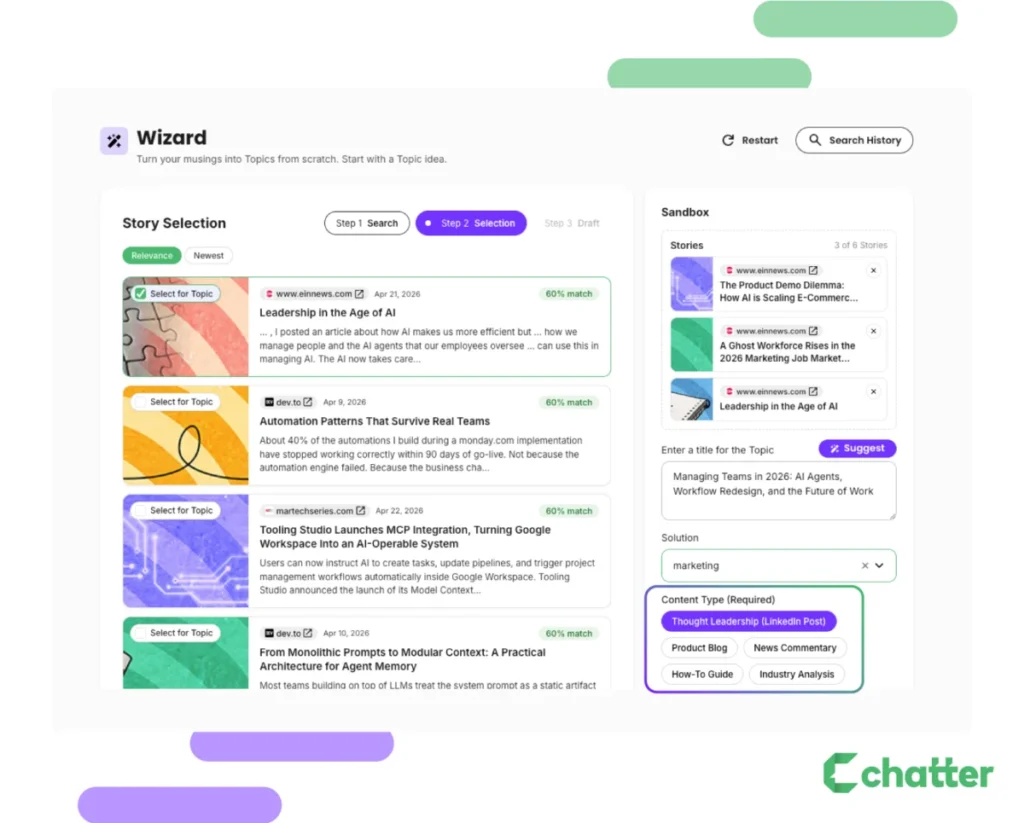
A powerful idea should never be confined to a single blog post. To maximize the value of an insight, it must be stretched across multiple formats—LinkedIn posts, newsletters, solution briefs, and outbound emails. However, the pitfall here is speed. If an agency takes weeks to repurpose content, the news cycle moves on. Modern agencies use AI "Content Wizards" to translate a single core perspective into various formats instantly, ensuring consistency and speed to market.
4. Strategic Sequencing
Once an idea is broken into several formats, it must be sequenced across a content calendar. Spreading publishing over several weeks ensures that the "angle" gains maximum visibility and creates multiple opportunities for engagement. This transforms a single insight into a sustained conversation.

5. Closing the Feedback Loop
Measurement is no longer just about "likes" or "shares." It is about seeing which "angles" landed and which "lagged." By analyzing performance across different formats, agencies can refine their intelligence for the next cycle. This data-driven approach seeds the next client pitch, proving that the agency is not just guessing, but iterating based on market reality.
6. Continuous Client Collaboration
The final step is making this process "infrastructure" rather than a "haphazard task." Agencies must integrate the client into the intelligence hub, allowing for real-time collaboration on ideas. This transparency reinforces the relationship, moving the agency from a "vendor" to a "strategic partner."
The Agency of 2028: Infrastructure vs. Task
The agencies that will remain relevant in 2028 are those that understand a simple truth: Knowing things and proving it in every interaction is the only thing a client cannot get from a standalone AI.
The "Retainer Reckoning" is a filter. It is removing agencies that rely on the manual labor of drafting and distribution—tasks that are now nearly free. The agencies that thrive will be those that treat industry intelligence as essential infrastructure. By staying ahead of the conversation and joining the client in the "current moment," these agencies justify their cost not through the volume of words produced, but through the power of the ideas they bring to the table. In the age of AI, the most valuable asset an agency can offer is no longer capacity—it is clarity.
