
The Retail Balancing Act: Why Fundamentals—Not Trends—Are Winning the Customer Experience War in 2026
The landscape of American retail is undergoing a quiet, yet significant, transformation. While the industry is often fixated on the latest AI-driven innovations or omnichannel buzzwords, new data suggests that the secret to long-term success is far less revolutionary than many executives might hope. According to Forrester’s latest assessment of 41 major US retailers, the industry is making slow, steady progress—but it is doing so by focusing on the bedrock of retail: the product, the employee, and the basics of availability.
Forrester’s Total Experience Score (TX) for 2026 reveals that while the retail sector remains in a period of incremental growth, the brands that have successfully climbed into the "leading" quadrant are those that have mastered the art of getting the basics right.
Main Facts: The State of the Industry in 2026
The industry’s performance in 2026, while improved, highlights a persistent gap between retail and other high-performing service sectors. The average Total Experience Score across the 41 assessed major US retailers sits at a modest 59.1 out of 100. While this figure might appear underwhelming at first glance, it represents a statistically significant improvement of 0.4 points over the 2025 industry average.
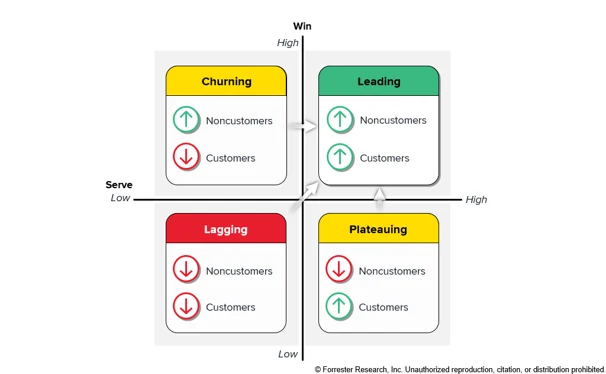
Forrester categorizes these retailers into four distinct quadrants based on their ability to win and serve customers: Lagging, Churning, Plateauing, and Leading. The "Leading" quadrant—the gold standard for this assessment—represents brands that excel simultaneously in customer acquisition and customer retention.
In 2026, the number of retailers achieving "Leading" status rose to 11, up from nine in 2025. This growth signals that despite economic headwinds and shifting consumer sentiment, a subset of the retail sector is finding a winning formula. Chewy continues to dominate the rankings, maintaining its top spot with a score of 65.5, proving that its model of high-touch service and product reliability remains the benchmark for the industry.
Chronology: A Trajectory of Incremental Progress
To understand where retail is headed, one must look at how it has evolved over the past 24 months.
- 2025 – The Baseline: The industry struggled to find its footing following years of supply chain volatility and inflationary pressure. The average score was lower, and the gap between the "leading" retailers and the "lagging" ones was wider. Only nine brands met the threshold for the "Leading" quadrant.
- Late 2025 – The Pivot: Throughout the latter half of the year, many retailers shifted their focus from rapid digital expansion to operational stability. This strategic pivot began to show dividends in consumer sentiment surveys.
- 2026 – The Year of Fundamentals: The current assessment shows that retailers who prioritized inventory management, product quality, and employee support saw the most significant year-over-year gains. Brands like Tractor Supply Co., Kroger, Costco Wholesale, and Walmart all reported positive growth, suggesting that the "big box" and "specialty" models are currently finding favor with consumers who prioritize reliability over experimental shopping features.
Supporting Data: Decoding the Drivers of Sentiment
The most striking takeaway from the 2026 data is the simplicity of what drives consumer loyalty. When Forrester analyzed the primary factors influencing Customer Experience (CX) and Brand Experience (BX) scores, the results debunked the idea that consumers are primarily seeking high-tech bells and whistles.
The CX Hierarchy
For CX, the most impactful driver—the single biggest influence on a customer’s score—is the simple declaration: "Offers the products/services that I want." This is followed closely by the reliability of the inventory. In an era where consumers are increasingly time-poor, the retailers that win are those that ensure the right product is in stock and available when the customer arrives, whether online or in-store.
The BX Hierarchy
Brand Experience (BX) is driven by a slightly different but equally fundamental metric: "High-quality products/services." For non-customers, the primary driver for brand perception is, again, the availability of the desired product assortment.
Essentially, the data confirms that a high-tech app cannot compensate for an out-of-stock item or a poor-quality product. Consumers are sending a clear message to the C-suite: Before you innovate, you must execute.
The New Frontier: Employee Experience (EX) as a Catalyst
A major evolution in Forrester’s 2026 methodology is the formal integration of Employee Experience (EX) into the Total Experience assessment. The logic is circular but sound: retailers that support their staff are better equipped to satisfy their customers.
When employees are provided with the correct tools, leadership, and operational support, the friction in the customer journey decreases. Forrester’s data found that among the top five retailers in the 2026 rankings, three possess a notably positive EX impact. This suggests that the "Great Resignation" and the subsequent labor shortages in retail were not just HR problems—they were customer service problems. By investing in the workforce, leading retailers are effectively investing in their customer’s happiness.
Official Perspectives: The "Leading" Quadrant Strategy
For those retailers currently in the "Lagging" or "Churning" quadrants, the path forward does not necessarily require a massive technological overhaul. Instead, the experts at Forrester suggest a recalibration of priorities.
"Retailers that score well are those that are building strong fundamentals, not necessarily those carving a completely new path to selling," noted the research team. The pressure to adopt every new trend—from generative AI chatbots to complex AR fitting rooms—can distract leadership from the core mission: delivering the right product at the right time.
The data indicates that when the fundamentals are strong, the experience builds a "moat" of loyalty that protects the brand from competitors. A customer who knows they can consistently find the high-quality items they want at a store is significantly less likely to churn, regardless of how fancy a competitor’s app might look.
Implications: What Retail Leaders Must Do Next
As we move into the second half of 2026, the implications for retail leadership are clear. The market is saturated with noise, but the signal remains consistent.
- Stop Chasing the "Shiny Object": If your fundamental inventory and quality metrics are slipping, investing in a new digital initiative will only amplify your failures. Focus on the core assortment first.
- Double Down on EX: Your employees are the frontline of your brand experience. If they do not have the tools or the morale to serve customers, your TX score will inevitably suffer. Treat EX as a primary business metric, not a secondary HR concern.
- Bridge the Gap Between Customers and Non-customers: The data shows that while existing customers want the "products they want," non-customers are looking for the same thing—they just haven’t been convinced of your quality yet. Marketing and operations must align to prove that your assortment is superior and reliable.
- Prioritize "Total Experience": Leaders should stop viewing CX, BX, and EX as separate silos. The Forrester report demonstrates that these three pillars are inextricably linked. A failure in one is a failure in the total brand promise.
Conclusion: A Return to Retail Basics
The 2026 Total Experience Score rankings offer a refreshing, if challenging, dose of reality. In a business environment that often demands constant reinvention, the data suggests that the most successful retailers are those who have mastered the "boring" parts of the business: supply chain reliability, product quality, and employee empowerment.
While the average score of 59.1 shows that the industry has a long way to go, the steady rise of the "leading" quadrant brands proves that growth is possible. For retail executives, the message is not to discard innovation, but to ground it in the fundamental needs of the consumer. As Forrester’s research concludes, the path to improvement is not found in adding something completely new, but in perfecting the experience that the customer already expects.
For those looking to benchmark their own progress, the full Forrester’s US Retailers Total Experience Score Rankings, 2026 report provides a granular look at where the gaps lie and how to bridge them. In the end, the brands that win will be those that realize the most sophisticated technology in the world is useless if it doesn’t help the customer get exactly what they came for.
