
The New SEO Frontier: Why Brand Gravity Outweighs Traditional Tactics in the Age of AI
This article was originally published on the Growthrocks blog by their Chief Strategist.
In the digital marketing ecosystem, not all search queries are created equal. For years, the industry has been obsessed with the mechanics of ranking: backlinks, technical audits, and keyword density. However, as search engines evolve into answer engines, the most vital lens through which to view your performance is the divide between branded and non-branded search.
By segmenting your traffic into these two distinct buckets, you gain more than just data—you gain a clear understanding of the "Brand Gravity" that dictates your survival in an AI-driven future.
Main Facts: Defining the Two Pillars of Search
To understand your digital footprint, you must first distinguish between the two primary drivers of search traffic:
- Branded Keywords: These are search terms that include your company name, product names, or variations thereof. They represent high-intent users—individuals who already recognize your brand, have been influenced by your PR, social media, or word-of-mouth, and are actively seeking your specific solution.
- Non-Branded Keywords: These are generic, category-level terms (e.g., "best CRM for startups" or "how to automate accounting"). This is the arena where the "SEO battles" are fought. These terms capture potential customers in the early stages of the buyer journey, often before they have formed a brand preference.
The critical insight here is that attribution defines accountability. Brand and PR teams should be held responsible for the growth of branded search, while SEO teams should be evaluated on their ability to capture net-new traffic through non-branded, intent-based keywords. When teams conflate these metrics, they create a distorted reality that masks stagnant growth.
Chronology: From Keyword Stuffing to Brand Authority
The evolution of SEO has been a transition from "gaming the system" to "building a reputation."
- The Early Era (Pre-2010s): SEO was purely technical. If you had enough mentions of a keyword, you ranked. Branded search was a secondary concern.
- The Content Era (2010–2020): Search engines began rewarding "helpful content." While non-branded traffic exploded, brands started to realize that organic discovery was easier when people already knew who they were.
- The AI Era (2023–Present): With the rise of LLMs (Large Language Models) like ChatGPT, Perplexity, and Google’s AI Overviews, the rules have shifted fundamentally. The algorithm is no longer just looking for keywords; it is looking for authority and familiarity.
Supporting Data: The Google Curiosity Index
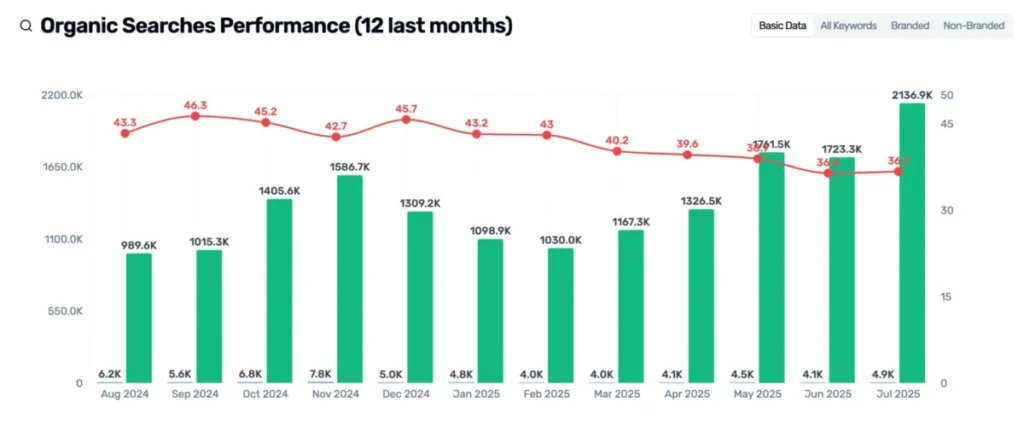
Before diving deep into the technicalities, we must revisit a concept we introduced: the Google Curiosity Index. While not an official Google metric, it is our proprietary way of measuring brand awareness by tracking the frequency of branded searches over time.
It serves as the missing link between SEO performance and overall brand impact. Crucially, it is one of the few metrics that reveals how "offline" activities—such as high-profile PR, physical events, and strategic partnerships—actually bleed into and elevate your digital presence.
The AI Shift: Why Branded Keywords are Now More Important
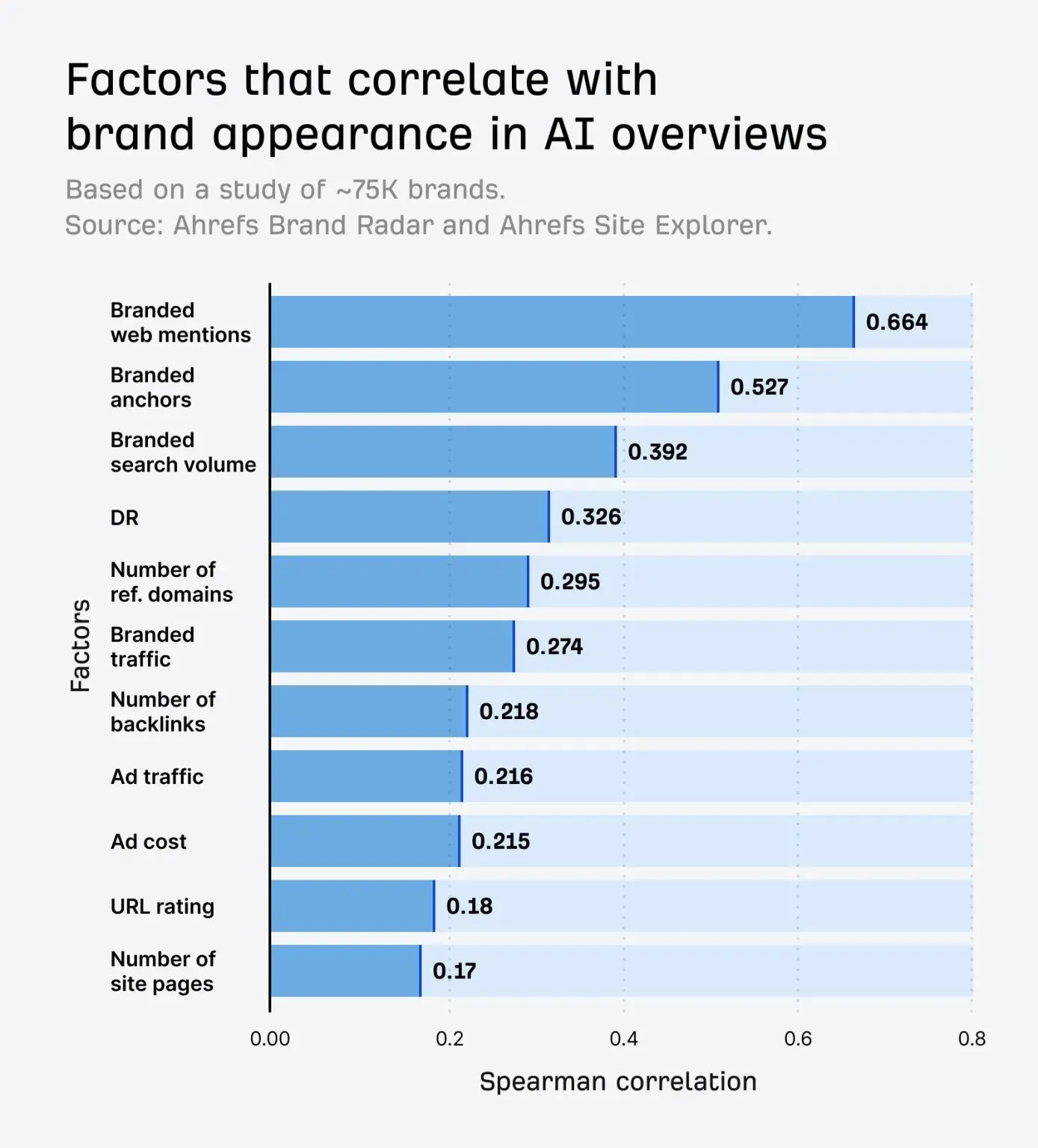
According to recent research from Ahrefs, the top factors correlating with a brand’s presence in AI Overviews are not traditional SEO metrics like domain rating or link count. Instead, they are:
- Brand Mentions: How often your brand is talked about across the web.
- Branded Search Volume: How many people are searching for you by name.
- Contextual Co-occurrence: How often your brand is associated with specific topics or solutions.
In the AI era, brand signals outperform raw SEO signals. LLMs act like humans reading the internet; they gravitate toward familiar names because those names come with a pre-established "trust score."
Official Perspectives: The "Popularity Contest"
Large Language Models do not index the web like a traditional search engine. They synthesize information based on probability and trust. When an AI generates a summary, it is essentially running a "popularity contest."
- Familiarity: AI models favor entities with a massive, consistent footprint of branded search.
- Context: They look for "clusters." If your brand is consistently linked to a category (e.g., "Salesforce" and "CRM"), the LLM will prioritize your brand when that category is queried.
This creates a "shortcut" for brands. You aren’t "gaming" the AI; you are simply providing the data points—consistent branded interest—that the algorithm is hardwired to trust.
Implications: How to Pivot Your Strategy
The shift toward AI-driven search has significant implications for how you manage your marketing stack.
1. Separate Your Reporting
Stop reporting branded and non-branded traffic as a single "organic growth" number. If your branded traffic is up but your non-branded traffic is flat, your SEO team is underperforming, even if the total traffic graph looks green.
2. The Domain Name Connection
There is a profound semantic tie between your domain and your brand. Many users now type a company’s domain directly into the search bar as a "branded query." Check your Google Search Console (GSC); if you see significant traffic for your own domain name, that is brand interest masquerading as SEO. Treat it as a KPI for your brand awareness, not a win for your keyword optimization strategy.
3. Leverage "Brand Gravity"
SEO is no longer just about ranking; it is about being remembered. If a user remembers your brand, they search for it. If they search for it, the AI learns that you are the authority. If the AI learns you are the authority, you win the AI Overviews. This is the new virtuous cycle of modern search.
Practical Application: Implementing the Strategy
Tracking this is notoriously difficult because GSC does not natively separate branded from non-branded data. To gain clarity, you must:
- Export and Classify: Regularly export GSC data and filter it through a custom keyword classification system.
- Use Specialized Tools: Platforms like
os.growthrocks.comhave automated this process, segmenting branded vs. non-branded traffic in real-time so that teams can see exactly which efforts are driving which results. - Monitor Volatility: Track the "Curiosity Index" monthly. A sudden spike in branded search usually correlates with a specific PR effort or campaign, while a steady decline is a warning sign that your brand relevance is slipping, regardless of your SEO rankings.
Conclusion
Your SEO strategy is not just a battle for the top spot on a results page—it is a battle for mental real estate. When someone types your name into Google, you aren’t seeing the results of an algorithm; you are witnessing Brand Gravity.
In an era where AI can synthesize and answer questions in seconds, the brands that win will be the ones that are already top-of-mind. Stop chasing the algorithm, and start building the brand that the algorithm is forced to acknowledge.
