
The New Frontier of B2B: Jon Miller’s 2026 Go-To-Market Forecast
As the B2B landscape hurtles toward 2026, the industry stands at a precarious intersection of unprecedented technological capability and profound economic uncertainty. Jon Miller, the legendary co-founder of Marketo and a defining architect of modern B2B marketing, has released his annual set of industry predictions. His outlook for 2026 suggests that the "AI revolution" is finally transitioning from a period of experimental hype to a complex, hybrid reality where humans and autonomous agents must learn to coexist.
The Main Facts: Marketing to Machines and Humans
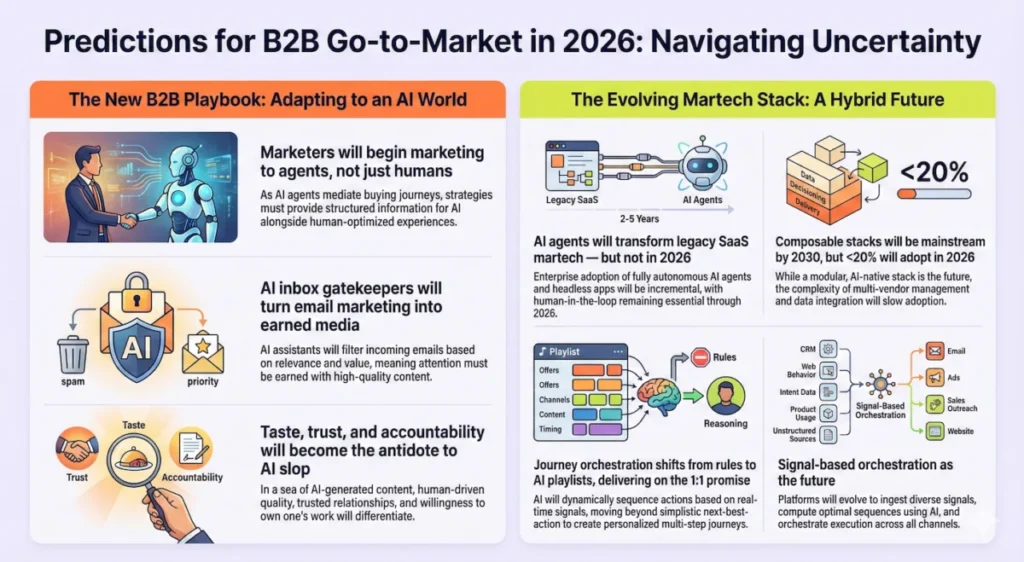
The central thesis of Miller’s 2026 forecast is a paradigm shift in the fundamental nature of the buying journey. For the first time, marketers must account for a non-human constituency: the AI agent.
As buying committees increasingly rely on LLMs and AI-mediated research tools to evaluate vendors, the traditional "human-only" marketing funnel is effectively obsolete. Miller posits that in 2026, successful firms will adopt a "headless" content architecture—one foundation of core data that serves both branded human experiences and direct, machine-readable API services for AI agents.
However, Miller is careful to temper the techno-optimism currently flooding LinkedIn. While the potential for fully autonomous GTM operations exists, he argues that 2026 will be a year of "hybrid experimentation" rather than a total replacement of the human workforce.
Chronology: From Keyword Stuffing to Context Engineering
To understand the current trajectory, one must look at the evolution of B2B search and automation over the last three years:
- 2023-2024: The industry focused on the basics of generative AI adoption and the initial impact of LLMs on search behavior.
- 2025: The "Year of Answer Engine Optimization (AEO)." Marketers shifted focus toward optimizing content for AI-driven summaries rather than traditional search rankings.
- 2026 (The Current Outlook): The focus shifts to "Context Engineering." As AI begins to handle more complex, multi-step tasks, the bottleneck is no longer compute power or algorithm quality—it is the lack of institutional context. Organizations must now formalize the tribal knowledge—the "why" behind their Salesforce schemas and campaign strategies—to ensure AI agents don’t merely execute tasks, but execute them in alignment with business strategy.
Supporting Data and Market Trends
The transition is backed by shifting metrics across the enterprise:
- The Rise of Agentic Traffic: Data indicates that 90% of B2B buyers now utilize AI tools for initial research. Consequently, 51% of firms are actively increasing their investment in AEO, leaving traditional SEO growth in the rearview mirror.
- The "Silent Freeze": Perhaps most concerning is the labor market trend. Research from the Stanford Digital Economy Lab and Pave suggests a decline in entry-level roles as companies use AI to maintain productivity without backfilling junior positions. The percentage of employees aged 21–25 at large tech firms has plummeted from 15% to 6.8% in just two years.
- The Complexity of Composable Stacks: While the "composable" martech stack—building a system from best-of-breed modular components—is the theoretical ideal, Miller predicts that fewer than 20% of firms will fully achieve this in 2026. The operational burden of managing multiple vendors and disparate data schemas remains a significant barrier to entry.
Official Perspectives and Industry Realities
While influencer-led narratives suggest "SaaS is dead," Miller argues that the reality is far more nuanced. He identifies three distinct fronts where legacy SaaS is being disrupted:
- Labor vs. Software: The next generation of GTM companies will not sell "seats" for software; they will sell "labor" via autonomous agents.
- UI Disappearance: User interfaces will increasingly become "headless," with users interacting with data through chatbot interfaces rather than navigating complex, menu-heavy dashboards.
- The Persistence of Human Trust: Despite the rise of AI, the human buyer remains the final arbiter. The 6sense Buyer Experience Report confirms that the average number of vendor interactions for a complex purchase remains high (16+). Machines may compress research time, but they cannot replace the trust and relationship-building required to close a high-stakes B2B contract.
Implications for the Modern CMO
The implications for leaders in 2026 are clear: the era of "batch-and-blast" email marketing is dead. As AI gatekeepers—such as Outlook Copilot and Apple Mail—filter and summarize communications, inbox attention is no longer "owned" media; it must be "earned" through extreme relevance and trust.
Strategic Recommendations:
- Invest in ‘Alpha’ Signals: Public data is now a commodity. Competitive advantage will be found in proprietary data sets and unique signal combinations that competitors cannot access.
- Embrace ‘Playlist’ Orchestration: Move away from rigid, rules-based "if-then" workflows. Instead, treat journey orchestration like a music streaming service, where AI dynamically sequences actions based on real-time engagement and account context.
- Prioritize Resilience over Perfection: With the World Uncertainty Index at historic highs, efficiency is not just a cost-saving measure—it is a strategic buffer. Organizations that operate leanly will have the maneuverability to survive the "rolling disruption" that characterizes the next half-decade.
Conclusion: Navigating the Uncertainty
The year 2026 will not be one that can be easily predicted by rigid roadmaps. Instead, it demands a high degree of navigational agility. Miller concludes that while AI will inevitably displace routine tasks, the premium on human judgment—the ability to exhibit taste, maintain trust, and take accountability for outcomes—has never been higher.
For the modern B2B professional, the goal is not to become an AI expert, but to become a better operator who uses AI as an extension of strategy. As the ground shifts beneath the industry, the winners will be those who stop treating AI as a tool for efficiency and start treating it as a catalyst for a more sophisticated, signal-driven model of customer engagement. The path forward is not found in a textbook; it is built through the disciplined application of human intent, guided by the immense power of intelligent, agentic systems.
