
The Great Plateau: Has the Marketing Technology Industry Finally Reached "Peak Martech"?
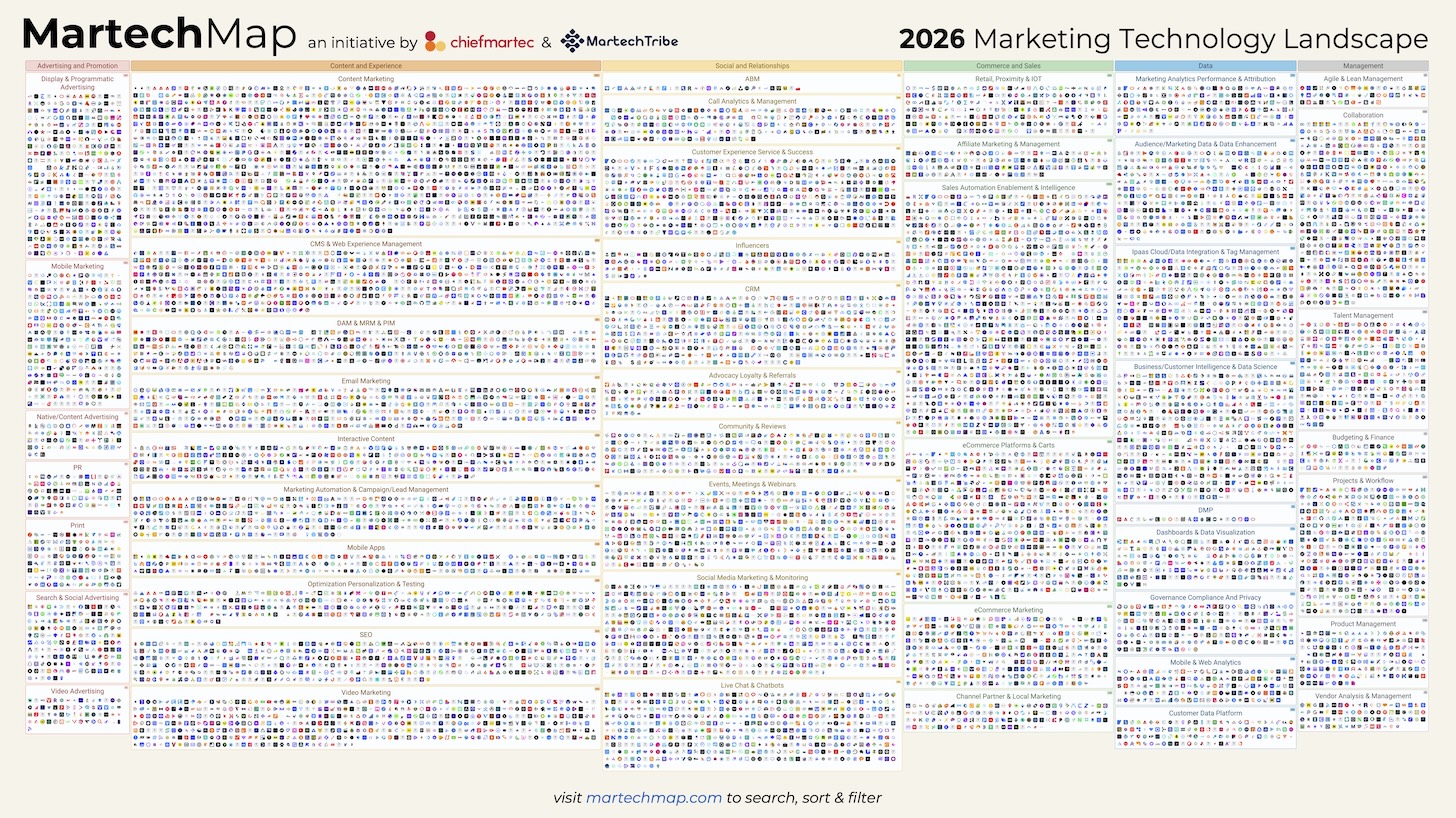
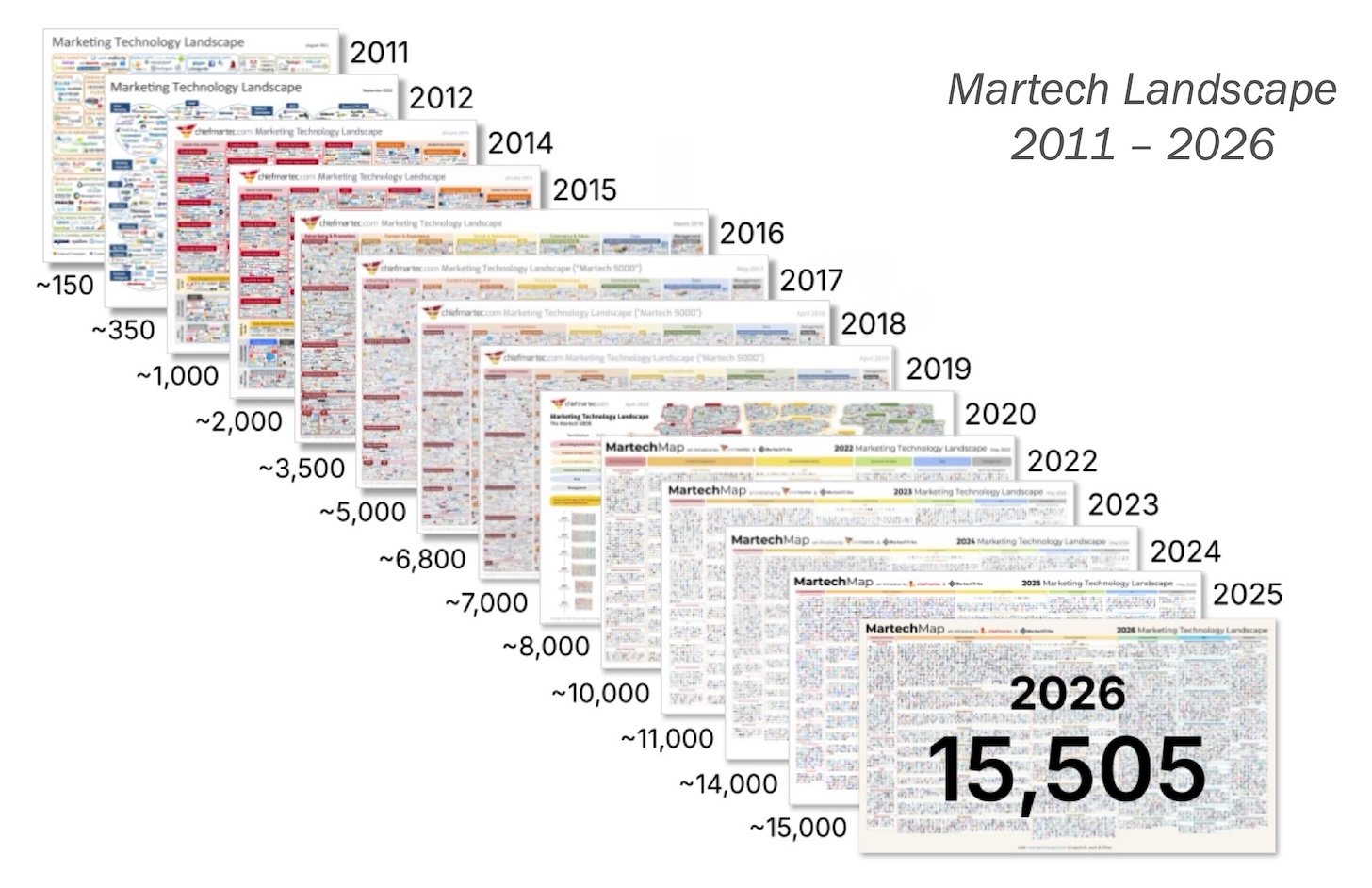
For fifteen years, the annual release of the Marketing Technology Landscape has been the industry’s most anticipated—and most anxiety-inducing—tradition. Year after year, the narrative remained consistent: explosive, relentless growth. It was a visual metaphor for the digital transformation of the global economy, characterized by an ever-expanding supergraphic that challenged even the most sophisticated graphic design software to contain its thousands of logos.
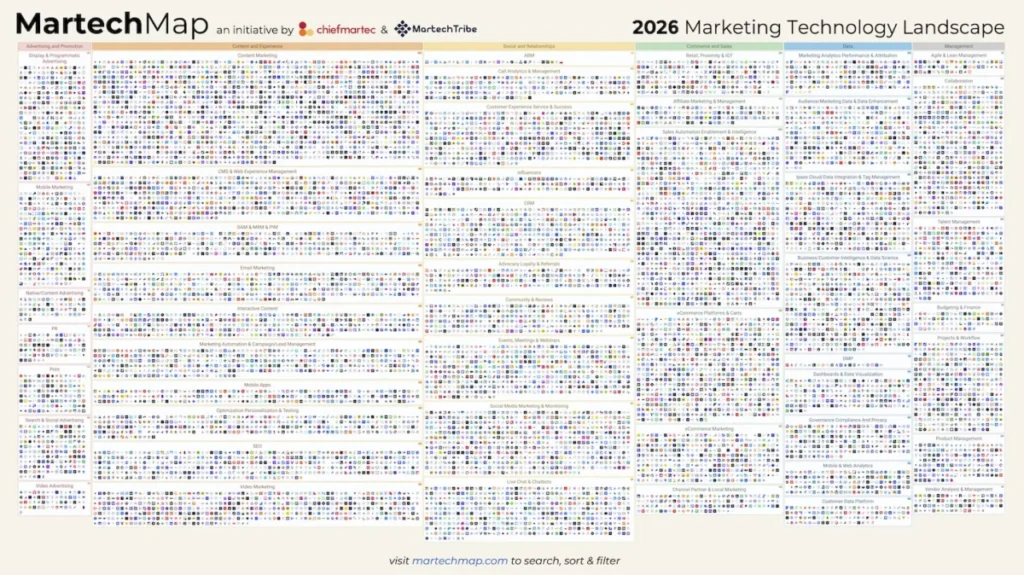
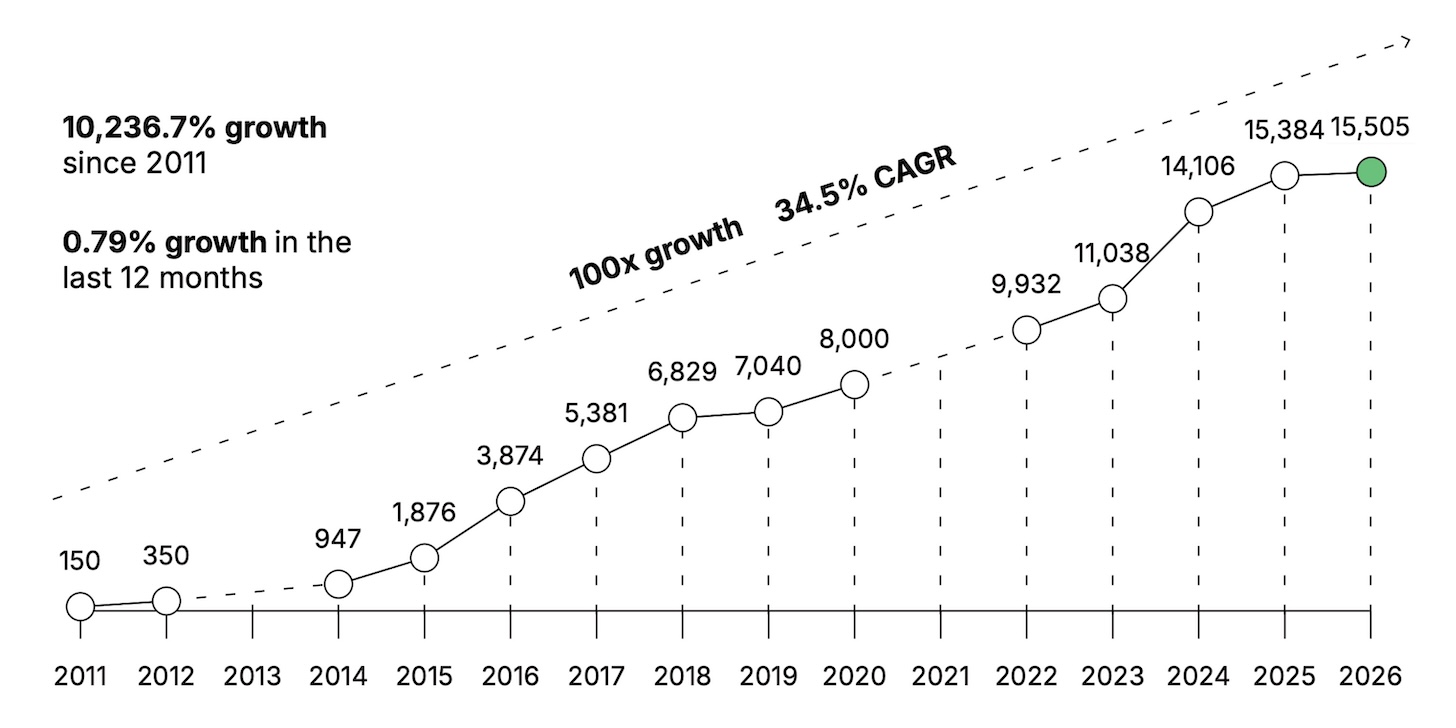
However, the 2026 edition of the Marketing Technology Landscape, released this week, suggests that the era of runaway expansion has hit a definitive structural wall. With a total of 15,505 products tracked, the industry has recorded a mere 0.79% growth—a statistical plateau that signals a maturing, if not entirely saturated, market.
The Main Facts: A Market in Equilibrium
For those who have tracked this evolution since 2011, when the landscape featured a mere 150 companies, the current figure of 15,505 is a milestone. Yet, the marginal net increase of just 121 products from last year’s 15,384 suggests that the industry’s "Jurassic Park" phase of unbridled proliferation is effectively over.
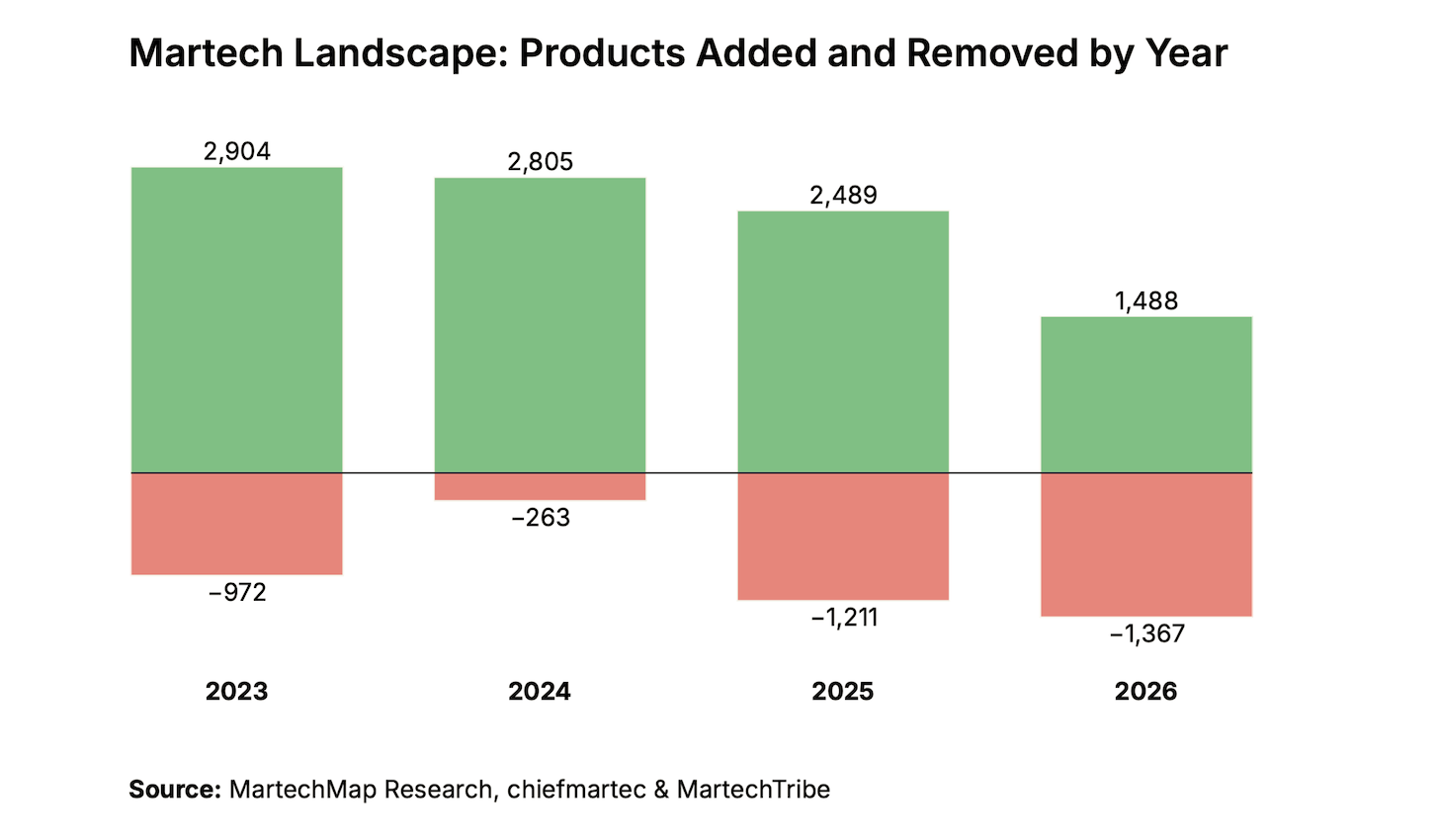
The headline figure of near-zero growth, however, belies a violent undercurrent of churn. The ecosystem is not stagnant; it is simply undergoing a massive reallocation of capital and relevance. This year saw 1,488 new products enter the fold, while 1,367 were removed. The net growth is the result of these two massive forces nearly canceling each other out, marking a transition from a "growth-at-all-costs" environment to a "survival of the fittest" economy.
A Chronology of Expansion and Consolidation
To understand how we reached this plateau, one must look back at the trajectory of the last decade and a half. The period between 2011 and 2025 was defined by the democratization of software development and the rise of cloud-native SaaS. During these years, the barriers to entry for building a marketing tool collapsed, leading to an explosion of niche products.
- 2011–2015: The "Wild West" phase. The initial explosion of digital marketing channels created a vacuum that hundreds of startups rushed to fill.
- 2016–2020: The "Platform Era." Consolidation rhetoric began to emerge, but the sheer volume of marketing budget shifting to digital channels allowed both incumbents and challengers to thrive simultaneously.
- 2021–2024: The "AI Gold Rush." The sudden arrival of generative AI saw a surge of "AI wrapper" startups, inflating the landscape with thousands of thin, single-feature applications.
- 2025–2026: The "Rationalization Phase." As buyers face budget fatigue and technical debt, the market has begun to shed the experimental startups of the previous three years, leading to the current plateau.
Supporting Data: The Anatomy of Exits
The data surrounding the 1,367 removed products provides a sobering look at the reality of the modern martech stack. Crucially, this is not merely a "bonfire of AI wrappers."
The analysis reveals that 51.7% of the departed products originated from the 2010–2019 SaaS boom. This indicates that a significant portion of the "first generation" of modern martech is now being cycled out. These are companies that established themselves early but failed to evolve in the face of modern AI integration.
The demographic of the "exited" is equally telling:
- Revenue Profile: 45.5% of removed products fell within the $1 million to $10 million annual revenue bracket.
- Team Size: 41.2% of the departed firms had between 1 and 10 employees, while 38.7% employed between 11 and 50.
These companies were not "failures" in the traditional sense; they were businesses that found traction but could not achieve "inevitability." In a market currently squeezed by large incumbents rolling out AI features from above and nimble AI-native startups attacking from below, the mid-market of martech is finding it increasingly difficult to survive.
The AI Reactivation: Why Some Categories are Booming
While the overall landscape is flat, specific sub-sectors are seeing significant growth, driven by the shift toward AI-centric architectures. It is a paradox of the 2026 data: the most "mature" categories are experiencing the fastest growth.
The Rise of Context Engineering
CMS and Web Experience Management (WEM) grew by 21.4%, jumping from 504 to 612 products. Similarly, Ecommerce Platforms and Carts grew by 19.9%. These growth spurts are not about better website design; they are about preparing data for a new audience: the machine.
For two decades, web development focused on humans and search engines. Today, websites must be optimized for "agents"—AI search assistants, procurement bots, and answer engines. These entities do not "browse" a site; they extract, compare, and summarize. Consequently, companies are investing in CMS and Ecommerce platforms that prioritize clean, structured, and machine-readable data.
The "Rhyming" Effect
The fastest-growing subcategories all share a common theme: they provide the plumbing for an AI-mediated world.
- Mobile & Web Analytics (+11.3%): As customer journeys become opaque due to AI interaction, firms are scrambling to instrument what remains visible.
- iPaaS/Data Integration (+8.0%): Because agents must operate across silos, the connective tissue between systems has become a strategic priority.
- Governance, Compliance & Privacy (+7.1%): The more autonomy an agent has, the greater the need for guardrails.
Implications for the Future of Marketing
The shift to "Peak Martech" carries profound implications for Chief Marketing Officers and technology buyers.
1. From "More" to "Better"
For years, the mandate for marketing ops teams was to "try everything." In a plateaued market, the mandate shifts to "rationalize everything." The rise of AI features within existing platforms (like Marketing Automation, which grew 5.9% despite being considered a legacy category) suggests that buyers prefer to consolidate their stack around AI-capable incumbents rather than managing dozens of niche tools.
2. The Death of the "Point Solution"
The data suggests that the "point solution" era is ending. If a tool cannot provide deep context or interoperate with an organization’s existing data lakes, it is highly vulnerable to being pruned during the next budget cycle.
3. The New Web Experience
The transition from a "page-view" internet to a "collaborative agent" internet is the most significant development of the year. Marketers are no longer just building websites; they are building "knowledge graphs" that allow AI concierges to answer complex queries, compare product trade-offs, and facilitate decisions in real-time.
Conclusion: Still Waters Run Deep
The 2026 Martech Landscape is a testament to the fact that stagnation at the macro level does not imply a lack of innovation. On the contrary, the current plateau suggests that the industry is finally moving past the phase of unorganized, chaotic growth and entering a phase of professionalized, AI-integrated maturity.
As the industry grapples with the fallout of the first generation of SaaS and the integration of the first wave of AI, the message for 2026 is clear: the focus has moved from the quantity of tools to the quality of the connections between them. We may have hit "Peak Martech," but the real work—the work of building the infrastructure for an agentic future—has only just begun.
For a deeper dive into the methodology and detailed breakdowns of the 15,505 products, readers are encouraged to consult the full "State of Martech 2026" report, which is available for download as an ungated resource.
