
The Global Stage on Home Soil: Decoding the 2026 FIFA World Cup’s Commercial Power
As the 2026 FIFA World Cup descends upon North America, a new comprehensive analysis from the Video Advertising Bureau (VAB) provides a high-definition roadmap for brands navigating what is poised to be the most commercially significant sports event in U.S. history. Published in June 2026, the report, titled “How will the World Cup deliver for brands this summer?”, demystifies the behavior of the 63.9 million American adults who plan to tune in during the tournament’s five-week residency across 16 host cities.
The VAB’s research—drawing from MRI-Simmons, ThinkNow, and tvScientific data—frames the tournament not merely as a sporting event, but as a "premium video" ecosystem. By analyzing eight core attributes, including cross-platform accessibility, emotional engagement, and second-screening behavior, the bureau offers a strategic blueprint for marketers looking to capture value from an audience that is as diverse as the 48 nations competing on the pitch.
The Scale of the Spectacle: Main Facts and Figures
The 2026 FIFA World Cup represents a radical departure from the tournament’s historical footprint. By expanding from 32 to 48 teams, the event now spans 104 matches, creating an unprecedented volume of premium advertising inventory.
According to the VAB, approximately 24% of the U.S. adult population (63.9 million people) intends to watch the matches. This audience is notably younger and more balanced than traditional American sports demographics. While the 35–44 age bracket leads the charge with a 34% participation rate, the 25–34 and 18–24 demographics remain highly engaged, indexed significantly above the average for the 18+ base.
Perhaps most vital for media buyers is the gender breakdown. The projected viewership is 58% male and 42% female. This 42% female share challenges the outdated practice of segmenting sports inventory exclusively toward male demographics, signaling a more inclusive commercial opportunity for brands in the retail, beauty, and consumer goods sectors.
A Tournament Chronology: From Kick-off to the Final
The tournament structure is a marathon, not a sprint, necessitating a long-term media strategy. The schedule, spanning June 11 to July 19, 2026, is divided into distinct phases that dictate the rhythm of advertising spend:
- Group Stage (June 11 – June 27): The initial surge of 48 nations competing across 12 groups. This period offers the highest frequency of matches and the broadest possible audience reach.
- Round of 32 (June 28 – July 3): The first stage of elimination, where intensity and viewer urgency begin to climb.
- Round of 16 (July 4 – July 7): A critical window coinciding with the U.S. Independence Day holiday, likely inflating out-of-home and social viewing figures.
- Quarterfinals (July 9 – July 11): The narrowing field concentrates attention, increasing the value of premium ad slots.
- Semifinals (July 14 – July 15): The penultimate stage, drawing massive global and domestic interest.
- The Final (July 19): The culmination of the tournament, representing the peak of advertising ROI and national attention.
Supporting Data: The Anatomy of a Modern Fan
The VAB analysis highlights a unique motivational texture among American viewers. Unlike domestic leagues where fan loyalty is binary, World Cup viewership is driven by a fusion of national pride and cross-cultural curiosity.
Emotional and Cultural Drivers
According to the For Soccer “Insights Into American World Cup Fans” survey, 84% of viewers are motivated by a sense of national pride, while an impressive 82% view the tournament as a gateway to learning about foreign cultures. This dual-purpose engagement is reinforced by the "multi-team support" phenomenon: 66% of U.S. soccer fans support more than one national team. For advertisers, this means that even after the U.S. team’s exit, the audience remains highly active, extending the shelf-life of tournament-specific campaigns.
Viewing Environments: The Hybrid Reality
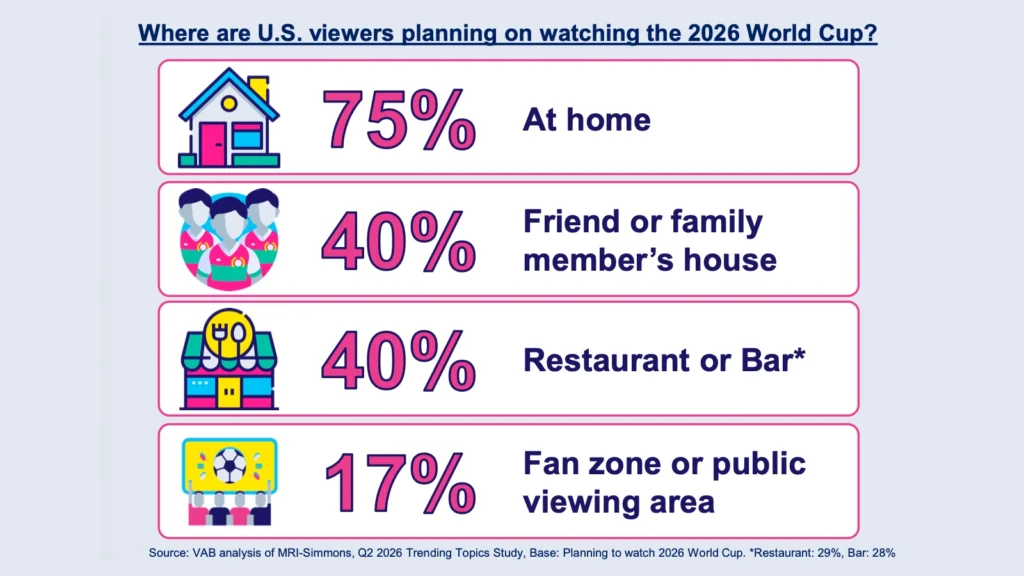
The report shatters the myth that the World Cup is exclusively a living-room experience. While 75% of fans will indeed watch from the comfort of their homes, a significant 40% will engage with the tournament in public spaces, including restaurants and bars. Furthermore, the partnership between FOX Sports and ReachTV to broadcast all 104 matches in U.S. airports creates a captive, high-value out-of-home audience that remains untapped by standard home-broadcast metrics.
Official Perspectives and Strategic Implementation
The VAB’s report is not merely a collection of statistics; it is a call to action for the advertising community. Authors Jason Wiese, Reed Kiely, Karolina Guillen, and Amanda Cashman emphasize that the fragmentation of media requires a sophisticated, multi-platform approach.
Addressing the Streaming Landscape
With 51% of viewers planning to consume content via streaming services, the technical infrastructure has evolved. The launch of FOX One on The Roku Channel and the integration of voice-activated access through Amazon’s Fire TV signify the "streaming-first" nature of the 2026 edition. Programmatic providers like Magnite have already reported a 30% year-over-year increase in CTV contributions, suggesting that the technical requirements of delivering localized, real-time ads across 104 matches are being met with robust solutions.
FIFA’s New Commercial Frontier
A major development for the 2026 tournament is the official sanctioning of advertising during the three-minute water breaks in each match. This creates a brand-new inventory category, allowing sponsors to reach viewers during the match flow without competing with the traditional half-time noise.
Implications: The Second-Screen Revolution
Perhaps the most actionable insight from the VAB report is the prevalence of "second-screening." With 59% of fans utilizing a second device during matches, the screen in front of the viewer is now a bridge to commerce.
The Conversion Bridge
The data suggests a direct correlation between television advertisements and immediate digital action:
- 74% of viewers search for content related to what they are watching in real-time.
- 68% of second-screeners browse for products they see in advertisements during the same session.
- 63% of viewers report they are more likely to purchase from official World Cup sponsors.
These figures underscore the importance of synchronizing broadcast buys with search engine marketing (SEM) and social media strategy. As Google continues to roll out features like lock-screen score pinning and Gemini-powered scheduling, the "second screen" is effectively becoming a control center for consumer purchasing.
Conclusion: A New Standard for Premium Video
The VAB’s analysis concludes that the 2026 FIFA World Cup is the ultimate test of the "premium video" framework. The tournament is not just a sporting event; it is a massive, multi-week data engine that rewards advertisers who understand the intersection of live broadcast intensity and the agility of digital performance marketing.
For brands, the message is clear: the scale is massive, the audience is engaged, and the pathways to conversion are more accessible than ever. Whether through the emotional hook of national pride or the logistical necessity of cross-platform visibility, the 2026 World Cup offers a unique commercial window that will define the sports marketing landscape for the remainder of the decade. As the tournament kicks off in June, the winners will not just be the teams on the field, but the brands that successfully bridge the gap between the television screen and the consumer’s wallet.
