
The Future of the Creator Economy: Decoding the Hidden Trends Reshaping Social Video
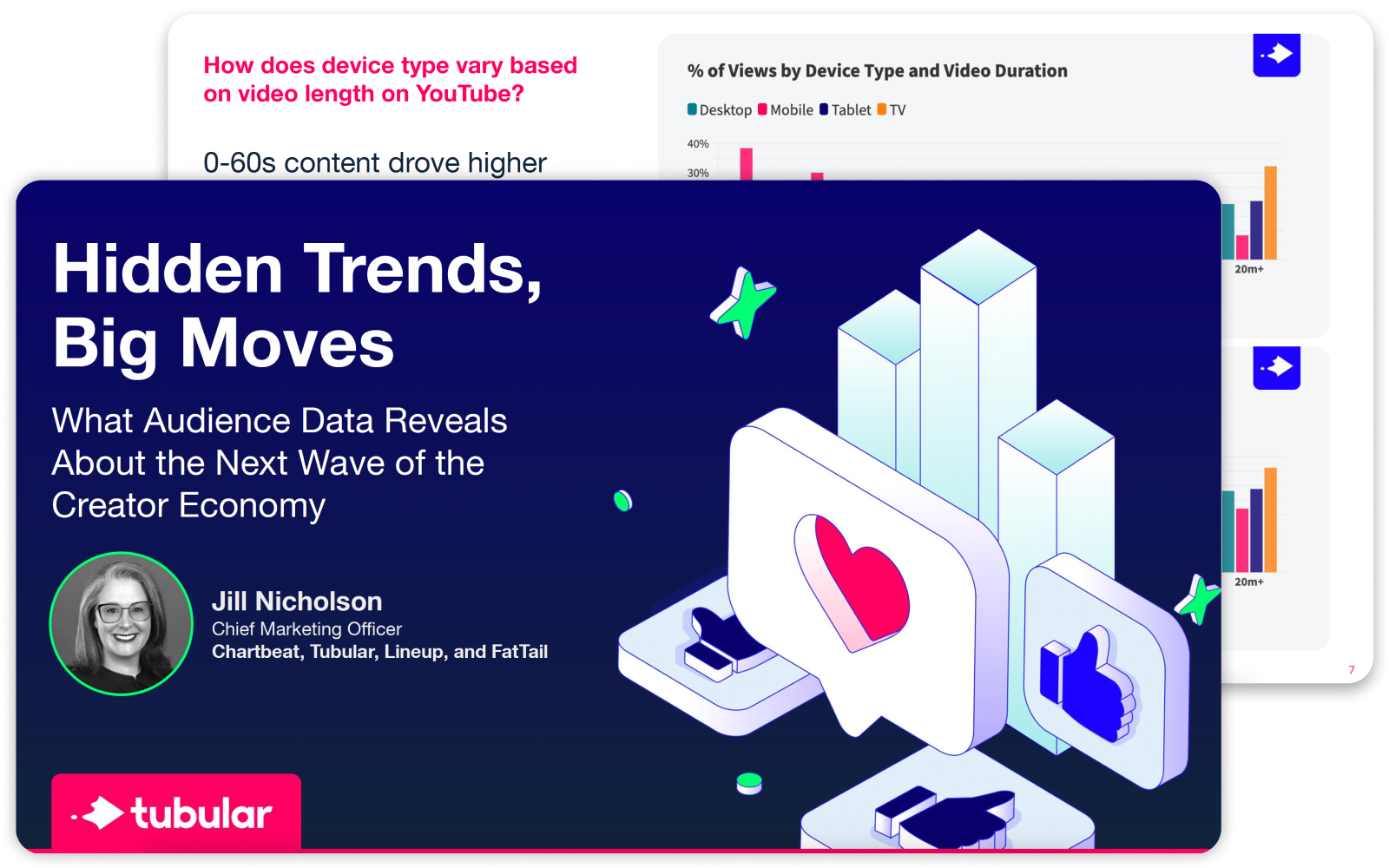
The digital landscape is undergoing a tectonic shift. At this year’s VidCon—the premier annual gathering for the global creator economy—industry leaders and stakeholders gathered to parse the data defining the next generation of social video. Among the most anticipated presentations was the keynote by Jill Nicholson, CMO of Tubular Labs, who unveiled a suite of "hidden" trends that are quietly dictating the success or failure of modern content strategies.
While many brands remain fixated on vanity metrics and superficial engagement numbers, the real battleground for audience attention has moved into more nuanced territories: device-specific consumption habits, the efficacy of counter-intuitive brand partnerships, and the high-stakes balancing act of AI-assisted versus human-centric content production.
This report dives into these emerging patterns, providing a blueprint for creators and brands aiming to navigate the complexities of the current media landscape.
The New Hierarchy of Engagement: Why Device Matters
For years, the industry operated under a "one-size-fits-all" mentality regarding video duration. If a video was too long, it was deemed unfit for social media. If it was too short, it lacked depth. However, Nicholson’s research challenges this binary view by highlighting a critical variable: the hardware.
The Connected TV (CTV) Phenomenon
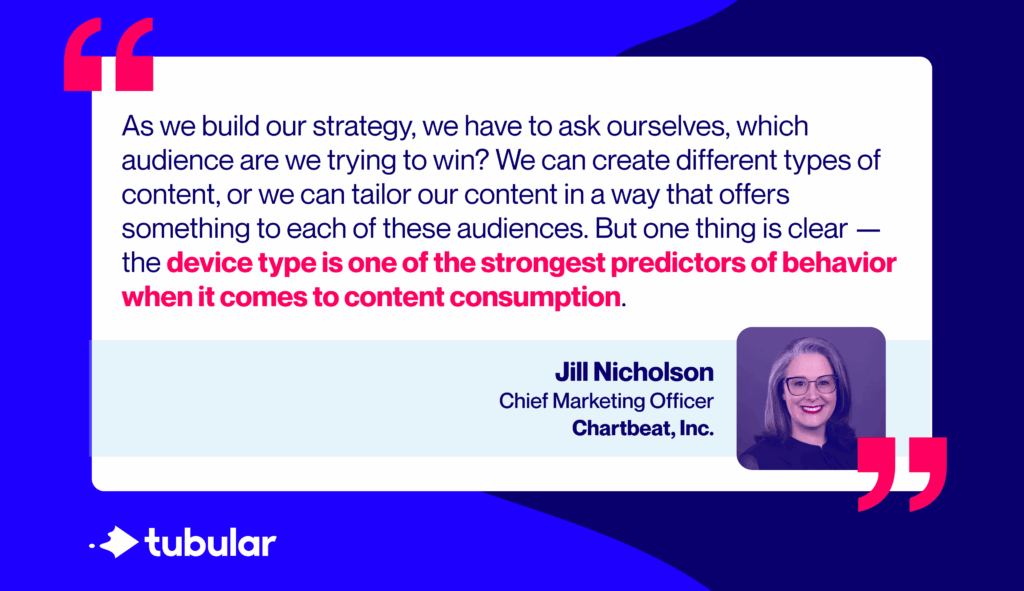
Data from the first half of 2025 reveals that the "scroll-and-swipe" behavior associated with mobile devices is increasingly being replaced by a "lean-back" experience on Connected TVs. On these larger screens, viewers are demonstrating a surprising appetite for long-form content.
The data indicates that when viewers are positioned in front of a living room display, they are significantly more likely to engage with videos exceeding the 20-minute mark. This contradicts the traditional social media playbook, which prioritized sub-60-second clips. For brands, this represents a massive opportunity to shift from fleeting brand awareness campaigns to deep-dive, narrative-driven content that builds genuine brand affinity.
The Mobile Constraint
Conversely, mobile devices continue to act as the gatekeepers of short-form, high-velocity content. The psychology here is driven by convenience and intermittent engagement. On mobile, the "hook" must be instantaneous. The lesson for creators is clear: your content strategy must be platform-agnostic, but device-aware. Producing a 20-minute documentary for a user commuting on a train is a strategic failure, just as a 15-second clip on a 65-inch television may feel incomplete to a viewer settling in for the evening.
Breaking the Mold: The Power of Unexpected Collaborations
One of the most profound revelations from the VidCon insights is the changing face of brand influence. Traditional influencer marketing relied on the "category match"—a skincare brand partnering with a beauty influencer, or a gaming peripheral brand teaming up with a professional esports athlete.

The Beauty Industry’s Pivot
Tubular Labs’ research identifies a major disruption in the US beauty sector. Brands that have moved away from traditional beauty-only partnerships are seeing exponential growth in engagement. By stepping into adjacent or even entirely unrelated categories, brands are successfully infiltrating new subcultures.
A striking case study is the partnership between skincare giant Nivea and TikTok creator @Onezwambola, who primarily produces Food & Drink content. By leaning into this cross-category collaboration, Nivea achieved a 3X increase in engagements within the first seven days. This "unexpected" association acted as a pattern interrupt for the audience, providing a refreshing change of pace that drove higher click-through rates than standard beauty-focused endorsements.
Implications for Brand Strategy
The data suggests that audiences are experiencing "category fatigue." When a brand stays within its lane, it often struggles to capture the attention of a saturated demographic. By partnering with creators in unexpected niches, brands can leverage the creator’s trust within their community while exposing the brand to an entirely new set of potential consumers.
The AI Dilemma: Quality, Quantity, and the Gaming Creator
Perhaps the most contentious topic addressed at VidCon was the role of Artificial Intelligence in content production. Nowhere is this more visible than in the gaming category on YouTube, where the pressure to stay relevant has pushed creators to experiment with high-frequency, AI-assisted output.
The Efficiency Trap
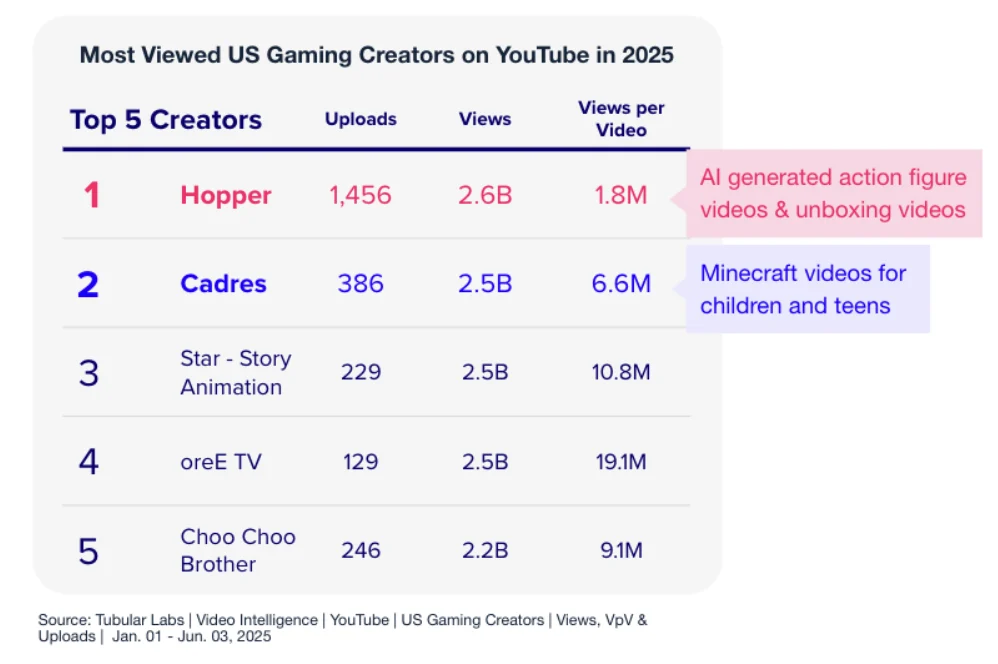
The 2025 landscape shows that top US gaming creators are grappling with the trade-off between AI-driven volume and human-curated quality. A comparative analysis of top creators shows a fascinating discrepancy:
- The Volume Strategy: Some creators are using AI to generate high-frequency content. While this results in massive total view counts, the "views per video" metric remains significantly lower than their peers.
- The Human-Centric Strategy: Creators who rely on high-production, human-driven content post less frequently but command a higher view-per-video ratio.
The mathematical reality is stark: if a high-volume AI-creator could match the engagement quality of a human-centric creator, their potential reach would jump from 2.6 billion views to nearly 9.6 billion. However, current data suggests that the market has a ceiling for AI-generated content. If your strategy relies on AI to fill the content calendar, you must be prepared to post far more frequently to maintain relevance, as the individual impact of each video is inherently diluted.
The Optimal Frequency
The research concludes that in H1 2025, the most successful creators—defined by both overall views and consistent views per video—averaged four uploads per day. This "goldilocks zone" of four uploads represents a high-intensity threshold that allows for algorithmic visibility without sacrificing the core appeal that keeps audiences coming back.
Official Responses and Strategic Implications
Following the release of these findings, industry experts have been quick to interpret the results. Jill Nicholson, in her address to the VidCon attendees, noted that "the creator economy is no longer a monolith. It is a fragmented ecosystem where success is defined by how well you align your content format with the specific psychological state of your viewer."

Strategic Actions for Brands and Creators
To translate these insights into actionable results, stakeholders should prioritize the following:
- Device-First Planning: Before scripting a single line of dialogue, determine the primary consumption device for your target demographic. Build for the TV screen if you want to tell a story; build for the mobile screen if you want to capture a moment.
- Radical Collaboration: Challenge your marketing team to identify at least one "unexpected" partner each quarter. Look for creators in categories that share your brand values, even if they don’t share your product niche.
- Audit Your Production Workflow: If you are utilizing AI to scale, ensure it is augmenting your human storytelling, not replacing it. If your "views per video" are trending downward, it is time to pivot back toward human-led, high-quality production to recover your audience’s trust.
- Consistency Over Perfection: The data regarding the four-upload-per-day average for top gaming creators serves as a benchmark for volume. Creators should aim for consistent, high-frequency output that keeps their brand top-of-mind, provided they can maintain a threshold of quality that avoids "content bloat."
Conclusion: The Path Forward
The insights presented at VidCon 2025 confirm that the "hidden trends" of the creator economy are hidden only to those who refuse to look at the data. The era of guessing is over. We have entered a period of precise, data-backed content creation where the winners are those who can synthesize technical performance metrics with genuine human connection.
As brands and creators look toward the second half of 2025 and beyond, the message from Tubular Labs is clear: the future belongs to those who adapt their tactics to the hardware, expand their reach through unexpected partnerships, and master the delicate balance between AI-assisted volume and the irreplaceable power of human-driven storytelling.
For those looking to gain a deeper competitive advantage, the full report on these emerging patterns offers a comprehensive breakdown of the metrics that matter. In an industry that moves as fast as social video, the ability to pivot is not just a strategy—it is a survival requirement.
