
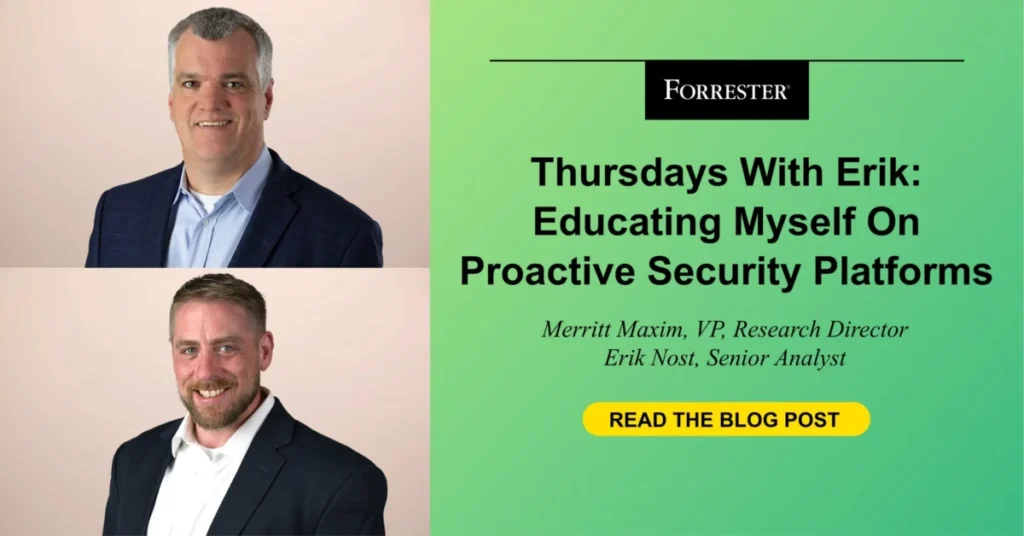
The Evolution of Proactive Security: How AI and Platform Convergence Are Reshaping Enterprise Defense
SAN FRANCISCO — In the rapidly shifting landscape of enterprise cybersecurity, the traditional paradigm of "find a vulnerability, patch a vulnerability" is officially buckling under its own weight. Driven by the relentless proliferation of corporate assets, the convergence of internal and external attack surfaces, and the dawn of autonomous, AI-enabled threat actors, the industry is witnessing a structural transformation.
At the center of this movement is the emergence of "proactive security"—a unified market category that marries visibility, asset context, exposure validation, and automated remediation. This maturation of the market culminated recently with the publication of the inaugural Forrester Wave™ evaluation on proactive security platforms, marking a watershed moment for how organizations approach risk management before an incident occurs.
Main Facts: The Shift to Proactive Security Platforms
For years, security programs have fought a high-volume, low-margin war against endless lists of vulnerabilities. However, industry analysis and recent market evaluations reveal a critical consensus: visibility alone is no longer enough.
- The Convergence of Disciplines: Once-siloed markets—such as vulnerability risk management (VRM), external attack surface management (EASM), internal attack surface management, and breach and attack simulation (BAS)—have steadily merged.
- The Rise of Platforms: Major security vendors now package these capabilities into comprehensive "proactive security platforms" designed to move organizations beyond fragmented, standalone tooling.
- The Core Pillars: Modern proactive security relies on four foundational capabilities: continuous asset discovery, context-aware prioritization, advanced exposure validation, and—increasingly—autonomous, agentic remediation.
- The AI Imperative: The integration of Agentic AI is accelerating this shift, allowing security architectures to dynamically reconfigure policies, implement compensating controls, and execute mitigations without waiting for human intervention.
Chronology: The Journey to Market Maturity
To understand how proactive security became a recognized enterprise category, one must trace the rapid evolution of security risk management over the past several years.
2022: The Foundation of Vulnerability Risk Management
In the late spring of 2022, enterprise focus was largely anchored in traditional vulnerability risk management. At the time, organizations struggled simply to maintain accurate inventories of software vulnerabilities and asset footprints. Disparate teams managed internal networks and external exposures independently, creating massive blind spots and inefficient remediation cycles.
2023–2024: Market Convergence and the Blurring of Lines
As cloud adoption, remote work, and digital supply chains expanded corporate attack surfaces, the boundaries between internal and external security dissolved. CISOs realized that attackers did not view corporate infrastructure through siloed lenses.
- Organizations began demanding tools that could assess external exposures alongside internal vulnerabilities.
- Breach and attack simulation (BAS) and exposure validation emerged as critical complements to standard prioritization engines, forcing security teams to ask not just "what is vulnerable?" but "what is actually exploitable?"
Early 2025: The Acceleration of AI-Driven Threats
The cyber threat landscape shifted dramatically with announcements regarding advanced, AI-driven cyber capabilities—exemplified by models like Anthropic’s Mythos—which demonstrated the potential for automated, rapid exploitation of software weaknesses. This development drastically compressed the time window security teams have to identify and neutralize risks, making manual remediation workflows obsolete.
Late 2025: The First Forrester Wave™ on Proactive Security Platforms
Reflecting these sweeping market dynamics, the industry reached a definitive milestone with the release of the first-ever Forrester Wave™ evaluation dedicated entirely to proactive security platforms. This report codified the shift away from legacy, reactive vulnerability scanners toward unified platforms capable of end-to-end proactive defense.
Supporting Data: Why Traditional Vulnerability Management Falls Short
The push toward proactive security platforms is supported by stark operational realities facing enterprise security teams today.
- The "Whack-A-Mole" Dilemma: Traditional vulnerability management programs often generate millions of findings per month. Security teams find themselves trapped in an endless remediation cycle, fixing individual bugs without addressing the structural weaknesses or systemic attack paths that allowed those vulnerabilities to exist in the first place.
- The Visibility Paradox: Organizations possess more dashboards, scanning tools, and asset inventories than ever before. Yet, according to industry insights, raw visibility data fails to improve security outcomes unless it is paired with deep asset context and exploitability validation.
- The AI Threat Multiplier: Threat actors are increasingly utilizing artificial intelligence to automate reconnaissance, discover zero-day vulnerabilities, and launch coordinated attacks at machine speed. Enterprises relying on human-paced, quarterly or monthly vulnerability patching cycles face an insurmountable disadvantage.
Proactive security addresses these data points by shifting the operational objective: the goal is no longer to fix more vulnerabilities, but to eliminate the root conditions that create recurring security vulnerabilities at scale.
Official Perspectives: Navigating the Taxonomy and Future of Defense
As the market expands, industry leaders and research directors emphasize the importance of clear definitions and architectural strategy. Security taxonomy has long been plagued by overlapping terminology—including continuous threat exposure management (CTEM), exposure management, vulnerability management, and attack surface management.
According to market analysts, organizations must look past fluctuating vendor marketing terms and focus on a use-case-oriented framework.
"Proactive security is a use case that borrows from a variety of market categories and emphasizes visibility, asset context, prioritization, validation and, increasingly, autonomous action," notes enterprise research leadership tracking the space. "Even as technology categories continue to converge, organizations will still need capabilities focused on discovering what matters, validating exposure, and closing risk loops efficiently."
Vendors are responding by building platforms that synthesize these disparate threads, ensuring that security leaders can justify their tool consolidation strategies to executive boards by demonstrating measurable risk reduction.
Implications: The Rise of Agentic AI and What It Means for Enterprises
The integration of artificial intelligence into proactive security represents the most profound operational shift for enterprises in decades. A central debate among security architects has centered on whether "agentic security"—AI systems capable of autonomous reasoning and action—will disrupt reactive or proactive workflows.
The prevailing consensus points to a hybrid reality: Agentic AI is an enabler, not a replacement.
1. Contextual Intelligence at Machine Speed
AI allows organizations to rapidly ingest massive streams of environmental context, threat intelligence, and asset telemetry. Instead of relying on static rules, AI-driven systems can analyze complex attack paths and identify systemic choke points within seconds.
2. Preemptive Mitigation and Automated Action
Perhaps the most significant implication for enterprise security is the shift toward automated risk mitigation. When risk thresholds are crossed, modern proactive platforms can autonomously trigger:
- Compensating network controls and segmentation changes.
- Policy adjustments across cloud environments.
- Targeted remediation workflows without requiring human intervention for every minor ticket.
This reduces the dwell time of exposures from weeks or months down to minutes, neutralizing threats before they can be leveraged by attackers.
3. Redefining Enterprise Expectations
For CISOs and security directors, the rise of proactive security platforms means moving past compliance-driven box-checking. The standard for enterprise security is no longer measured by how many vulnerability tickets were closed, but by how effectively the organization reduced its attack surface and neutralized exploit paths before an incident could occur.
Looking Ahead
The cybersecurity industry has spent the past two decades successfully improving enterprise visibility. The defining challenge of the next era is turning that insight into preemptive, automated action.
Organizations that successfully bridge the gap between discovery, contextual prioritization, validation, and automated remediation will be best positioned to weather the accelerating threat landscape. By treating proactive security not as a series of standalone tools, but as an integrated, AI-empowered operational philosophy, enterprises can finally stop playing catch-up to cyber adversaries—ensuring that potential exposures are resolved long before they ever transform into business-disrupting incidents.
