
The Digital Podium: How Social Video Trends Are Predicting the 2026 Milano-Cortina Breakout Stars
As the world turns its gaze toward the snow-capped peaks of the Italian Alps for the 2026 Olympic Winter Games in Milano-Cortina, the media landscape is already shifting. While traditional broadcast television remains the primary vehicle for live event coverage, the "pre-game" for the Olympics is now being played entirely in the digital arena. For creators, publishers, and global brands, the path to capturing the Olympic zeitgeist lies in decoding the granular viewership data of the preceding year.
With the 2026 Games approaching, recent insights from 2025 social video performance offer a compelling roadmap. By analyzing billions of views across platforms, we can identify which sports are poised to capture the global imagination and how the digital storytelling economy is evolving to meet the demands of a modern, sports-obsessed audience.
The Pre-Olympic Surge: Data as a Predictive Tool
Olympic years historically generate a massive influx of interest in sports that often live on the periphery of mainstream consciousness during the off-cycle. However, the 2026 Milano-Cortina Games are unique because the digital infrastructure for sports consumption has matured significantly.
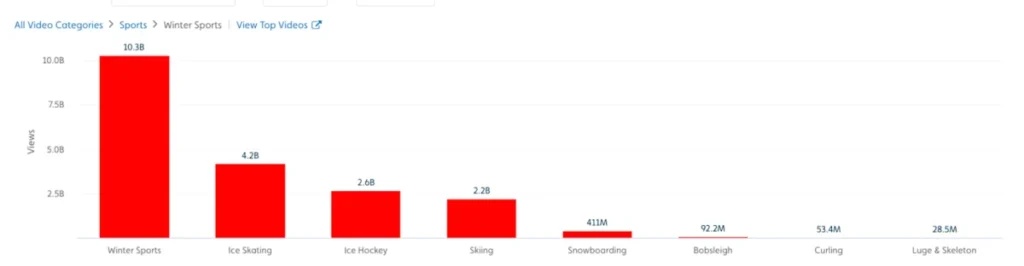
According to data synthesized by Tubular Labs, the "Olympic effect" is no longer a localized phenomenon that kicks in during the Opening Ceremony. Instead, it is a sustained, year-round momentum built on the back of social video. In 2025—a non-Olympic year—winter sports content saw staggering engagement, proving that audiences are increasingly seeking "snackable" athletic content that transcends the traditional four-year cycle. By analyzing which categories outperformed others, we can derive a data-backed forecast for which disciplines will dominate the social media algorithms when the torch is lit in Italy.
Ice Skating: The Undisputed Sovereign of Winter Content
When it comes to winter sports, figure skating remains the undisputed heavyweight champion of the digital space. Despite the absence of a major Olympic tournament in 2025, ice skating content generated a massive 4.2 billion views across various social platforms.
Breaking Down the Numbers
- Figure Skating Dominance: Of those 4.2 billion views, figure skating accounted for 2.2 billion, bolstered by 36.8 million total engagements.
- The Aesthetic Factor: Unlike many high-speed, gear-heavy sports, figure skating occupies a unique intersection of athleticism and artistry. This allows it to penetrate non-traditional verticals.
The data suggests that the success of skating content is not limited to sports enthusiasts. Because of the inherent focus on choreography, costuming, and technical precision, the sport has become a hub for fashion, beauty, and lifestyle creators. By incorporating hair-and-makeup tutorials, costume design breakdowns, and "how-to" skating basics, publishers are successfully tapping into demographics that might otherwise never tune into a sports broadcast. For brands, this represents a massive opportunity to move beyond traditional sports sponsorships and engage with the "aesthetic-first" consumer.
Skiing: Scaling the Digital Heights
With more than 20 distinct skiing disciplines scheduled for the 2026 Games, skiing is poised to be the most represented sport in Milano-Cortina. The 2025 viewership data confirms that audiences are already primed for this influx of content.
The YouTube Phenomenon
In 2025, skiing videos on YouTube amassed 2.2 billion views. While this figure is impressive, the distribution of these views provides a deeper insight into audience behavior:
- Freestyle and Alpine dominance: Together, these two categories accounted for roughly one-third of the total skiing viewership.
- The Efficiency of Niche: While freestyle and alpine skiing rely on volume (over 6,000 uploads), ski jumping operates on a high-impact, low-volume model. Averaging 426,000 views per video, ski jumping demonstrates that while it may have fewer entries, its core audience is intensely dedicated, offering a high-value environment for targeted advertising.
Creators like Anthony Robert have mastered this niche, utilizing skiing as a lens for storytelling. Interestingly, Robert’s viewership data peaked during the summer months, proving that high-quality, aspirational sports content has a shelf life that extends far beyond the winter season.
Niche Sports and the Power of Storytelling
One of the most profound shifts in sports media is the move toward "human-interest" storytelling, specifically in sports like bobsleigh, curling, and skeleton.
The Cool Runnings Legacy and Beyond
The bobsledding community has long benefited from the cultural cachet of the film Cool Runnings, which humanized a sport that many previously viewed as inaccessible or overly technical. Today, that legacy is being updated by the athletes themselves.
The Great Britain bobsled team, for instance, has effectively used social video to document the grueling reality of their preparation. By stripping away the polish of a network broadcast and showing the "behind-the-scenes" grind—the gym sessions, the travel, the tactical meetings—they have created a loyal following. In 2025, bobsled content earned 317,000 views per video. This success underscores a critical trend: modern sports fans don’t just want to see the win; they want to invest in the journey.
Chronology: Building Toward the Games
To understand how this data will manifest during the 2026 Games, it is helpful to look at the timeline of engagement:
- 2025 (The Foundation Year): Broad interest in winter sports, driven by organic social content, tutorial videos, and athlete-led vlogs.
- Late 2025 – Early 2026 (The Awareness Peak): Brands and publishers begin to shift their focus from general winter sports content to specific Olympic storylines and athlete profiles.
- February 2026 (The Event Horizon): The period of maximum saturation. While NBC holds the exclusive broadcast rights for the US, the "second-screen" experience—where fans watch the event on TV while simultaneously engaging with social content on their phones—will be the primary driver of conversation.
- Post-Games (The Legacy Phase): The transition of Olympic stars into influencers. Athletes who successfully leverage their personal brands on social media during the games will see their engagement metrics skyrocket in the months following the closing ceremony.
Implications for Stakeholders
For Content Publishers
The data is clear: do not wait for the Opening Ceremony to start your coverage. The "pre-game" has already begun. Publishers should prioritize content that highlights the human elements of the games—training regimens, personal challenges, and the cultural context of the sports.
For Brands and Advertisers
Traditional 30-second spots during live broadcasts are no longer sufficient. Brands should be looking to partner with athletes who have demonstrated high engagement on social platforms. As seen with figure skating, there is immense value in cross-pollinating sports with lifestyle, beauty, and fashion content.
For Athletes
The power is in your hands. The success of the Great Britain bobsled team proves that direct-to-audience communication is the most effective way to build a personal brand. Athletes who provide a transparent, authentic look at their preparation are the ones who will capture the largest share of voice during the 2026 Games.
Conclusion: Looking Ahead to Milano-Cortina
The 2026 Winter Olympics represent more than just a sporting event; they represent a digital milestone. By leveraging the insights from 2025, we can see that the future of sports media is decentralized, creator-led, and hyper-engaged.
Whether it is the aesthetic appeal of figure skating, the technical intensity of ski jumping, or the narrative-driven drama of the bobsled track, the most successful content will be that which treats the audience as participants in the journey rather than passive spectators. As we count down the days to Italy, the metrics are already telling the story of the next Olympic generation.
For those looking to stay ahead of the curve, the message is simple: monitor the data, embrace the niche, and tell the human story behind the athlete. The digital podium is waiting.
