
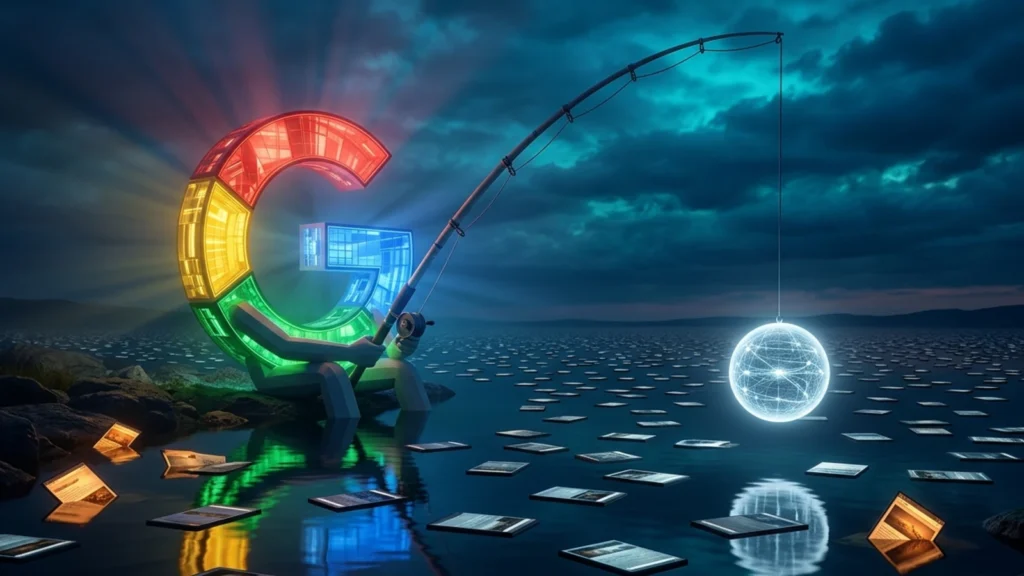
The Death of a Digital Library: How AI Search Engines Dismantled a Two-Decade Public Resource
For 21 years, a single, volunteer-run website stood as a bastion of objective, data-backed truth in an increasingly cluttered digital landscape. For students, environmental policymakers, documentary filmmakers, and the curious public, overfishing.org was the definitive portal for understanding the precarious state of the world’s oceans. It was a site without ads, without tracking cookies, and without an agenda—save for the promotion of scientific literacy.
Then, in the final quarter of 2023, the traffic began to evaporate. It didn’t vanish in a sudden server crash or a black-hat SEO penalty; it disappeared with the cold, mechanical precision of an algorithm shift. Today, overfishing.org is effectively dead, a casualty of the transition from a "search-to-source" internet to an "AI-summary" ecosystem. Its story is not merely the tale of one Dutch volunteer, Pepijn, closing a project; it is a case study in the systemic erasure of the independent, expert-led web.
The Architect and the Archive
At its peak, overfishing.org was a digital anomaly. While the rest of the web chased clicks through clickbait headlines and intrusive monetization, the site remained a curated, ad-free reference library. It featured approximately 300 pages of original content, ranging from introductory primers on fisheries policy to high-resolution satellite imagery documenting illegal bottom trawling in the Dutch Waddensea.
Pepijn, the site’s operator, spent two decades meticulously maintaining its accuracy. Because overfishing is a dynamic issue—subject to changing international quotas, shifting environmental regulations, and evolving stock assessments—the site required constant stewardship. It was this rigorous maintenance that allowed overfishing.org to consistently outrank Wikipedia and major news outlets for critical environmental keywords. It was a trusted, non-commercial reference used by national governments to shape fisheries policy and by educators to build lesson plans.
"Every claim was properly referenced," Pepijn noted in a February 2024 announcement on Mastodon. When the site shuttered that same month, it took with it a body of institutional knowledge that had become a foundation for public understanding of marine sustainability.
Chronology of a Digital Collapse
The decline of the site was not a slow decay; it was a volatile, oscillating process that mirrored the rollout of Google’s "AI Overviews" (formerly known as Search Generative Experience).
The Q4 2023 Disruption
Beginning in late 2023, Pepijn observed a bizarre pattern in his traffic logs. On Mondays and Tuesdays, the site would see roughly 750 unique visitors—a standard figure for the site’s established reach. Then, as if on a timer, traffic would plummet to 50 visitors for two days before miraculously recovering on Fridays.
This was not a glitch. It was the footprint of Google’s regional and time-sensitive A/B testing of AI summaries. Whenever Google enabled AI-generated responses for queries related to overfishing in a specific region, traffic to the original site vanished. When the feature was toggled off, the humans returned. By early 2024, the "low" numbers became the new baseline. The experiment had moved from a test to a permanent structural fixture.
February 2024: The Final Shut-Down
On February 25, 2024, after two decades of operation, Pepijn posted a farewell on Mastodon. He acknowledged that while the site had once been a pillar of the search ecosystem, it was no longer reaching the people who needed it. The "distribution mechanism"—the search engine—had stopped serving as a bridge to knowledge and had instead become a destination that cannibalized the source.
May 2026: The Post-Mortem
In May 2026, when a thread resurfaced his closure announcement, Pepijn provided further context. He clarified that he had no interest in maintaining a site that acted only as a raw data feed for an "AI rewriting machine" that neither properly attributed his work nor provided a functional link for users to learn more. The site’s domain remains, but the project is officially dormant.
The Data: A Industry-Wide Epidemic
The collapse of overfishing.org is not an isolated incident; it is a statistical trend. Analysis from multiple independent research firms confirms that the "zero-click" era has arrived with devastating consequences for the open web.
The Erosion of Click-Through Rates (CTR)
According to Ahrefs research comparing data from March 2024 to March 2025, the presence of AI Overviews in search results cut traffic to the first organic result by an average of 34.5%. For informational queries—the exact type of search that sustained overfishing.org—the click-through rate dropped from 0.073 to 0.026.
The Shift in User Behavior
A July 2025 study from the Pew Research Center provided even grimmer insights. When users encountered AI summaries, website link clicks were halved. Crucially, 26% of users ended their search session entirely after reading the AI summary, compared to only 16% when presented with traditional blue links. When citations were provided within the AI summaries, users clicked them a mere 1% of the time.
Sector-Wide Decline
The economic impact is mirrored in broad industry data:
- Total Web Traffic: Rand Fishkin of SparkToro reports a 46% decline in open web traffic over the past three years.
- The "Zero-Click" Reality: Nearly 60% of all Google searches in the U.S. now result in zero clicks to external websites.
- Sectoral Impact: A study by the agency Tank, analyzing 800 companies across 16 industries, found that average monthly organic traffic growth collapsed from 26.3% before the AI rollout to just 3.7% afterward. Hospitality, a sector heavily reliant on informational search, saw growth turn negative at -6.7%.
Official Responses and Industry Tension
Google has consistently defended its AI Overviews as a way to "simplify" the search experience and provide users with faster, more concise information. In response to mounting criticism, the company has argued that its AI systems drive high-quality traffic and that it is committed to an "ecosystem-first" approach.
However, the tech giant’s claims are increasingly being challenged by empirical evidence. In 2025, Google publicly disputed a Pew Research study suggesting that AI summaries were responsible for a 50% drop in clicks. Despite this, the search giant has faced intense pressure from publishers, ranging from independent bloggers to massive news conglomerates. The disconnect remains: publishers argue that Google is effectively "scraping" their work to create a replacement product, while Google maintains it is merely evolving the search interface.
The Structural Implications
The death of overfishing.org carries three profound implications for the future of the internet.
1. The Death of the Independent Expert
Commercial websites, such as e-commerce giants or major media outlets with subscription models, have ways to buffer against traffic loss. They can pivot to social media, newsletters, or paid apps. But independent, volunteer-run, or mission-driven sites that rely solely on search for discovery have no such shield. These sites represent the "source layer" of the internet—the experts who write the papers, document the images, and build the databases. If they disappear, the AI has nothing new to learn from.
2. The Rise of the "Misinformation Machine"
As Pepijn noted, AI summaries provide a "false sense of quality." Because these models synthesize information from a vast, uncurated pool of sources, they often fail to distinguish between peer-reviewed science and industry-funded lobbying. Without the editorial oversight of a domain expert, the information becomes sterile, generalized, and potentially inaccurate. As the original sites die off, the AI will eventually be forced to train on its own previous, inaccurate outputs, potentially leading to a "model collapse" where information quality degrades over time.
3. The Vulnerability of Knowledge
The closure of overfishing.org highlights a fragility in our digital infrastructure. Wikipedia editors have already noted that the disappearance of specialized reference sites makes the platform itself less reliable, as there are fewer verified, high-quality sources to cite. We are essentially watching the "middle" of the internet—the space between corporate behemoths and social media echo chambers—hollow out.
Conclusion: A Digital Ghost Town
The story of overfishing.org is a warning. We are moving toward a web where the original creators of information are increasingly invisible, obscured behind a veil of AI-generated summaries that prioritize speed over depth.
Pepijn’s decision to stop updating his site was a rational response to an irrational ecosystem. By choosing to let the site fade rather than feeding it into a machine that undermines the very value of human expertise, he has laid bare the central tension of our time. As the internet shifts from a library of human voices to a closed-loop system of algorithmic summaries, we may find that we haven’t just lost a few websites—we have lost the ability to find the truth for ourselves.
