

The Clarity Deficit: Why the Next Era of Marketing Belongs to Brands That Simplify the Noise
Main Facts: The Shift from Attention to Interpretation
In the contemporary marketing landscape, a fundamental paradigm shift is underway. For decades, the primary objective of corporate marketing strategies was simple: capture attention. In a world of limited digital channels, the brand that shouted the loudest, published the most, and secured the highest visibility emerged victorious.
However, recent observations from both academic classrooms and corporate boardrooms indicate that this playbook is no longer effective. The core challenge facing modern consumers is no longer a lack of information, but an overwhelming surplus of it. Driven by the rapid proliferation of generative artificial intelligence (AI) and automated content creation, buyers are now drowning in a sea of generic blog posts, automated emails, and algorithmically generated reviews.
This phenomenon was recently brought to light by Brianna Miller, an adjunct professor at the University of Missouri-St. Louis (UMSL) and Director of Marketing at healthcare compliance analytics firm Protenus. Reviewing the final capstone projects of her Honors Marketing students—who developed comprehensive marketing strategies for organizations across fintech, healthcare, retail, and manufacturing—Miller expected to see student strategies dominated by discussions of emerging AI delivery channels, novel technology stacks, and hyper-targeted distribution tactics.
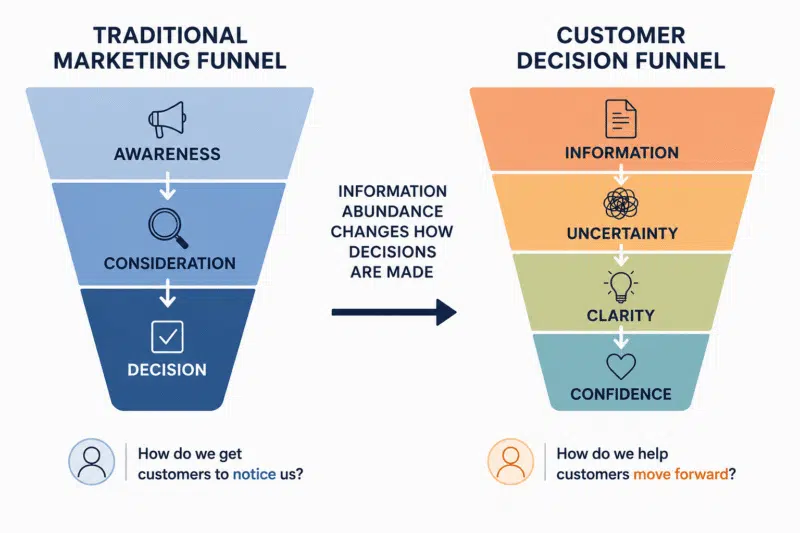
Instead, a completely different pattern emerged. Across every industry, the most impactful and sophisticated student projects converged on a singular, powerful theme: helping customers navigate uncertainty.

The consensus among these future marketing leaders was clear: modern marketing is no longer about giving customers more information. It is about giving them clarity. In an era characterized by declining public trust, information overload, and highly convoluted buying journeys, the brands that succeed will not be those that produce the most content, but those that help buyers synthesize and interpret the data already available to them.
Chronology: The Evolution of the Consumer Buying Journey
To understand why clarity has surpassed attention as marketing’s most valuable currency, it is necessary to trace the evolution of the buyer’s journey over the last three decades.
[Phase 1: The Scarcity Era] ---> [Phase 2: The Attention Economy] ---> [Phase 3: The Generative AI Boom] ---> [Phase 4: The Clarity Era]
  - Limited channels               - Explosion of digital channels      - Frictionless content creation       - Extreme information overload
  - Focus on reach & awareness     - Playbook: "Get noticed"            - Declining trust & search fatigue    - Focus: Curation & trust
Phase 1: The Scarcity Era (Pre-Internet to Early Web)
In this period, information was scarce and highly controlled by brands. Buyers relied heavily on direct sales representatives, print brochures, and trade shows to learn about products. The marketing goal was straightforward: build brand awareness and establish basic reach.
Phase 2: The Attention Economy (Web 2.0 to the late 2010s)
The explosion of digital channels, search engines, and social media platforms democratized information. Brands quickly realized that visibility was key. The prevailing marketing playbook was built around search engine optimization (SEO) content farming, social media saturation, and multi-channel nurturing. The dominant challenge was cutting through the digital noise to get noticed.

Phase 3: The Generative AI Boom (2022–Present)
The commercialization of large language models (LLMs) made content creation practically frictionless. The cost of producing text, images, and code plummeted to near zero. Consequently, digital channels became flooded with automated, often highly generic content. For buyers, the cost of searching for information decreased, but the cognitive load required to verify and trust that information skyrocketed.
Phase 4: The Clarity Era (The Emerging Future)
We are now entering an era defined by "search fatigue" and deep consumer skepticism. The linear sales funnel has collapsed. Buyers no longer move predictably from awareness to consideration to purchase. Instead, they loop continuously through stages of research, validation, and second-guessing, frequently stalling due to the sheer volume of conflicting data. The modern marketer’s role has shifted from that of a content publisher to that of a trusted curator.
Supporting Data: The Psychological and Economic Toll of Information Overload
The transition to the Clarity Era is not merely a theoretical shift; it is backed by empirical data demonstrating the severe business costs of customer confusion.
The Phenomenon of Decision Paralysis
Psychologist Barry Schwartz famously detailed "The Paradox of Choice," demonstrating that while some choice is good, too much choice paralyzes the consumer. In a business-to-business (B2B) context, this paralysis has reached critical levels.
According to research by Gartner, the average B2B buying group now consists of 6 to 10 decision-makers, each armed with four or five pieces of independently gathered information. Rather than streamlining the purchase, this abundance of data leads to internal friction. Gartner’s data reveals that:
- 77% of B2B buyers state that their latest purchase was very complex or difficult.
- Buyers who encounter helpful information that simplifies their purchase decision are 2.8 times more likely to experience a high degree of purchase ease, and 3 times more likely to buy a larger deal with less regret.
| Metric | Impact of Information Overload | Impact of Buying Simplification |
|---|---|---|
| Purchase Complexity | 77% of buyers report high difficulty | Significant reduction in friction |
| Deal Size & Customer Retention | Deals stall; high buyer’s remorse | 3x increase in high-value, low-regret purchases |
| Sales Cycle Duration | Extended indefinitely due to validation loops | Accelerated decision-making and consensus |
The Rise of the "No-Decision" Outcome
Many buying journeys do not end with a customer choosing a competitor; they end with the customer choosing nothing at all. In sales and marketing, the "No-Decision" or "Status Quo" outcome is often the largest competitor.
When buyers are presented with dozens of comparative feature charts, endless software demos, and conflicting online reviews, the perceived risk of making a wrong decision outweighs the perceived benefit of making a change. The customer delays the purchase indefinitely to mitigate risk.
The Collapse of the Search Funnel
With search engines integrating AI-generated summaries directly into search results, the traditional click-through journey is changing. Users no longer need to visit multiple websites to find basic answers. Instead, they rely on AI interfaces to synthesize information for them. This means that brands can no longer rely on vanity traffic from informational search queries; they must establish deep, authoritative trust so that they are cited as the primary source of truth by both human buyers and AI engines.

Expert Perspectives: Re-Engineering Marketing for Confidence
To successfully navigate this shift, organizations must restructure how they approach customer engagement. Brianna Miller’s observations of her UMSL Honors students provide a practical framework for how this mindset can be applied across diverse business sectors.
                  ┌─────────────────────────────┐
                  │   Traditional Marketing     │
                  │   Goal: "Get Noticed"       │
                  └──────────────┬──────────────┘
                                 │
                                 ▼
                  ┌─────────────────────────────┐
                  │    Modern Clarity-First     │
                  │  Goal: "Reduce Uncertainty" │
                  └──────────────┬──────────────┘
                                 │
         ┌───────────────────────┼───────────────────────┐
         ▼                       ▼                       ▼
┌─────────────────┐     ┌─────────────────┐     ┌─────────────────┐
│     Fintech     │     │   Healthcare    │     │      Retail     │
│   Simplifying   │     │   De-escalating │     │ Radical Product │
│   Compliance    │     │      Fear       │     │  Transparency   │
└─────────────────┘     └─────────────────┘     └─────────────────┘
Fintech: Simplifying Compliance Over Product Features
In highly regulated sectors like financial technology, marketing often degenerates into a feature war. However, Miller noted that her students tackling fintech challenges avoided the trap of listing technical specifications. Instead, they focused their strategies on helping prospective clients understand complex regulatory frameworks.
By positioning the fintech brand as an educational guide that helps buyers understand why certain compliance measures matter, the students successfully shifted the conversation from product costs to risk mitigation.
Healthcare: De-Escalating Fear and Empowering Patients
In healthcare marketing, trust is paramount. The internet has made it incredibly easy for patients to self-diagnose, often leading to heightened anxiety and misinformation.

Students working on healthcare strategies focused on creating clear, empathetic, and highly vetted pathways for patients. Their plans prioritized clear, plain-language symptom navigation tools and transparent pricing models over flashy promotional campaigns, recognizing that clarity in healthcare directly equates to consumer safety and peace of mind.
Retail and Manufacturing: Radical Transparency
For retail and manufacturing projects, the student plans addressed the rise of consumer skepticism. With greenwashing and exaggerated marketing claims at an all-time high, the students designed campaigns centered on radical transparency—such as clear ingredient sourcing, supply chain traceability, and realistic product limitations.
They treated marketing and customer experience as an inseparable loop, understanding that setting realistic expectations upfront reduces post-purchase regret and builds long-term customer lifetime value.
Implications: The New Marketing Playbook for 2026 and Beyond
As generative AI continues to scale, the volume of digital noise will only increase. For Chief Marketing Officers (CMOs) and business leaders, adapting to this reality requires a complete rewrite of the marketing playbook.

1. Shift from Content Volume to Content Depth
The era of measuring marketing success by the sheer volume of blog posts or email sends is over. Brands must prioritize high-quality, original research, proprietary data, and expert-led commentary.
Instead of using AI to generate hundreds of generic articles, successful marketing teams will use AI to analyze customer support logs, identify the exact friction points in the buying cycle, and create hyper-targeted resources that address those specific points of confusion.
2. Prioritize Trust and Brand Authority over SEO Hacks
As search engines evolve into answer engines, optimization will rely less on keywords and more on brand authority.
Brands must focus on securing genuine third-party validation, publishing original case studies, and cultivating a distinct, human voice. Trust cannot be automated; it is earned through consistent, accurate, and transparent communication.

3. Redefine Marketing KPIs
To align with the Clarity Era, marketing leaders must transition from vanity metrics to business-impact metrics:
- Old KPIs: Impressions, Page Views, Content Output Volume, Lead Quantity.
- New KPIs: Deal Velocity (how quickly a buyer moves through the funnel), Content Engagement Depth, Customer Acquisition Cost (CAC) Efficiency, and Customer Retention Rates.
Conclusion: The Ultimate Competitive Advantage
The future of marketing does not belong to the loudest voice or the fastest content generator. It belongs to the brands that act as filters for their customers—clearing away the digital clutter, de-escalating decision anxiety, and providing the path of greatest clarity.
As the next generation of marketers enters the workforce, they bring with them an intuitive understanding of this reality: in a world of infinite noise, the ultimate competitive advantage is simple, undeniable clarity.
