
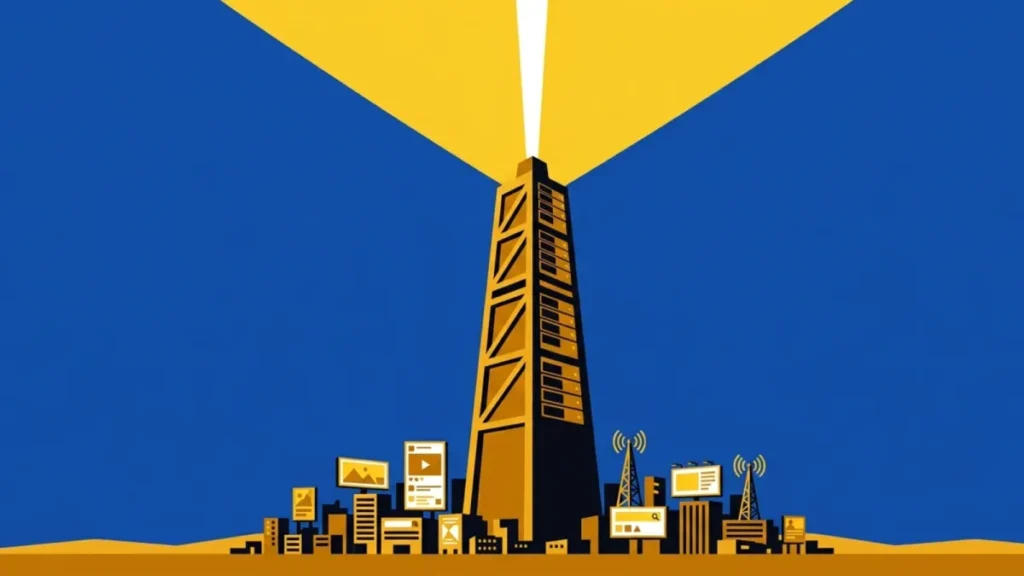
The AI Gold Rush: WPP Media’s 2026 Forecast Decodes a $1.3 Trillion Advertising Landscape
In a landscape defined by geopolitical fragmentation, supply-chain volatility, and shifting consumer sentiment, the global advertising industry is not merely surviving—it is surging. According to the midyear This Year Next Year forecast published by WPP Media on June 16, 2026, global advertising revenue is projected to hit $1.3 trillion this year. Excluding the massive influx of U.S. political spending, the sector is set for a robust 4.4% growth rate, a figure driven almost exclusively by a historic investment cycle in artificial intelligence.
Kate Scott-Dawkins, Global President of Business Intelligence at WPP Media, characterizes this shift as the 21st century’s "Gold Rush." As traditional economic headwinds—including conflict in the Middle East and energy price shocks—threaten to dampen corporate spending, the relentless race for AI supremacy among technology giants has acted as a powerful countervailing force, injecting unprecedented capital into the advertising ecosystem.
The Structural Anatomy of the 2026 Market
The WPP Media report identifies a fundamental shift in how advertising revenue is generated. The "AI Gold Rush" manifests in two distinct but reinforcing ways. First, "AI-native" companies—those developing large language models, inference infrastructure, and complex agent frameworks—are spending aggressively on advertising to capture developers, enterprise buyers, and early-adopter consumers.
Simultaneously, traditional advertisers are pivoting to integrate AI into their operational workflows. By leveraging AI to compress production costs and automate campaign activation, these legacy players are widening the scale at which they can reach audiences, effectively doing more with less. This phenomenon is most concentrated in the United States, where ad revenue growth is expected to hit a staggering 11.9%—nearly triple the global average—highlighting the U.S. market’s role as the epicenter of AI infrastructure investment.
The Three Pillars of Modern Market Dynamics
WPP Media structures its 2026 outlook around three core thematic drivers:
- Political and Regulatory Control: The regulatory landscape is shifting from ideological debates to structural questions of control. As governments worldwide implement age-verification laws and scrutinize AI supply chains, the influence of these measures on social media platforms is profound. The ability of a platform to maintain its user base under these new constraints has become a primary variable in its long-term viability.
- Economic Paradoxes: The 2026 economy is a study in contradictions. The closure of the Strait of Hormuz has created energy and supply-chain shocks, while tariff volatility continues to reshape manufacturing. Yet, these pressures are offset by the AI investment cycle. While consumer spending faces downward pressure in some sectors, corporate technology budgets are inflating, creating a bifurcated market that rewards those capable of navigating high-tech efficiency.
- Social and Cultural Shifts: We are entering an era of "paradoxical connection." Despite the ubiquity of digital communication, IRL (in real life) isolation persists. The "AI-native" generation, which expects instant, personalized, and free information, is beginning to rely on trusted AI agents as intermediaries for products and services, fundamentally changing the consumer journey.
Chronology: A Path to $1.3 Trillion
The current forecast is the latest milestone in a rapidly evolving series of projections.
- June 2025: WPP Media publishes its initial midyear forecast, setting the baseline for the industry’s recovery from post-pandemic cooling.
- December 2025: The year-end forecast projects global ad spending to reach $1.14 trillion. Notably, it marks the first time commerce-related advertising surpasses television, a shift largely fueled by the early integration of AI-powered platforms.
- May 2026: Market analysts observe a structural bifurcation in the advertising market. Analysts like Ian Whittaker highlight that traditional agency-mediated ad markets are being outpaced by self-serve, SMB-driven ecosystems.
- June 16, 2026: WPP Media releases the current midyear This Year Next Year report, raising the ceiling for global advertising to $1.3 trillion and formalizing the "AI-driven growth" thesis.
Supporting Data: Search, Social, and the Rise of Generative Interfaces
The channel-by-channel breakdown provided by WPP Media suggests that the industry is undergoing a period of intense migration.
The Split in Search
Traditional and generative search combined will account for 21.8% of total global ad revenue in 2026. However, this figure masks a massive internal migration. Generative search is on a growth trajectory that potentially makes it the fastest channel in history to hit the $100 billion mark. The report’s comparison charts demonstrate that generative search is gaining market share faster than social media or retail media did at comparable stages of their evolution.
The Social Plateau
Social media remains the largest single channel for content-driven advertising. However, WPP Media forecasts a deceleration in growth to single digits starting in 2027. This slowdown is attributed to three converging pressures: a plateau in total time spent on social feeds, the impact of global age-verification mandates, and the emergence of AI chatbots as "destination" platforms that compete for user attention.
Commerce as the Foundation
Retail media has cemented its position as the bedrock of the advertising industry. WPP Media asserts that messages directed at humans may soon prove insufficient as non-human systems—AI agents—begin making commercially relevant decisions. This is leading to a "new topology" of ad traffic, where campaigns are increasingly trafficked through agentic systems rather than traditional programmatic channels.
Official Responses and Analytical Nuance
The WPP Media forecast is not without its skeptics or its counterparts. Analysts at eMarketer provide a more measured view, particularly regarding the "chatbot" segment.
While WPP Media points toward a future of $100 billion in generative search, eMarketer’s June 2026 data indicates that the vast majority of "AI advertising" will be "AI-adjacent." Their data suggests that more than 80% of AI-related ad spend will flow through traditional search ads appearing next to AI-generated summaries (like Google AI Overviews) rather than through advertisements inside standalone chatbot interfaces.
eMarketer principal analyst Nate Elliott has been vocal about the limitations of the "chatbot bubble." He notes that standalone platforms like ChatGPT are unlikely to generate the astronomical revenue figures projected by some investment firms. The structural constraint is simple: chatbots lack the ad density of search engines. Consequently, while AI usage will continue to skyrocket, the revenue will primarily accrue to companies that can successfully bridge the gap between traditional search infrastructure and new generative surfaces.
Implications for the Marketing Practitioner
For the modern advertiser, the implications of these findings are profound. The transition to an AI-mediated world demands a rethink of brand salience.
Building Brand Trust in an AI World
WPP Media argues that in a world where an AI agent might make a purchase decision on behalf of a consumer, brand recognition will not be built in two-second social media clips or fleeting chatbot interactions. Instead, it will be built in environments that command deep engagement and earn long-term trust: streaming TV, live sports, premium publishing, and out-of-home (OOH) media.
The inclusion of "physical robots" and "connected vehicles" as emerging content surfaces in the WPP forecast signals that the industry is preparing for a future where brands must establish presence in the physical world through digital interfaces.
Strategic Budget Allocation
The current market is characterized by uneven growth. The gap between WPP Media’s 4.4% global growth projection and WARC’s 8.9% estimate highlights the difficulty in accounting for AI’s dual role as both an advertising medium and a technological infrastructure.
For practitioners, the takeaway is clear:
- Do not mistake "AI-adjacent" for "chatbot advertising." The growth is in the infrastructure of search, not necessarily the conversational interface.
- Diversify away from reliance on social-only strategies. As growth in social channels plateaus due to regulation and user fatigue, reinvestment in high-trust, high-engagement environments (like CTV and premium content) is essential.
- Prepare for agentic commerce. The future of the ad stack is being rewritten by the likes of Walmart Connect, Mediaocean, and Magnite. Media planners must begin treating AI agents as legitimate "customers" in the consumer journey.
Conclusion: The New Era of Media Planning
As 2026 progresses, the advertising industry finds itself at a crossroads. The $1.3 trillion valuation is a testament to the resilience of the sector, but the composition of that value is changing irrevocably. The "AI Gold Rush" is not merely about new ad formats; it is about a fundamental redistribution of power from content-driven environments to intelligence-driven platforms.
The challenge for the remainder of the year and into 2027 will be for advertisers to navigate this structural bifurcation. Those who continue to rely on legacy measurement tools to map an increasingly AI-mediated landscape risk falling behind. Success will depend on the ability to federate data, orchestrate across complex systems, and, ultimately, maintain brand salience in a world where the consumer’s final decision may be made by an algorithm.
In this new, AI-centric market, the most valuable currency remains what it has always been: trust. Whether that trust is brokered by a human or an AI agent, the environments that can foster it will command the lion’s share of the next $1.3 trillion.
