
The AI Decision Matrix: How Generative Intelligence is Rewriting the Consumer Journey
Market dynamics have entered a new epoch. For decades, the marketing playbook was built on a linear understanding of the consumer funnel: Awareness, Interest, Desire, and Action. Brands focused on capturing eyeballs, assuming that if the message reached the right demographic, the conversion would naturally follow.
However, in 2026, that traditional model is no longer merely aging—it is being fundamentally dismantled. The rise of Artificial Intelligence hasn’t just reshaped how consumers discover products; it has fundamentally altered the psychological architecture of how they decide to purchase. As over 60% of consumers now utilize AI-driven tools for product research, brands are finding that their message is often interpreted, summarized, and filtered by algorithms long before it reaches the end user.
The New Reality: The "AI-Mediated" Consumer
The most significant shift in modern commerce is the introduction of the "AI layer." Whether through ChatGPT-integrated search, AI-powered social media recommendation engines, or personal shopping assistants, the consumer decision-making process has become an outsourced task.
Brands are no longer just competing against other companies; they are competing against the efficiency of AI. If your brand does not appear in the AI-generated summaries, the curated comparison lists, or the predictive recommendation engines, you effectively cease to exist for a massive segment of the population. This isn’t just about SEO anymore; it is about "Answer Engine Optimization" (AEO) and ensuring your brand values are correctly encoded into the latent space of the AI tools that consumers trust as their primary advisors.
Chronology of the Shift: From Search to Synthesis
The transition from human-led research to machine-assisted synthesis did not happen overnight. Its trajectory has been defined by three distinct phases:
- The Era of Information Overload (2015–2020): Consumers were overwhelmed by choice. Search engines provided millions of results, forcing users to manually vet sources, read reviews, and build their own mental spreadsheets of pros and cons.
- The Rise of Algorithmic Curation (2020–2023): Social commerce and "discovery" algorithms on platforms like TikTok and Instagram began to do the heavy lifting. Consumers stopped searching for answers and started waiting for the content to find them.
- The Age of Synthetic Decision-Making (2024–Present): The current era, where LLMs (Large Language Models) serve as the interface for consumption. Users now input a query—such as "best budget-friendly running shoes for flat feet"—and receive a finalized, synthesized recommendation. The "decision" is often made by the machine, with the user merely acting as the final rubber stamp.
Generational Divides in AI Trust and Usage
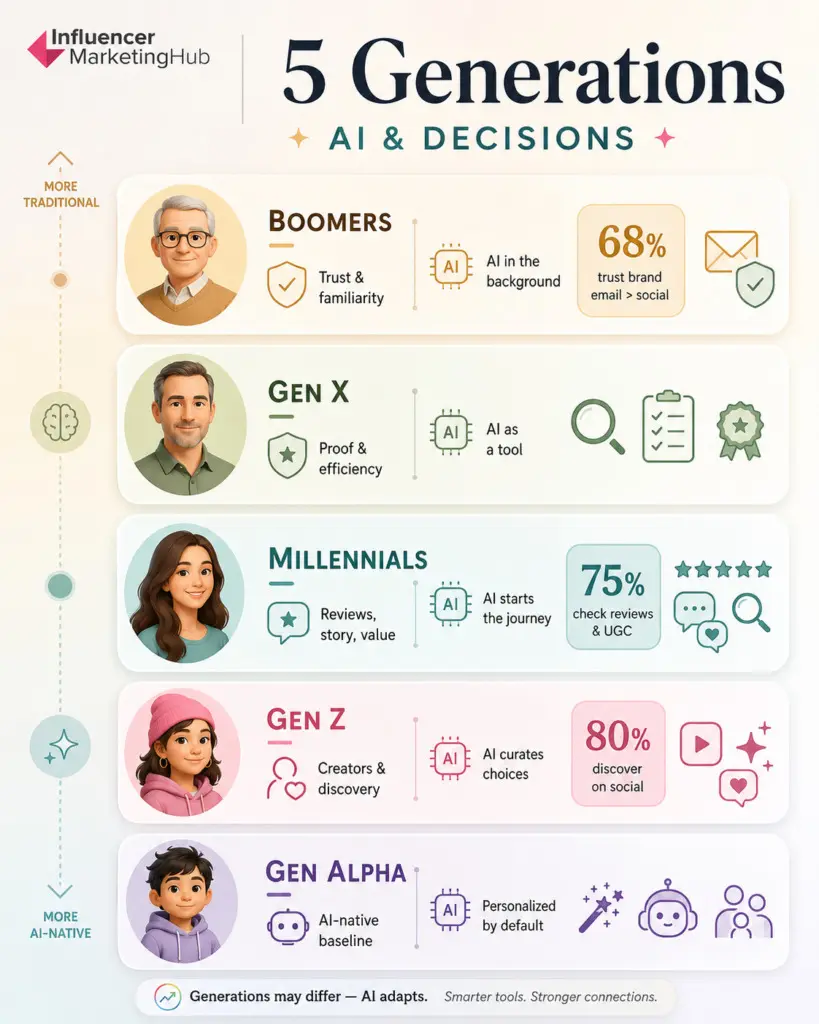
While the technology is universal, the relationship with it is not. Each generation interacts with AI-assisted decision-making through a different cultural lens.
Gen Z: The Social-First Searchers
For Gen Z, the concept of a traditional search engine is increasingly obsolete. Data suggests that 40% of this cohort prefers using TikTok and Instagram as their primary search engines. For them, AI is not a tool to be consulted in isolation; it is a feature embedded in the social fabric. They trust peer-verified, AI-summarized content over corporate landing pages.
Millennials: The Efficiency Seekers
Millennials, the "bridge" generation, view AI as a productivity hack. They are the primary users of AI for comparison shopping and administrative tasks. They are more likely to use AI to aggregate data, create comparison tables, and handle the "boring" parts of the research process, allowing them to make faster, more data-backed decisions.
Gen X and Boomers: The Verification Layer
For older generations, AI is treated with a healthy dose of skepticism. However, once they have crossed the threshold of adoption, they use AI as a digital concierge. They are less concerned with the "discovery" aspect and more focused on "verification"—using AI to check specs, read summarized reviews, and ensure they are not being scammed or overcharged.
Supporting Data: The Fragmentation of the Funnel
The marketing funnel is no longer a smooth, downward slope. It is a fragmented, multi-screen, multi-platform ecosystem.
- The Second-Screen Reality: Recent studies indicate that 87% of consumers utilize a second screen while watching television. This means that while a brand might capture attention through a high-production CTV (Connected TV) ad, the actual conversion research happens on a mobile device, often via an AI-powered browser extension or a social search bar.
- The Power of Experience: Despite the digital shift, 70% of consumers report that in-person experiences significantly increase purchase intent. The goal for modern brands is to use AI to identify when to drive a consumer from their digital research to a physical or experiential retail environment.
- The Personalization Mandate: 75% of consumers are more likely to purchase from brands that offer personalized experiences. AI is the only tool capable of scaling this personalization, shifting the paradigm from "discounting to everyone" to "offering value to the right person at the right moment."
Implications for Modern Brands
The implications for CMOs and brand strategists are clear: you must build a strategy that accounts for the "invisible" decision-maker.
1. Optimize for the "Answer"
Traditional SEO focused on keywords. The new frontier is focusing on "answer authority." If an AI assistant asks for the best product in your category, why should it choose you? Your content must be structured to be easily parsed, summarized, and recommended by AI. This means investing in high-quality, data-rich, and context-heavy content that serves as the "source material" for AI summaries.
2. Embrace Fragmented Discovery
Stop trying to force the user onto your website. If your audience is on TikTok, be the best brand on TikTok. If they are on Reddit, be the most helpful brand on Reddit. The brand that wins in 2026 is the one that shows up consistently and accurately across every platform, ensuring that no matter which AI tool a user consults, the recommendation remains consistent.
3. The New Personalization
Generic marketing is dead. AI allows for hyper-segmentation that was impossible just a few years ago. By leveraging first-party data and feeding it into AI models, brands can create personalized offers that feel bespoke. The key is to ensure that this personalization doesn’t feel invasive, but rather helpful—a digital assistant acting in the user’s best interest.
Conclusion: The Path to Precision
The core challenge for brands today is not "what is our message?" but rather "how does our audience decide?"
Conversion in 2026 is an exercise in precision. You must understand the specific AI layer that influences your customer. Are they asking an AI-powered search engine? Are they relying on social media recommendations? Are they using a voice-activated smart home device to check pricing?
The brands that will thrive are those that stop viewing AI as a competitor or a threat and start viewing it as a critical part of the customer journey. By positioning your brand as the logical, high-quality, and trustworthy answer to the questions being asked of AI, you can capture the attention of the modern, distracted, and tech-empowered consumer.
The future of marketing is not about being louder; it is about being more relevant, more helpful, and more present within the machine-learning loops that guide the modern world. Precision is the new scale. It is time to audit your presence, not just in the search results of yesterday, but in the intelligent summaries of tomorrow.
