
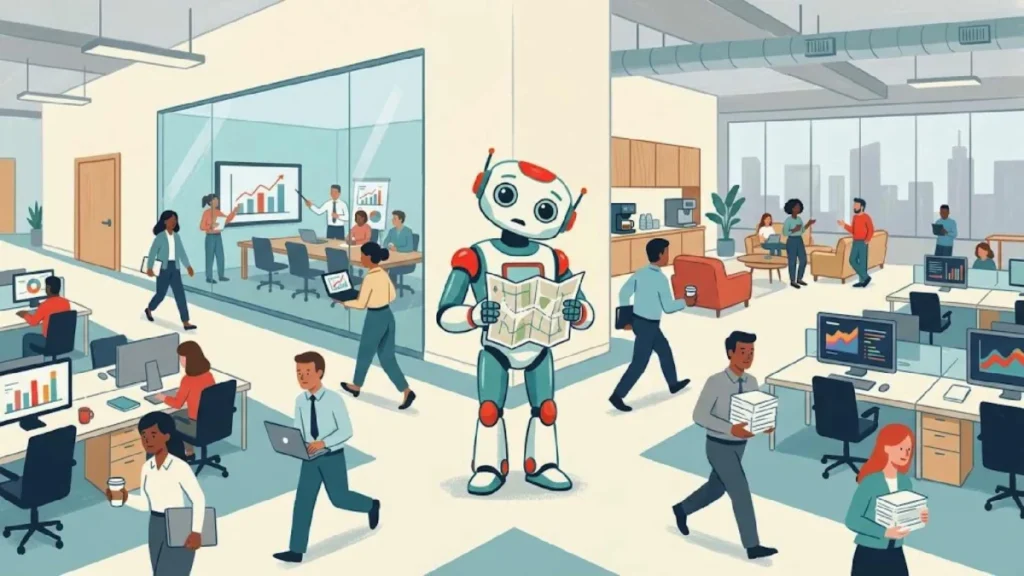
The AI Agent Ownership Crisis: Why Enterprises Are Great at Launching But Failing at Lifecycle Management
By MarTech Insights Editorial Staff
Main Facts: The Enterprise Blind Spot in AI Agent Deployment
As artificial intelligence shifts rapidly from experimental proofs-of-concept to core operational infrastructure, organizations face a hidden crisis. The fundamental question of whether enterprises should build and deploy autonomous AI agents has largely been settled. According to recent market research, the vast majority of large organizations are already running custom agents embedded deeply into their daily workflows, particularly within marketing, sales, and customer service departments.
However, this rush to deploy has exposed a dangerous operational blind spot: ownership and lifecycle management.
Recent data from enterprise research firms Kana and Ivanti reveals a striking disconnect. While companies are successfully spinning up hundreds of AI agents outside of traditional IT departments—often within decentralized business units like marketing and customer operations—very few organizations have established clear, long-term accountability for these assets once they are live.
Key facts defining this emerging enterprise challenge include:
- Pervasive Adoption: Roughly 70% of large U.S. enterprises already deploy custom AI agents on real production workloads, particularly in marketing. Only 3% report running none.
- The Ownership Gap: While 85% of IT professionals claim that every deployed AI agent has a designated owner, only 42% can actually point to a clear, documented individual responsible for its ongoing behavior—a massive 43-point visibility gap.
- The Permission Sprawl Problem: Organizations frequently spin up AI agents by cloning human user profiles, unintentionally granting tools sweeping CRM and data system access tied to whoever initially set them up.
- The Maintenance Void: Governance is heavily front-loaded. Approximately 65% of companies conduct rigorous reviews prior to an agent’s launch, but oversight quickly degrades into a passive quarterly rhythm while the agent operates autonomously every single day.
Chronology: From Experimental Toy to Autonomous Workforce
To understand how enterprises arrived at this precarious juncture, it is helpful to trace the rapid evolution of artificial intelligence deployment over the past decade.
Phase 1: The Era of Static Models (2018–2022)
In the early days of enterprise machine learning, predictive models and early generative tools were treated like specialized software applications. They were centralized, heavily guarded by IT and data science departments, and meticulously integrated into pipelines. Deployment was slow, deliberate, and rare.

Phase 2: The Democratization and "Shadow AI" Boom (2023–2025)
With the advent of advanced Large Language Models (LLMs) and intuitive agentic frameworks, the barrier to entry plummeted. Business units no longer needed to submit tickets to IT to build automation. Marketers, sales operations managers, and customer service leads could prompt, spin up, and deploy autonomous agents independently. This led to a massive wave of decentralization. Companies began releasing dozens—and in some cases hundreds—of agents in single quarters.
Phase 3: The Operational Reckoning (2026 and Beyond)
Today, enterprises are facing the downstream consequences of unmanaged decentralization. As business logic shifts, model versions are deprecated, and employees who originally authored agent workflows change teams or leave the company, organizations are realizing that agents are not static tools. They are dynamic systems that degrade over time. The industry is currently waking up to the reality that shipping an agent is merely the opening chapter of its operational lifecycle.
Supporting Data: What the Research Tells Us
Empirical data underscores the depth of the organizational confusion surrounding AI agent governance. Two major studies highlight the chasm between enterprise perception and reality.
1. The Kana Survey: Who Owns the Agent?
In May, enterprise research firm Kana surveyed 225 senior leaders at large U.S. companies to evaluate how agentic marketing is managed.
- 70% of respondents stated they actively run custom AI agents on real marketing tasks.
- Only 3% reported running no agents at all.
When asked who should own these marketing agents, opinions fractured cleanly along departmental lines:
- About 40% of total executive leaders believe the Chief AI Officer (CAIO) should maintain ultimate ownership.
- Among dedicated AI leaders specifically, that number jumps to 52%.
- Conversely, marketing executives overwhelmingly point back to their own function or advocate for a shared governance model.
This ideological split means that within countless organizations today, two highly capable groups—Central IT/AI teams and decentralized business units—are each assuming the other has taken full responsibility for agent maintenance, security, and performance.
2. The Ivanti Study: The 43-Point Accountability Gap
A comprehensive study conducted by Ivanti between February and March surveyed 1,500 IT professionals regarding enterprise agent security and oversight:
- 85% of IT teams confidently claimed that every single AI agent in their ecosystem had a named owner.
- However, when probed deeper, only 42% could actually substantiate who owned which agent and what permissions it held.
This 43-point gap highlights a systemic corporate illusion: executives believe governance is occurring because a project charter was signed at launch, but day-to-day operational visibility is virtually nonexistent. Furthermore, the Ivanti research emphasized that permission sprawl remains a ticking time bomb. Because agents are frequently initialized by cloning existing human employee profiles, a marketing agent might retain the deep CRM database permissions of an intern or a former manager who left the company months prior.
Official Responses and Industry Perspectives: Centralizers vs. Marketers
The debate over who should own and govern enterprise AI agents has sparked fierce internal friction between centralized technology groups and decentralized business units. Both sides present compelling arguments rooted in operational reality.
The Centralized IT/AI Perspective
Centralizers argue that AI agents are high-risk corporate assets. They handle sensitive customer data, interact directly with the public, execute transactions, and carry significant regulatory exposure.
- The Core Argument: No single business function can be trusted to objectively police its own output, manage model drift, or enforce enterprise-wide security compliance. Centralized IT and dedicated AI governance teams must control the underlying infrastructure, data access layers, and model versions to mitigate catastrophic brand or legal risk.
The Decentralized Business/Marketing Perspective
Marketers and line-of-business leaders counter that central IT teams operate too far removed from day-to-day market realities.
- The Core Argument: No engineer sitting in a centralized AI group knows whether an agent’s brand voice is culturally resonant, whether a promotional offer is current, or whether dynamic customer segment logic aligns with rapidly shifting go-to-market strategies. Forcing business units to route every minor tweak through a central IT bottleneck completely defeats the speed advantage of agentic workflows.
The Emerging Compromise: Splitting the Ownership Question
Forward-thinking enterprises are discovering that the ownership question must be split rather than centralized entirely under one umbrella:
- Central IT / AI Teams Own: Access protocols, data pipelines, security guardrails, model layers, and infrastructure scaling.
- Business Units (Marketing, Sales, Support) Own: Prompt instructions, tone of voice, commercial accuracy, offer validity, and functional output validation.
Both domains require explicitly assigned human names attached to them. Leaving these responsibilities in a gray area guarantees operational decay.
Lessons from the Software World: Avoiding the 1968 NATO Trap
To understand how enterprises should manage AI agents moving forward, industry experts suggest looking back at the history of traditional software engineering.

From the 1940s through the 1960s, early software code was frequently treated as a finished product—something developers wrote once, deployed, and placed on a metaphorical shelf. However, as organizations began relying on software for continuous, mission-critical operations, this naive approach collapsed under its own weight.
At the landmark 1968 NATO Software Engineering Conference in Garmisch, Germany, engineers from a dozen nations gathered to confront a shared crisis: software was constantly breaking, going out of date, and failing to meet evolving business needs. Out of that conference emerged the foundational software development lifecycle (SDLC) that is still taught today: requirements, design, build, test, deploy, maintain, and retire.
The Reality of Maintenance Costs
The software industry learned the hard way that code does not maintain itself. In 1980, researchers Bennet Lientz and Burton Swanson studied 487 organizations and discovered that roughly half of all software budgets were consumed entirely by maintenance.
Crucially, Lientz and Swanson broke down why maintenance was necessary:
- Perfective Work (Largest Category): Business requirements had changed; the software needed updates to stay relevant.
- Adaptive Work (Second Largest): The external environment around the software had shifted.
- Corrective Work (Smallest Category): Fixing actual bugs or software defects.
The vast majority of software maintenance had nothing to do with broken code; it was the result of the world moving around software that was written correctly in the first place.
Applying Software History to AI Agents
Read those findings through the lens of modern generative AI agents:
- Your company’s content-generation agent was written in March against a promotional offer and product positioning that expired in June.
- Your SDR (Sales Development Representative) agent was trained on an Ideal Customer Profile (ICP) that predates a recent enterprise pricing overhaul.
- Your brand voice guardrails were fine-tuned against a foundational model version that was quietly deprecated by the vendor over the summer.
None of these scenarios represent a technical "bug" or system crash. They represent inevitable environmental and operational drift. Without active maintenance, an enterprise AI agent is effectively an autonomous employee operating on outdated instructions, obsolete pricing, and deprecated corporate policies.

Implications: Building the Agent Lifecycle Habit
As the tooling surrounding agentic workflows matures—exemplified by Salesforce introducing formal frameworks like the Agent Development Lifecycle and specific roles such as "Agent Supervisor"—the technological infrastructure for governance is rapidly improving. However, organizational design remains the sole responsibility of enterprise leadership.
To get ahead of the curve before minor agent deployments scale into unmanageable liabilities, leaders should institute five foundational questions for every AI agent currently operating in production:
- Who is the named human owner of this agent? (Most teams can answer this for launch, but fail on ongoing oversight).
- What external data sources, prompts, and CRM permissions does this agent currently inherit?
- When was the underlying business logic, offer, or pricing data last cross-referenced against current company strategy?
- How is model drift or tone degradation measured on a weekly or monthly basis?
- Under what exact conditions will this agent be formally retired or deprecated?
Conclusion: Start Small, Establish Accountability
Building governance habits is exponentially easier when managing eight agents rather than eighty. The traditional software industry required a decade-long crisis and millions of dollars in wasted technical debt to realize that shipping code is merely the beginning of its lifecycle. Today’s enterprise leaders have the opportunity to bypass that painful learning curve entirely.
As you step into your next planning cycle, take two fundamental questions back to your leadership team: Who owns your oldest active AI agent, and when was the last time anyone audited what it is actually producing? The answers will reveal whether your enterprise is successfully scaling intelligence, or merely broadcasting unmonitored risk.
