
The Accelerated Reality: Mapping Generative AI’s Multi-Layered Hype Cycle in Martech
In the fast-evolving landscape of marketing technology, few frameworks are as polarizing or as essential as the Gartner Hype Cycle. It is a tool simultaneously revered for its predictive intuition and reviled for its oversimplification. Yet, as generative AI (GenAI) continues to reshape the marketing stack, the traditional model of a singular, linear progression—from innovation trigger to plateau of productivity—is proving insufficient.
To understand the current state of AI in marketing, we must accept a new reality: "GenAI" is not a monolithic entity moving in lockstep. It is a sprawling ecosystem of applications, each navigating its own unique, high-speed lifecycle.
The Multi-Generational Nature of AI Evolution
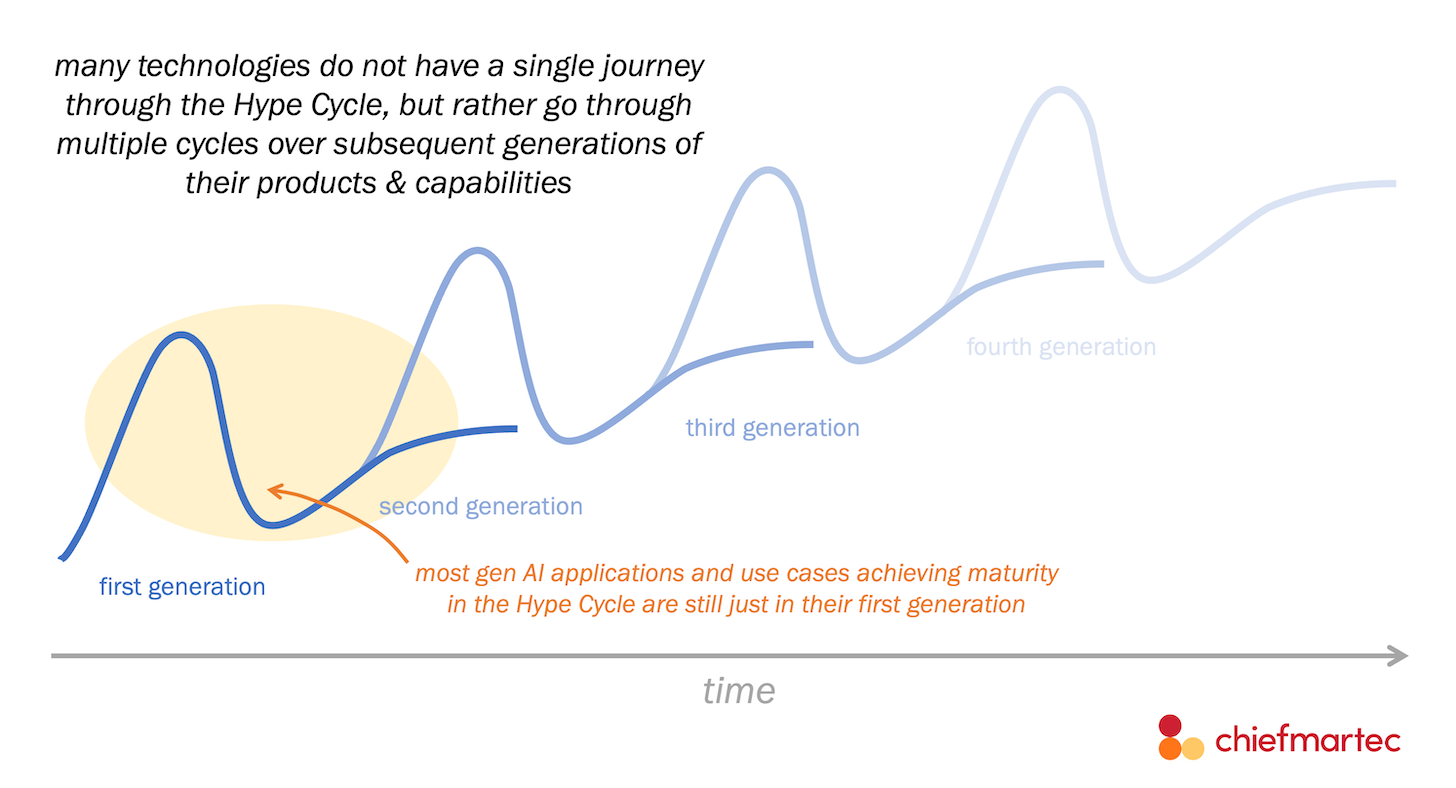
The first step in grasping the current state of marketing technology is to abandon the idea that we are witnessing a single "AI movement." Instead, we are observing a series of overlapping waves. A specific application, such as a customer service chatbot, may be firmly settled on the "Plateau of Productivity," delivering reliable, if modest, value. Simultaneously, the next, more autonomous iteration of that same technology—one capable of complex cross-selling or proactive problem-solving—is currently skyrocketing toward the "Peak of Inflated Expectations."
This phenomenon requires a shift in perspective. As F. Scott Fitzgerald once noted, the mark of a first-rate intelligence is the ability to hold two opposing ideas in the mind at the same time. In 2025, marketers must hold the concept of "productive utility" and "inflated hype" in the same mental space. We are not experiencing one Hype Cycle; we are witnessing a constant, recursive loop of generations, where the maturation of one tool triggers the birth of a new, even more ambitious cycle of expectation.
The Unprecedented Velocity of Adoption
The speed at which these technologies move is, quite frankly, jarring. Historical technological shifts—like the transition from desktop to mobile or the rise of social media—often played out over a decade. Today, the journey from initial trigger to widespread adoption is collapsing into a window of mere months. Before the industry has truly digested the nuances of one iteration, the subsequent generation is already demanding attention.
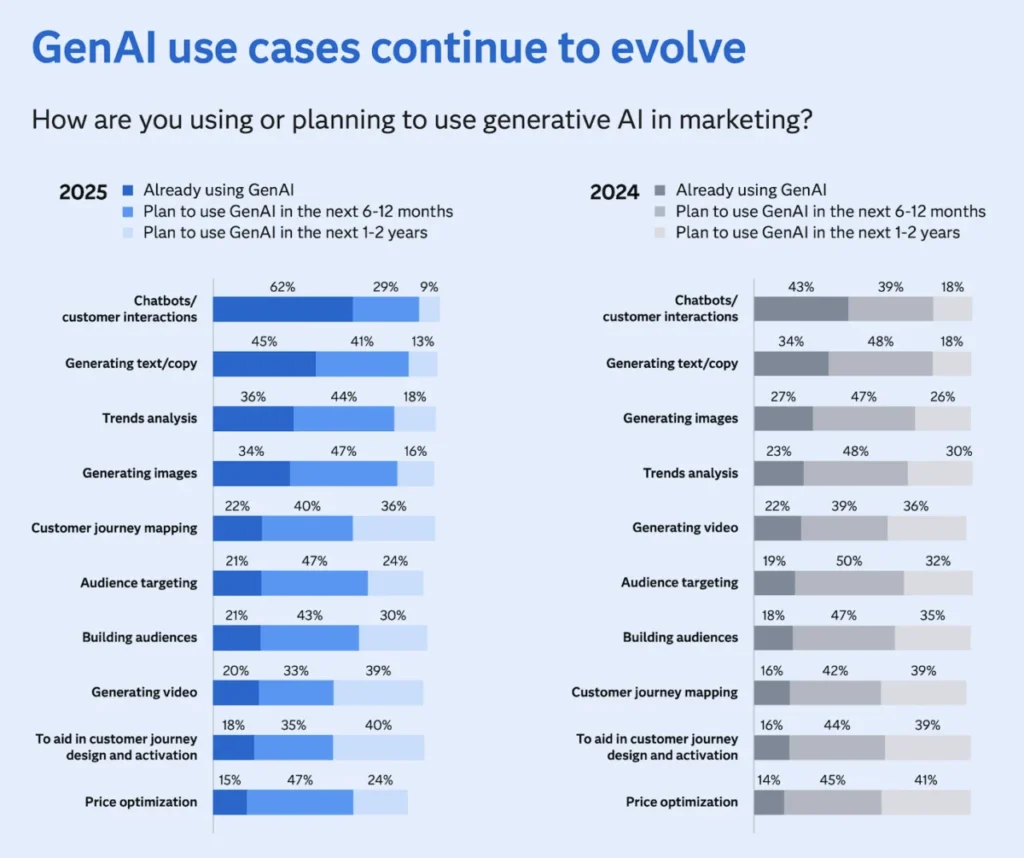
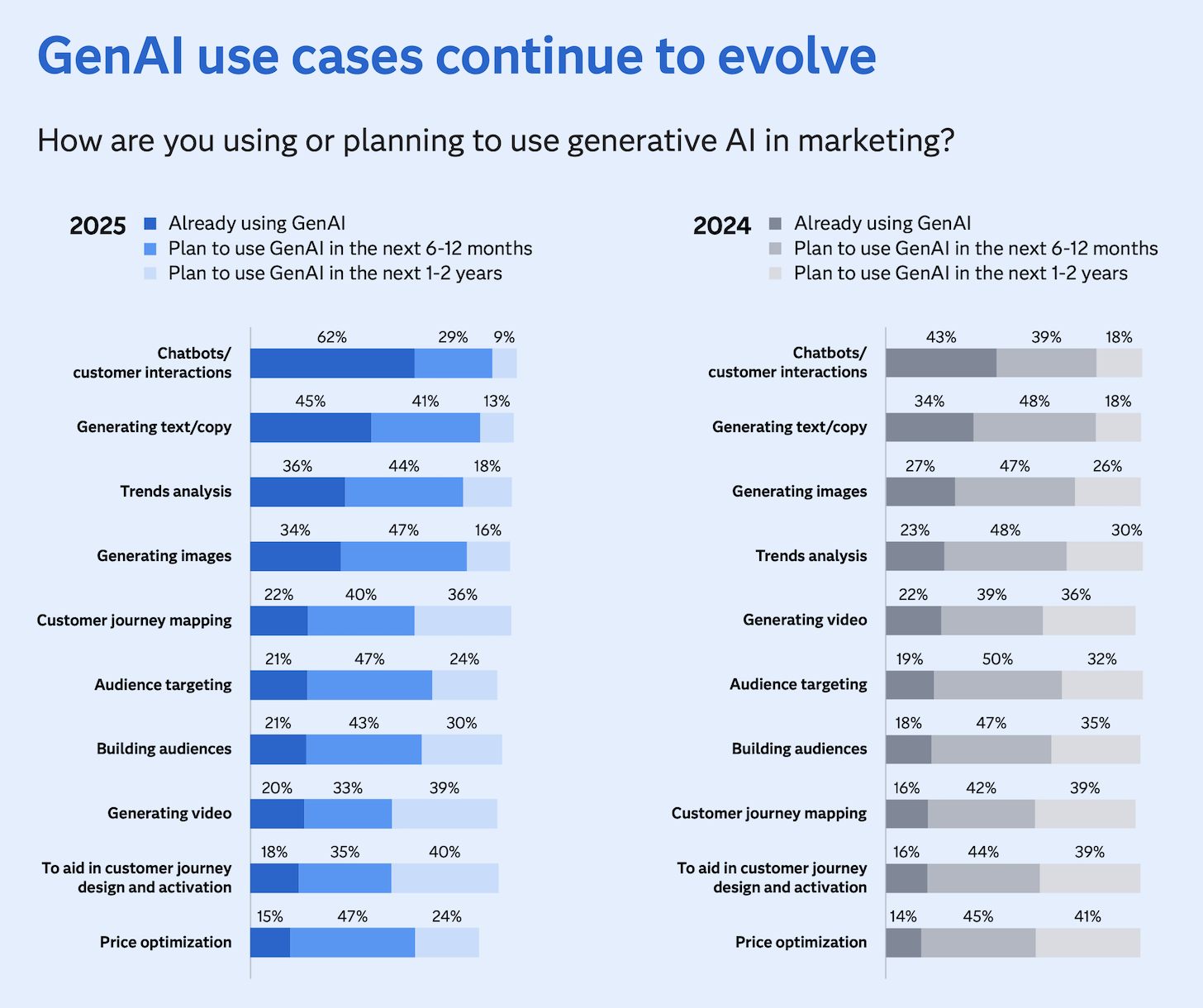
A recent report by SAS, titled Marketers and AI: Navigating New Depths, provides the empirical backbone to this anecdotal acceleration. By surveying 300 professionals in 2024 and 2025, the report sheds light on the shifting priorities and adoption rates across ten distinct AI use cases.
Supporting Data: The Shift in Marketing Priorities
The data reveals a dramatic, 12-month acceleration in how marketers are utilizing these tools. The most significant growth has been observed in:
- Content Creation: Moving beyond simple text to sophisticated, brand-aligned multimedia generation.
- Customer Insights & Personalization: Leveraging real-time data to create hyper-targeted experiences.
- Workflow Automation: Reducing the friction between data silos and creative output.
These three areas currently represent the highest levels of adoption. They have successfully transitioned from experimental "toys" into integral components of the modern marketing stack, signaling their arrival at the Plateau of Productivity. However, the data also highlights a surprising trend: certain use cases that were heavily promoted a year ago have seen a reduction in adoption, indicating they have slipped into the "Trough of Disillusionment." This retreat is not a failure of the technology, but rather a necessary correction as marketers realize that first-generation tools were insufficient for complex, enterprise-level demands.
Mapping the Hype: A Practitioner’s Perspective
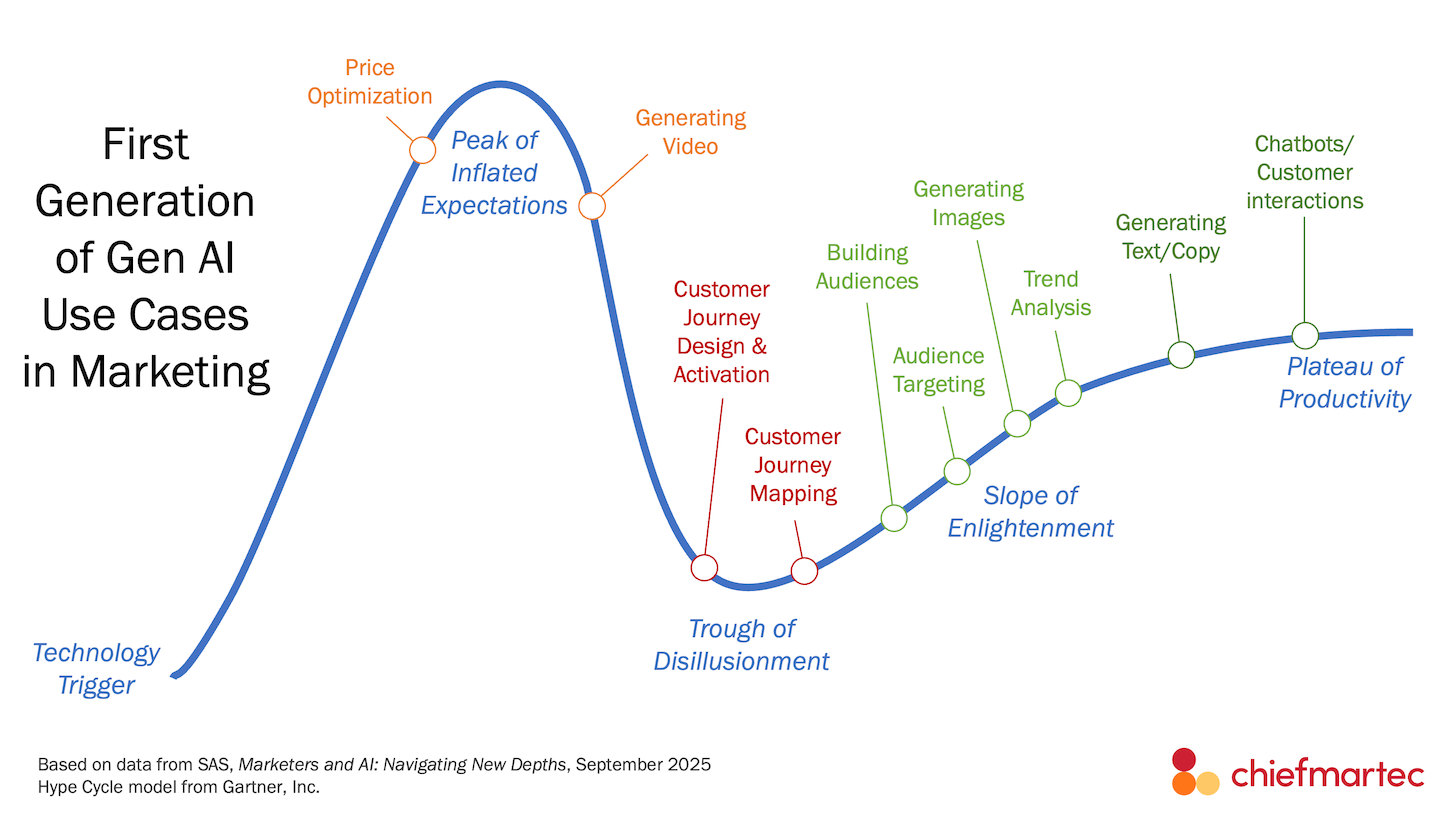
Based on the SAS data and ongoing observations from the martech community, it is possible to map these use cases onto a synthesized Hype Cycle. While Gartner is the architect of the model, the application here is an approximation based on current industry realities.
The Stages of Maturity
- Innovation Trigger: Nascent technologies, such as advanced autonomous agentic workflows, are currently here. They are defined by intense curiosity and significant VC investment.
- Peak of Inflated Expectations: This is the domain of "next-gen" generative search and predictive behavioral modeling. The promise is vast, but the reality is currently marred by technical constraints and integration hurdles.
- Trough of Disillusionment: Here, we find the first generation of generic AI-powered SEO tools and basic chatbots. Having failed to live up to the massive promises made during their initial launch, these tools are being scrutinized and often deprioritized.
- Slope of Enlightenment: Mid-tier content optimization tools that have begun to show consistent, measurable ROI are currently climbing this slope.
- Plateau of Productivity: The established heavy hitters—AI-driven email personalization and basic data analytics—have arrived here. They are no longer "AI projects"; they are simply the tools of the trade.
Implications for CMOs and Marketing Teams
The primary implication of this rapid cycling is the need for "agile architecture." Marketing leaders can no longer build long-term infrastructure around a single AI tool, as that tool may become obsolete within two years. Instead, the focus must be on modular, vendor-agnostic systems that allow for the "swapping" of AI capabilities as better, more efficient versions emerge.
Furthermore, the "Trough of Disillusionment" for certain use cases should not be viewed as a signal to abandon ship. Rather, it is a period of consolidation. It is the moment when "AI-washing" is stripped away, and the actual utility of the tool is refined for real-world application. Organizations that pull back during this phase often miss the opportunity to shape the next generation of the product into something that actually serves their needs.
The Future: Beyond Generative AI
The SAS report does not stop at the current horizon. It offers a glimpse into the next wave of disruption, including the early considerations of quantum computing in marketing. For many, the idea of quantum-driven marketing feels like science fiction. Yet, given the pace of the last three years, it is entirely possible that we will see these concepts entering the "Innovation Trigger" phase of the Hype Cycle before the decade is out.
The exhaustion felt by many marketers is a natural response to this unrelenting pace. However, it is also an exhilarating time to be in the industry. We are witnessing the maturation of intelligence at a scale never before imagined.
Conclusion: Embracing the Roller Coaster
The Hype Cycle is not a destination; it is a map for navigating the chaos. By acknowledging that we are living through multiple, overlapping generations of AI, marketers can move from a reactive state—chasing the newest, shiniest tool—to a proactive state of strategic evolution.
We must become comfortable with the idea that the "Plateau of Productivity" for today’s tools is merely the starting line for tomorrow’s breakthroughs. The challenge is not to keep up with every cycle, but to identify which cycles are worth riding and which are merely empty noise. In the end, the most successful marketers will be those who view these cycles not as a source of anxiety, but as the rhythmic heartbeat of progress in the digital age.
As we look toward the remainder of the year and into 2026, the mandate is clear: keep experimenting, remain skeptical of the peak, but stay deeply engaged with the technology that is fundamentally rewriting the rules of human-to-brand communication. The ride is fast, the terrain is shifting, but for those who can navigate the cycle, the rewards for the next generation of marketing will be profound.
