
The 2026 B2B Marketing Frontier: Navigating the Era of Agentic AI and Structural Disruption
As we move deeper into 2026, the B2B marketing landscape is undergoing a transformation that arguably rivals the advent of the internet. Industry veteran Jon Miller, co-founder of Marketo and a foundational figure in Account-Based Marketing (ABM), has released his annual outlook, painting a picture of a sector shifting from static automation to a dynamic, "agentic" future.
For marketing leaders, 2026 is no longer about simply adopting new tools; it is about navigating a fundamental redesign of how companies connect with buyers—both human and synthetic.
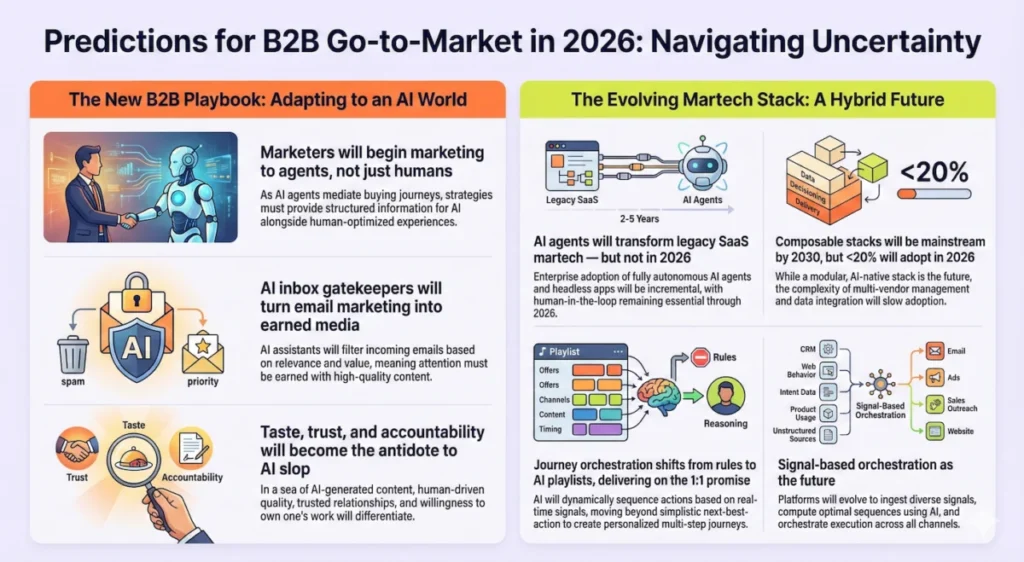
The Core Shift: Marketing to Agents, Not Just Humans
The most significant development in 2026 is the emergence of the "AI-mediated buying journey." B2B buyers are increasingly offloading research, vendor evaluation, and initial filtering to AI agents.
The Rise of Agentic Intent
The traditional B2B funnel is being superseded by a model where AI agents interact with brand content, pricing APIs, and product documentation before a human ever makes contact. This necessitates a shift in strategy:
- AEO (Answer Engine Optimization): Following the surge in AI-mediated research in 2025, marketers are shifting focus from traditional SEO to AEO. Brands must now treat how an AI describes their company as a primary KPI.
- Agent Identification: Just as marketers track human web visitors, they must now track "agent visitors." An AI from a Fortune 500 company comparing your product specs against a competitor is a high-intent signal that should be factored into lead scoring and Marketing Qualified Account (MQA) definitions.
- Headless Content Architecture: To satisfy both humans and agents, companies are adopting a "headless" model. Humans receive emotionally engaging, branded web experiences, while AI agents are granted direct access to structured services, such as dynamic pricing APIs and machine-readable product knowledge bases.
Chronology: From Static Tools to Autonomous Agents
The trajectory of marketing technology has accelerated from the rigid rules-based systems of the last decade toward a future of autonomous orchestration.
- 2023–2024 (The Awareness Phase): The initial exploration of Generative AI. Adoption was largely centered on content creation and basic conversational assistance.
- 2025 (The AEO Era): The year Answer Engine Optimization became a priority, with 90% of B2B buyers utilizing AI tools for vendor research.
- 2026 (The Hybrid Transition): A period of "advanced driver assistance" for marketing. We are not yet in a world of fully autonomous departments, but rather a "human-in-the-loop" model where AI agents handle the heavy lifting of data synthesis and journey orchestration while humans retain final approval.
- 2030 (The Horizon): The projected point where modular, signal-driven, and fully composable stacks will become the industry standard.
Supporting Data: Why Change is Necessary
The shift toward AI-native infrastructure is driven by both performance and necessity. Data from the Martech for 2026 report and other industry benchmarks illustrate this transition:
- The Decline of the "Center": Marketing Automation Platforms (MAPs) as the sole "center" of the stack have declined from 31% to 26% of the market in recent years, as firms move toward more modular, composable architectures.
- The "Silent Freeze": According to Pave data, entry-level roles are feeling the pressure of AI-driven efficiency. The percentage of employees aged 21–25 at major tech firms has plummeted from 15% to 6.8% since 2023, signaling a disruption in the traditional "on-ramp" for junior talent.
- The Productivity Gap: While 81% of AI usage remains "assist-only," the potential for autonomous action is increasing. Industry analysts project that as AI agent capability improves, we could see up to 20% of complex, commissioned GTM tasks handled autonomously by the end of the year.
Official Perspectives: The Institutional Response
Industry leaders are grappling with the reality that "SaaS is dead" as a standalone concept. The consensus among top-tier strategists is that the next generation of GTM companies will not "sell software," but rather "sell labor."
The "Composable Lite" Approach
While fully composable stacks—where every piece of technology is a modular, plug-and-play component—are the ideal, most enterprises are finding the operational maturity required to manage such systems is currently lacking. Instead, firms are opting for "composable lite." In this architecture, the data warehouse serves as the central source of truth, but final journey orchestration remains within a familiar, albeit upgraded, MAP interface.
The Problem of "AI Slop"
There is a growing institutional pushback against "AI slop"—the deluge of low-effort, machine-generated content flooding the market. In response, trust has become the most valuable currency in B2B. As noted in the latest Forrester predictions, customers are increasingly bypassing corporate marketing to rely on curated, individual voices and personal networks. Consequently, companies are doubling down on "Founder Brands" and influencer relations as a strategic safeguard against the noise.
Implications for 2026: Strategy and Survival
For the modern CMO, the implications of these shifts are profound and require immediate operational changes:
1. Context Engineering
Data quality is no longer enough. The differentiator is "Context Engineering"—the process of capturing the tribal knowledge, decision logic, and business nuances that allow an AI to act with the judgment of a veteran employee. Without this layer, AI will always remain generic and prone to error.
2. From Rules to Playlists
The "if-then" spaghetti diagrams of traditional marketing automation are being replaced by "AI Playlists." By looking several moves ahead—much like a streaming service sequences songs to fit a mood—AI can now curate personalized journeys that optimize for outcomes rather than just clicks.
3. The Shift to "Earned" Email
Email is undergoing a crisis of trust. With AI gatekeepers like Outlook Copilot and Apple Mail’s new summary features acting as filters, marketers can no longer rely on the "owned media" model of batch-and-blast. Email is effectively becoming "earned media," where inbox placement is granted only to those who provide genuine value and relevance.
4. Navigating Uncertainty
Perhaps the most daunting implication is the "World Uncertainty Index," which is currently at historic highs. Resilience is the only viable strategy. Organizations that prioritize efficiency today—building leaner, more agile teams and investing in the upskilling of their current workforce—will be the ones that navigate the "rolling disruption" of the next decade.
Conclusion
2026 is a year that will be defined by the tension between automation and human judgment. As Jon Miller suggests, the future is not about replacing the human marketer but about elevating them. The most successful teams will be those that use AI to handle the "messy middle" of operational tasks, freeing up human bandwidth to focus on what AI cannot replicate: emotional intelligence, high-level strategy, and the accountability that comes from staking one’s reputation on a brand’s promise.
