
Tapstitch vs. Printful: The Definitive Guide to Choosing Your Print-on-Demand Partner
The print-on-demand (POD) industry has undergone a radical transformation over the last decade. Once defined by thin, mass-produced garments and limited design capabilities, the sector now serves as the backbone for global fashion labels, influencer merchandise empires, and creative startups. At the center of this evolution sit two platforms with fundamentally different philosophies: Printful and Tapstitch.
Printful has long been the industry gold standard, a sprawling giant known for its logistical prowess and massive product catalog. Tapstitch, by contrast, has emerged as a disruptive force, positioning itself as the "streetwear-first" alternative for brands that prioritize garment weight, fit, and aesthetic precision over variety.
Choosing between these two is not merely a matter of checking prices; it is a strategic decision that will define your brand’s scalability, customer satisfaction, and long-term reputation.
The Core Comparison: Main Facts and Philosophy
To understand the difference, one must look at the "Why." Printful is a logistics company that happens to offer printing; Tapstitch is a fashion-manufacturing company that happens to offer on-demand fulfillment.
Printful: The Global Infrastructure Giant
Printful operates on a scale that is difficult to challenge. With over 12 global fulfillment centers—spanning North America, Europe, and Asia—it has perfected the art of the "local-for-local" supply chain. Their business model is built for the merchant who wants to sell everything from coffee mugs to embroidered beanies to wall art, all under one dashboard.
Tapstitch: The Streetwear Specialist
Tapstitch is a younger, more focused entity. It does not attempt to be a "everything store." Instead, it curates a catalog of approximately 400+ apparel blanks specifically chosen for the modern fashion market. Think heavy-GSM (grams per square meter) cotton, oversized silhouettes, and boxy, "street-ready" cuts. If your brand is defined by the quality of the fabric, Tapstitch is designed to facilitate that identity.
A Chronology of Growth: Evolution of the POD Market
The trajectory of both companies mirrors the maturity of the e-commerce sector.
- 2013–2015: The Printful Era Begins. Printful launched during the initial boom of Shopify-based dropshipping. They solved the primary pain point of the time: print quality consistency. By investing in their own DTG (Direct-to-Garment) facilities rather than outsourcing to third-party brokers, they gained control over the user experience.
- 2020–2022: The Demand for "Premium." As the pandemic forced a shift toward online retail, consumers became more discerning. Generic "pod-tee" quality was no longer enough.
- 2023–Present: The Rise of Tapstitch. Recognizing the "streetwearification" of casual fashion, Tapstitch entered the market. They focused on the "blank" quality that influencers and indie brands were demanding. By integrating directly with manufacturers of high-end blanks, they bridged the gap between expensive private-label production and accessible POD pricing.
Supporting Data: By the Numbers
When we analyze the technical specifications of both platforms, the divergence in their target audiences becomes clear.
| Feature | Tapstitch | Printful |
|---|---|---|
| Primary Focus | High-end streetwear apparel | Generalist merchandising |
| Global Reach | US & China facilities | 12+ Global centers |
| Integrations | Shopify, Etsy, Wix | 21+ (Amazon, TikTok, API, etc.) |
| Production Model | Vertically integrated | Hybrid (Own + Partner) |
| Best For | Boutique fashion labels | Scaling multi-category stores |
Pricing Breakdown: The "Growth" Factor
Neither platform requires a subscription to start. However, the cost of scaling differs.
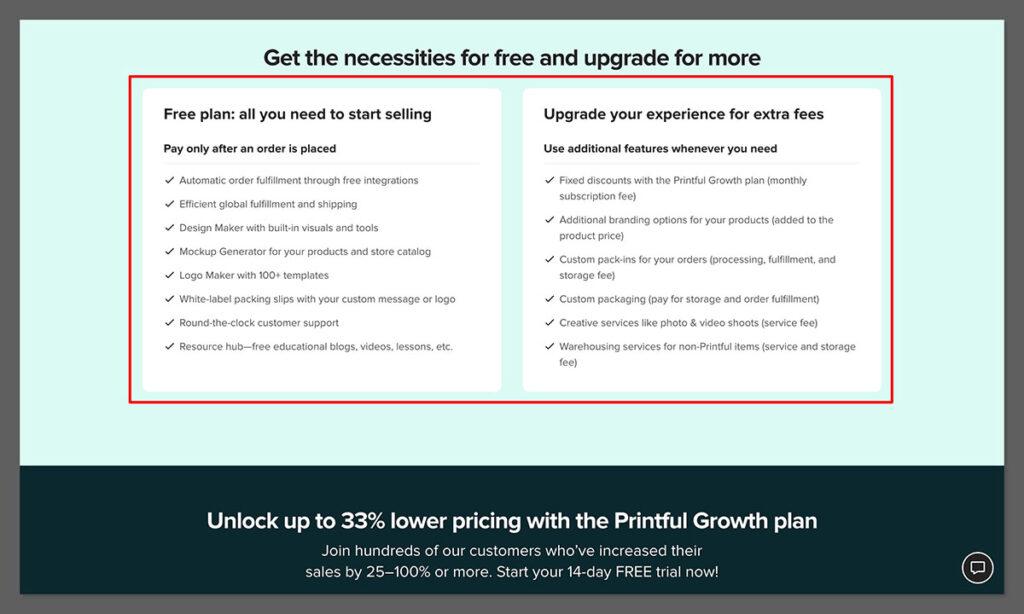
- Printful offers a "Growth Plan" for approximately $24.99/month, which unlocks significant discounts (up to 33%). For a brand shipping 500+ units a month, this subscription pays for itself almost instantly.
- Tapstitch relies on a pay-per-order model. While this lacks the "bulk discount" incentive of Printful, it keeps the barrier to entry low for smaller, boutique brands that may not have consistent monthly volume but require higher profit margins per unit.
Quality and Fulfillment: The "Hands-On" Experience
In our testing, we compared the physical output of both platforms, specifically focusing on a 100% cotton heavyweight hoodie—a staple of the streetwear market.
Printful’s Reliability
Printful’s output is consistent. If you order 1,000 units, the 1,000th will look identical to the first. However, their reliance on a massive, distributed network occasionally leads to minor discrepancies in print placement. Because they operate across so many facilities, a design file that prints perfectly in a North Carolina facility might have a half-inch shift in a European hub. For most, this is invisible; for high-end fashion brands, it can be frustrating.
Tapstitch’s Precision
Tapstitch’s vertical integration is their "secret sauce." Because they control the manufacturing of the blank and the printing process in the same facilities, the print-to-garment registration is exceptionally tight. They use modern DTF (Direct-to-Film) and DTG techniques that handle heavy-fabric textures better than the standard industry average. The "hand-feel" of a Tapstitch garment is generally perceived as more "retail-ready."
Implications for Your Business
Choosing between these platforms implies a choice about your brand’s future.
Why You Should Choose Printful
- Multichannel Ambition: If you plan to sell on TikTok Shop, Amazon, and your own website, Printful is the only choice. Their API and native integrations are mature and battle-tested.
- Global Customer Base: If your customers are in Germany, Japan, or the UK, Printful’s local production minimizes customs duties and shipping times, which is critical for customer retention.
- Product Diversity: If your brand strategy includes "lifestyle" items—mugs, posters, phone cases—Printful is your one-stop shop.
Why You Should Choose Tapstitch
- Brand Identity: If you are building a streetwear brand where the "blank" is as important as the design, Tapstitch offers the heavy, premium silhouettes that customers currently demand.
- Product Focus: If you want to keep your store clean and focused strictly on apparel, the lack of "clutter" in the Tapstitch catalog helps you maintain a professional, brand-specific aesthetic.
- Presentation: Their focus on brand-forward packaging and custom neck labeling makes it easier to create an "unboxing experience" that feels like a private-label drop rather than a dropship operation.
Official Stances and Support Ecosystems
Both companies have invested heavily in their respective support ecosystems.
Printful has built an extensive library of educational content, ranging from webinars on SEO for POD stores to design masterclasses. Their "Quick Stores" feature allows a novice to launch a storefront in minutes, making them the clear leader for the non-technical entrepreneur.
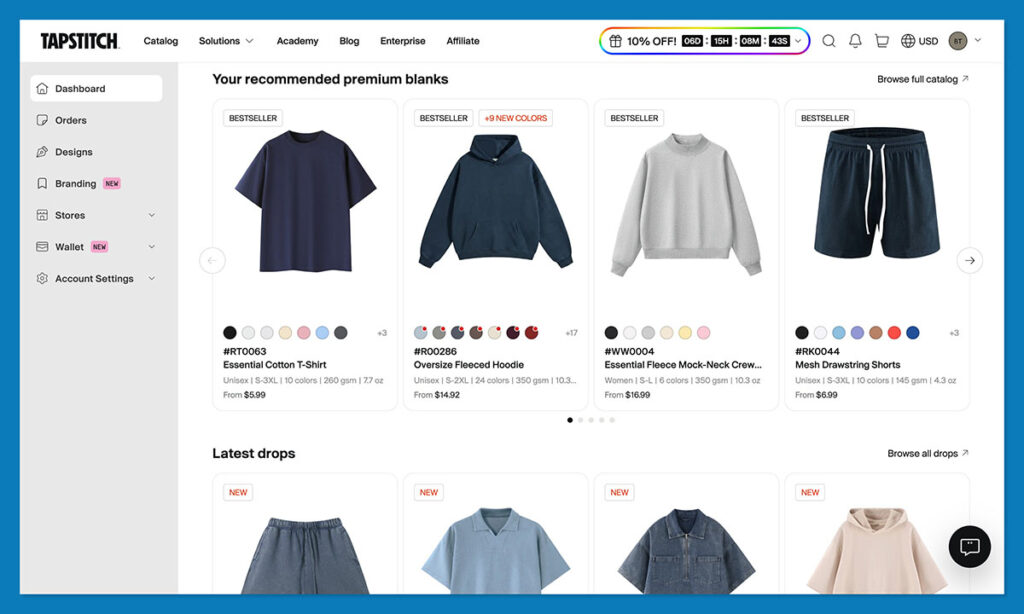
Tapstitch takes a more concierge-style approach. Because their catalog is smaller, their support team is often more attuned to the specific needs of apparel designers. They emphasize the "fashion-first" aspect, often providing better guidance on file preparation for complex, oversized, or multi-location prints that are staples of the modern fashion industry.
Final Verdict: The Strategic Choice
If you are a generalist entrepreneur—someone who wants to test various niches, sell a wide variety of products, or scale to high-volume, cross-platform retail—Printful is the safer, more robust choice. Its infrastructure is the closest thing to a "bulletproof" solution in the POD space.
However, if you are a creative professional—a designer, a streetwear enthusiast, or a niche clothing brand founder—Tapstitch is the superior tool. The sacrifices you make in terms of product variety and global shipping hubs are compensated by the superior garment quality and the ability to present your brand as a legitimate fashion label.
How to Make the Decision
Don’t take our word for it. The beauty of both platforms is that they require zero capital to test.
- Order Samples: Order the same design from both on a similar hoodie or tee.
- The "Wash Test": Wash both garments five times. Observe the cracking (or lack thereof) in the print and the shape retention of the garment.
- The "Shipping Test": Order a sample to a friend in a different city or country to see how the packaging and delivery time compare.
Ultimately, your POD provider is a silent partner in your business. Choose the one that aligns with your brand’s values: efficiency and scale, or craft and quality.
