
Peak Martech: The Great Plateau and the Evolution of the Marketing Stack
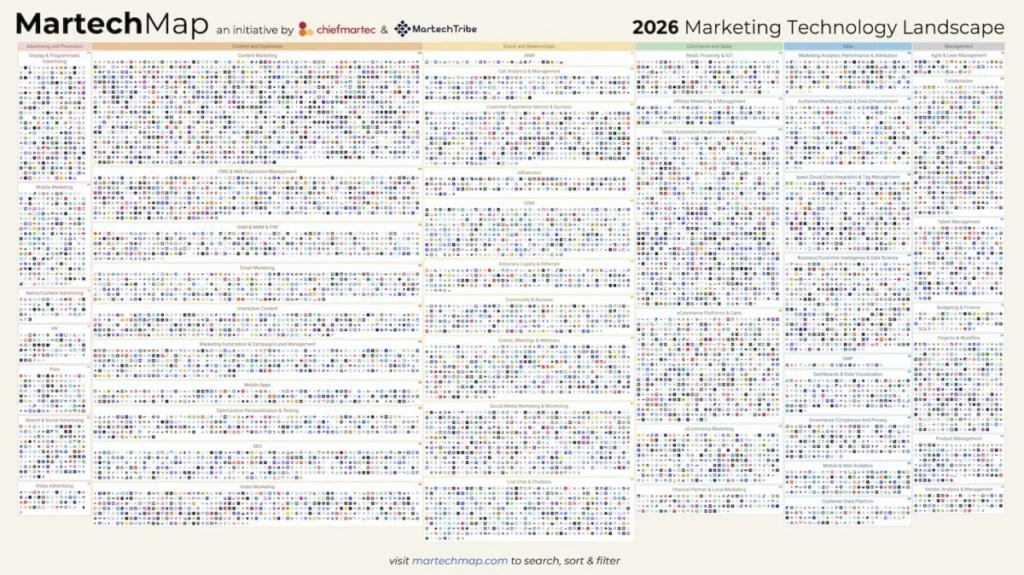
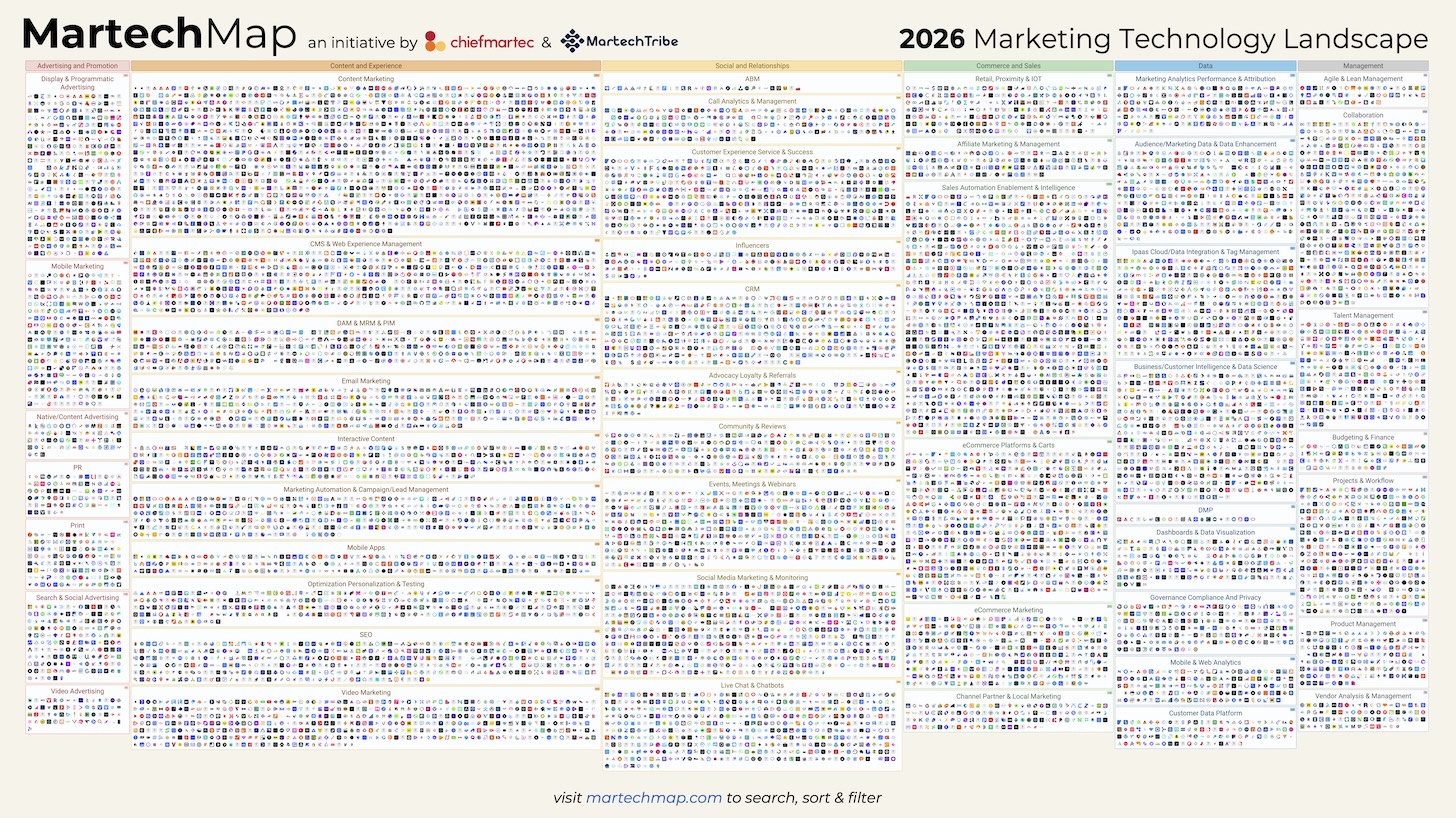
For fifteen years, the annual release of the Marketing Technology Landscape was a ritual defined by a single, inexorable trend: growth. Year after year, the “supergraphic” expanded, adding hundreds, and eventually thousands, of logos to a chart that became a staple of industry conversation. It was a visual representation of a digital gold rush—a sprawling, chaotic, and ever-multiplying ecosystem that seemed destined to expand toward infinity.
In 2026, however, the narrative has shifted. For the first time since the inception of the landscape in 2011, the relentless march of expansion has ground to a halt. With the release of the 2026 Marketing Technology Landscape, we are witnessing what may well be “Peak Martech”—a moment where the sheer velocity of new entrants is being perfectly countered by the exit of incumbents.
The Main Facts: A Market in Equilibrium
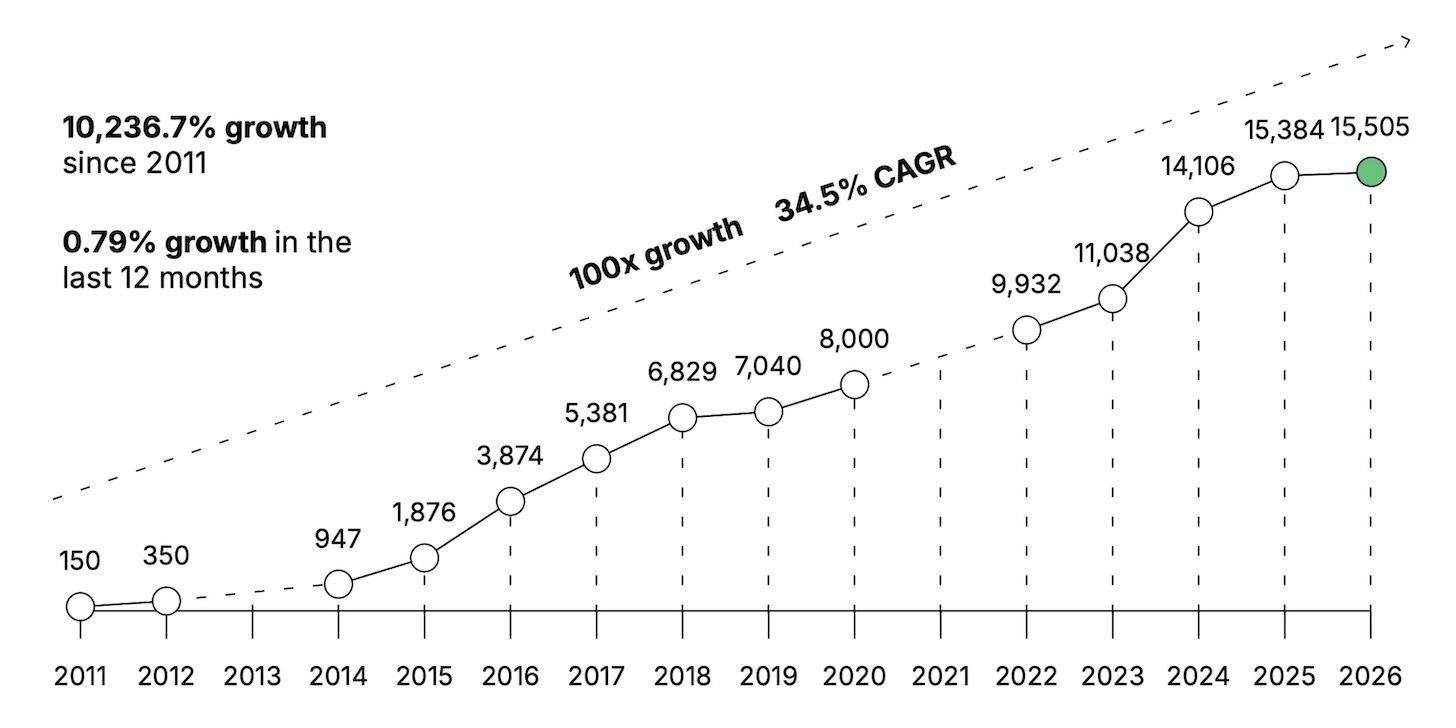
The 2026 data is striking in its stability. The landscape now tracks 15,505 products, a marginal increase from the 15,384 identified in 2025. This represents a growth rate of just 0.79%. In a world where double-digit expansion had become the expectation, a sub-one-percent shift feels, for all intents and purposes, like a plateau.
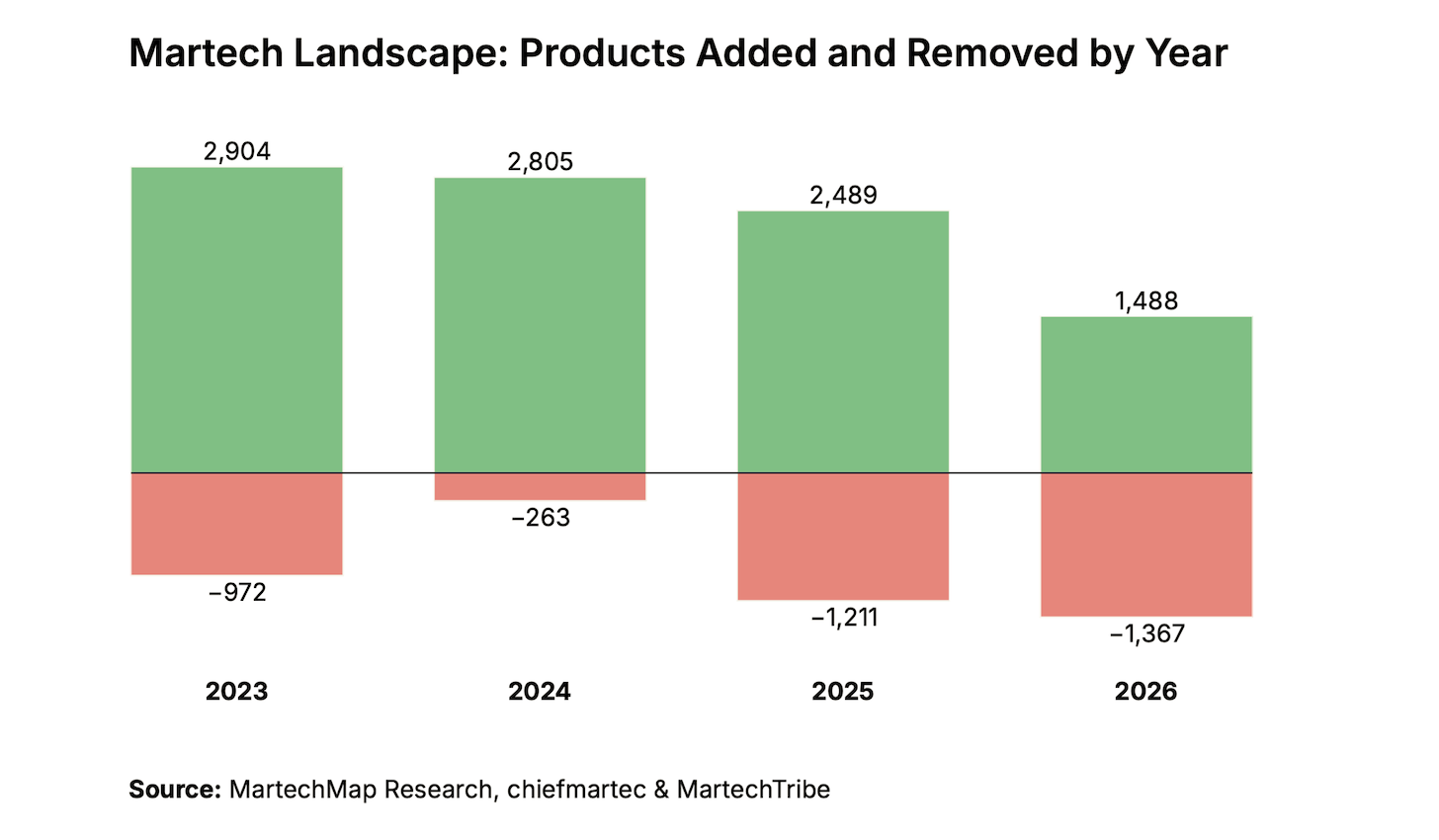
However, a stagnant top-line number masks a turbulent underlying reality. The market is not frozen; it is in a state of high-intensity churn. Over the past twelve months, the landscape added 1,488 new products while simultaneously removing 1,367. This high-velocity replacement cycle suggests that while the total volume of the market has stabilized, the internal composition of the industry is shifting with unprecedented speed.
A 15-Year Chronology: From 150 to 15,000
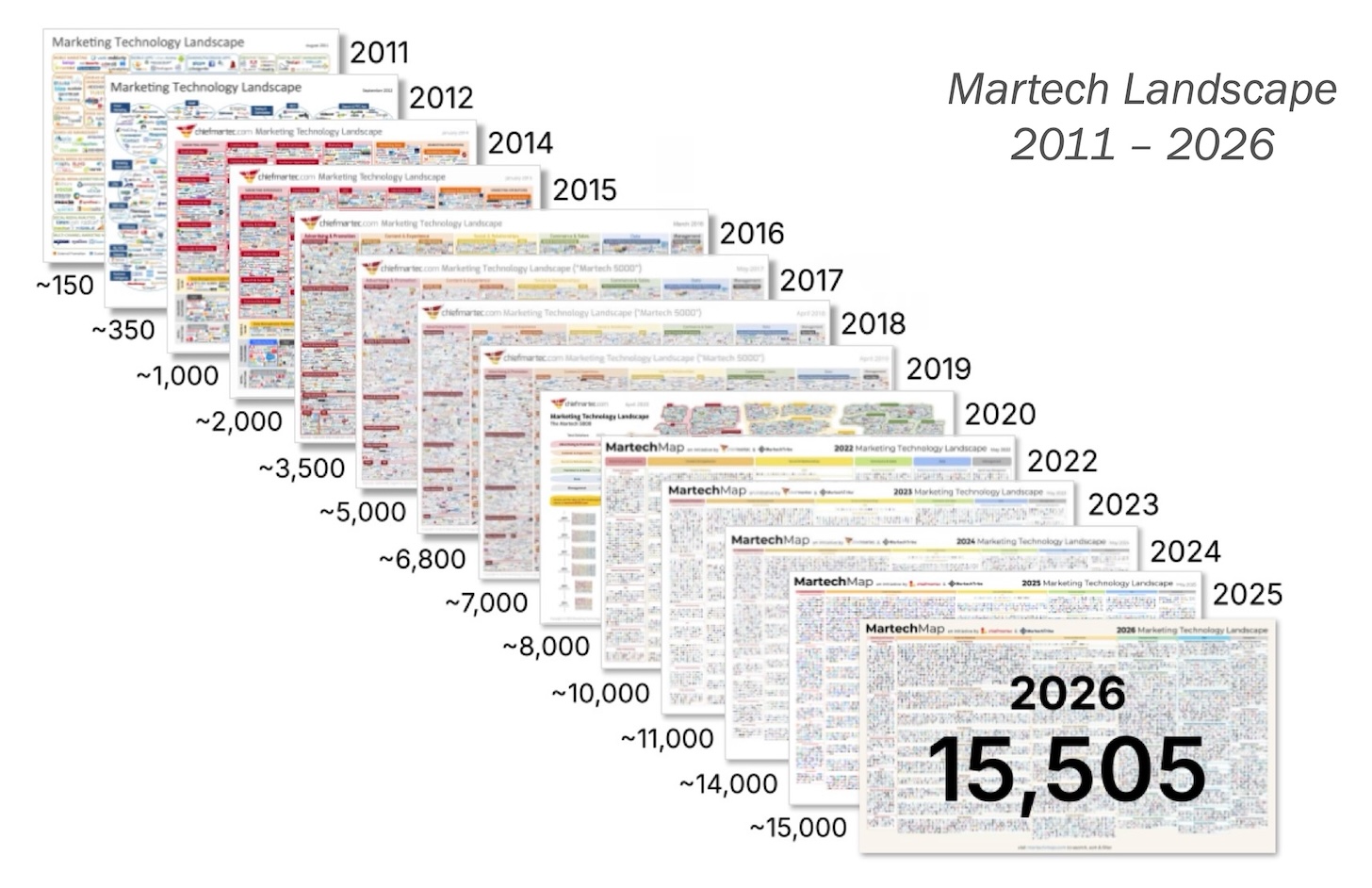
To understand the significance of this plateau, one must look at the trajectory of the last decade and a half. In 2011, the first iteration of the landscape contained a mere 150 products. It was a manageable, if burgeoning, space. By 2015, that number had surged to nearly 2,000. By 2020, it had cracked 8,000.
For years, skeptics predicted a “great consolidation” that never quite materialized. Every time the market appeared to reach a saturation point, it found a way to bifurcate, specialize, or pivot. Martech became the “Jurassic Park” of the enterprise software world—it constantly found a way to grow.
The 100x growth from 2011 to 2026 represents a 10,236.7% increase, a figure that highlights the sheer scale of the digital transformation that has swept through the marketing department. Yet, the 2026 data suggests that the era of “more is better” has finally hit the wall of economic reality and technological maturity.
Supporting Data: Dissecting the Churn
The primary driver behind this stabilization is a 40% decline in new market entrants compared to the previous year. If the “Gold Rush” of 2023 and 2024 was fueled by a flood of AI-native startups and lightweight wrappers, that fever has clearly broken.
Conversely, the exit rate has accelerated. The 1,367 removals represent a 13% increase in companies leaving the landscape. A critical observation from the data is that these exits are not limited to fly-by-night operations. More than half (51.7%) of the companies removed were part of the 2010–2019 SaaS wave—the bedrock of the modern marketing stack.
Furthermore, the data reveals a “middle-market squeeze.” The companies most likely to disappear are those with between $1 million and $10 million in revenue and teams of fewer than 50 people. These organizations often found enough initial product-market fit to survive the startup phase but lacked the scale or the defensive moats to survive a market where incumbents are aggressively bundling AI capabilities into their core offerings.
The AI Paradox: Reactivating the Old Guard
While the overall growth has flattened, specific subcategories are experiencing a renaissance. Paradoxically, the most significant growth is not occurring in new, experimental sectors, but in foundational categories that have been considered “mature” for years.
- CMS & Web Experience Management: Grew by 21.4% (from 504 to 612 products).
- Ecommerce Platforms & Carts: Grew by 19.9% (from 547 to 656 products).
The reason for this growth is the shifting role of the website. For two decades, web development focused on two audiences: humans and search engine crawlers. Today, a third, critical audience has arrived: the machine agent.
We are entering an era of “agentic browsers,” AI search assistants, and procurement bots. These entities do not “browse” websites in the traditional sense; they extract, compare, summarize, and act. This shift is forcing companies to rebuild their web presence to be more machine-readable and data-structured, driving a new wave of investment in CMS and ecommerce platforms that can provide the necessary context to these AI systems.
Implications for the Modern CMO
The plateau of the martech landscape signals a fundamental shift in the role of the marketing technologist. For years, the challenge was curation—choosing from a bewildering array of tools. Now, the challenge is integration and context.
1. The Death of the “Point Solution”
As the market consolidates and incumbents bundle AI features, the viability of small, single-feature point solutions is rapidly diminishing. CMOs are increasingly looking to rationalize their stacks, favoring platforms that offer deep integration and data accessibility over isolated tools that create silos.
2. Context Engineering
The future of competitive advantage lies in “context engineering.” As LLMs and generative agents become commodities, the quality of a company’s AI-driven marketing will depend on the data it feeds these agents. This makes the infrastructure layers—iPaaS, data integration, and privacy/governance tools—far more important than they were in the past. These categories have seen consistent growth (8% and 7.1% respectively), reflecting the priority being placed on the “connective tissue” of the stack.
3. The Shift to Collaborative Experiences
The web is evolving from a collection of static pages into a collaborative environment. Marketers are no longer just managing content; they are deploying agents that act as concierges, sales assistants, and advisors. This requires a move away from traditional “marketing automation” and toward a new paradigm of AI-orchestrated customer journeys. The 5.9% growth in Marketing Automation, despite its reputation for maturity, suggests that this category is being fundamentally re-engineered to meet the requirements of an agent-driven world.
Conclusion: The Quiet Revolution
If 2026 marks the arrival of “Peak Martech,” it is not a sign of stagnation. It is, instead, a sign of maturity. The era of chaotic, horizontal expansion has given way to an era of vertical integration and technical refinement.
The market has shifted from a “river” of endless, disorganized growth to a more structured, albeit complex, landscape. For the professional marketer, this is good news. The focus is shifting away from managing a sprawl of thousands of disparate logos toward building coherent, AI-ready architectures that can deliver actual business outcomes.
As detailed in the State of Martech 2026 report, the winners in this new environment will not be the companies that launch the most tools, but those that can best harness the existing 15,505 products to create meaningful, context-rich, and agent-driven customer experiences. The landscape may have stopped growing, but the work of optimizing it has only just begun.
