
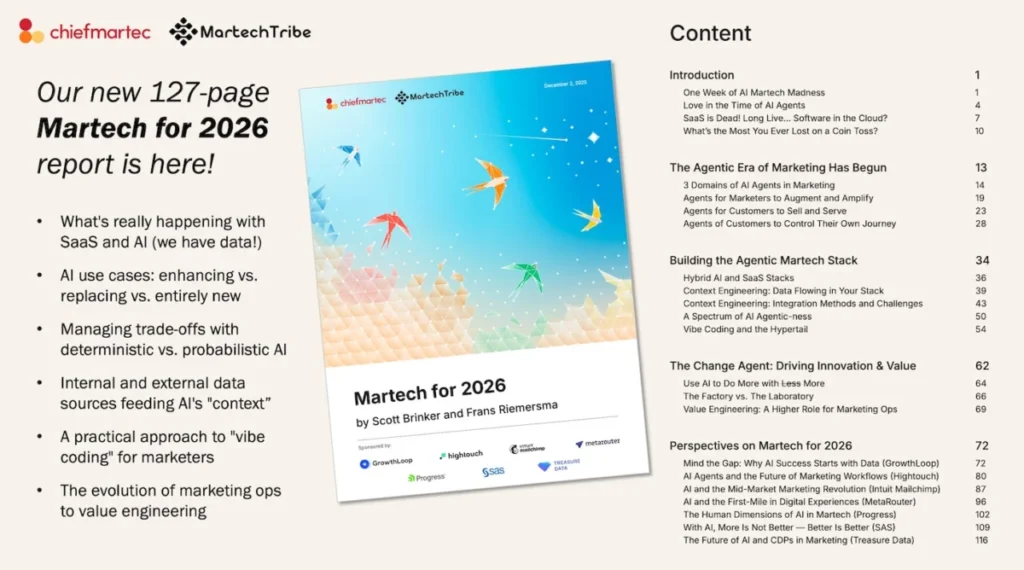
Navigating the Future: Unpacking the Comprehensive "Martech for 2026" Industry Report
The marketing technology landscape is undergoing its most radical transformation in a decade. As artificial intelligence moves from the experimental fringes to the structural core of enterprise strategy, the imperative for clarity has never been higher. Addressing this industry-wide pivot, the newly released "Martech for 2026" report—a 127-page definitive guide authored by Scott Brinker and Frans Riemersma—has arrived to serve as a roadmap for professionals struggling to reconcile innovation with operational reality.
In a departure from industry norms, this report arrives without the typical "gated" friction. There are no lead-generation forms, no mandatory social media engagements, and no hidden costs. It is, by all accounts, a masterclass in open-access knowledge sharing, designed to provide practitioners with the insights necessary to thrive in an increasingly automated ecosystem.
The Core Mandate: Why "Martech for 2026" Matters Now
The report is not merely a collection of trends; it is an analytical deep dive into the intersection of human expertise and machine intelligence. By synthesizing data from the recent AI & Data in Marketing survey, Brinker and Riemersma have identified the friction points preventing organizations from successfully scaling their martech stacks.
The document is meticulously structured to strip away the "techno-jargon" that often plagues the sector. Instead, it relies on accessible, plain-language analysis supported by high-fidelity visual illustrations. The objective is clear: to democratize the understanding of complex shifts in data architecture, workflow automation, and the evolving role of the marketing professional.
Chronology: A Multi-Month Synthesis of Market Intelligence
The creation of "Martech for 2026" was a rigorous, multi-month endeavor that mirrored the very speed of the industry it covers.
- Phase I: Data Collection. The authors initiated the project by conducting the AI & Data in Marketing survey, capturing the sentiment, challenges, and aspirations of thousands of practitioners across the globe.
- Phase II: Editorial Synthesis. Brinker and Riemersma spent months analyzing the raw data, cross-referencing it with historical market patterns, and drafting the thematic chapters that would form the backbone of the report.
- Phase III: Collaborative Perspectives. Recognizing that no single entity can capture the entirety of the martech ecosystem, the authors invited seven key industry leaders to provide independent commentary. Crucially, the authors maintained strict editorial independence; these industry partners were not given input or oversight on the report’s core content.
- Phase IV: Publication. The report was finalized and released as a free, accessible PDF, prioritizing industry education over corporate gatekeeping.
Supporting Data: The Pillars of the 2026 Strategy
While the full report spans over 120 pages, its foundational insights are anchored in seven critical areas of focus. These areas represent the "must-win" battles for marketing organizations over the next eighteen months:
1. Data Integrity as the AI Foundation
The report highlights that AI is only as effective as the data feeding it. Without clean, unified, and accessible data, generative AI remains a novelty rather than a utility.
2. The Rise of Marketing Agents
Moving beyond simple automation, the report explores the shift toward "AI agents"—autonomous or semi-autonomous systems that can execute complex, multi-step marketing workflows with minimal human intervention.
3. The Mid-Market Revolution
AI is no longer the exclusive province of the enterprise. The report provides a granular look at how mid-market firms are leveraging scalable tools to compete on a level playing field with larger incumbents.
4. The "First-Mile" Problem
A significant portion of the analysis is dedicated to the "first mile" of digital experiences—how data is captured and interpreted at the point of origin. If the initial ingestion is flawed, the downstream experience is doomed to be irrelevant.
5. Human-Centric AI
Perhaps the most poignant section of the report addresses the human element. Technology is moving faster than organizational culture; the report offers a framework for upskilling teams and integrating AI in a way that augments rather than replaces human creativity.
6. The "Better is Better" Doctrine
Rejecting the "more is more" mentality that defined the early days of the Martech 5000, the authors argue for a streamlined approach. For 2026, the competitive advantage lies in surgical, high-quality implementation rather than the accumulation of disparate tools.
7. The Future of CDPs
Customer Data Platforms (CDPs) are entering a new era. The report examines how these systems are transitioning from passive data repositories to active, intelligence-driven hubs that orchestrate the entire customer journey.
Official Perspectives: Expert Commentary from the Frontlines
The report’s unique structure includes separate chapters featuring interviews with seven industry leaders. These organizations provided their distinct lenses on the current state of the industry:
- GrowthLoop highlights the "Mind the Gap" phenomenon, emphasizing that successful AI adoption is fundamentally a data-engineering challenge.
- Hightouch explores the mechanics of AI agents, painting a picture of a future where workflows are orchestrated by intent rather than manual configuration.
- Intuit Mailchimp provides a masterclass on the "Mid-Market Marketing Revolution," showing how accessibility is the primary driver of adoption.
- MetaRouter dives into the technical complexities of the "First-Mile," underscoring why data privacy and precision at the edge are non-negotiable.
- Progress champions the "Human Dimensions" of martech, arguing that the success of the technology depends entirely on the organization’s ability to adapt its culture.
- SAS offers a contrarian and necessary view: "More is not better—Better is better," advocating for a return to statistical rigor in an age of LLM-fueled hype.
- Treasure Data outlines the evolution of CDPs, predicting a future where AI and customer data become inseparable.
Implications: What This Means for the Modern Marketer
For those in the trenches, "Martech for 2026" offers a clear directive: Stop chasing tools and start building architectures.
From Accumulation to Orchestration
The era of the "bloated stack" is coming to a close. The findings suggest that the most successful companies in 2026 will be those that have successfully pruned their tech stacks to favor interoperability and data fluidity.
The Skill Gap is the New Tech Gap
The report implies that the greatest risk to a marketing organization in 2026 is not the technology itself, but the lack of internal expertise to wield it. Companies must prioritize the "Human Dimensions" identified in the report to ensure that AI adoption doesn’t lead to operational paralysis.
The Return of the Specialist
While AI can generate content and analyze trends at scale, the report hints at a resurgence of the need for deep, strategic thinking. As "average" content and "average" analysis become commodities via AI, the human ability to create unique, value-driven, and culturally resonant experiences becomes the ultimate premium.
Conclusion: A Blueprint for the Next Chapter
"Martech for 2026" stands as a rare example of high-value industry research provided without the expectation of a transaction. By removing the barriers to entry, Brinker and Riemersma have ensured that the insights within can reach the widest possible audience—from junior marketers to CMOs.
In an industry that thrives on novelty, this report is a grounded, necessary anchor. It serves as a reminder that while the tools of the trade are evolving at an exponential rate, the core tenets of marketing—understanding the customer, delivering value, and maintaining data integrity—remain constant.
As the industry moves toward 2026, the question is no longer whether your organization will adopt AI, but how you will integrate it into a sustainable, human-led, and data-driven framework. This report provides the roadmap; the execution, as always, remains with the practitioner.
For those interested in the full 127-page analysis, the Martech for 2026 report is available for direct download. For ongoing analysis and industry insights, you can join the 42,000+ professionals currently following the latest developments via the chiefmartec newsletter.
