
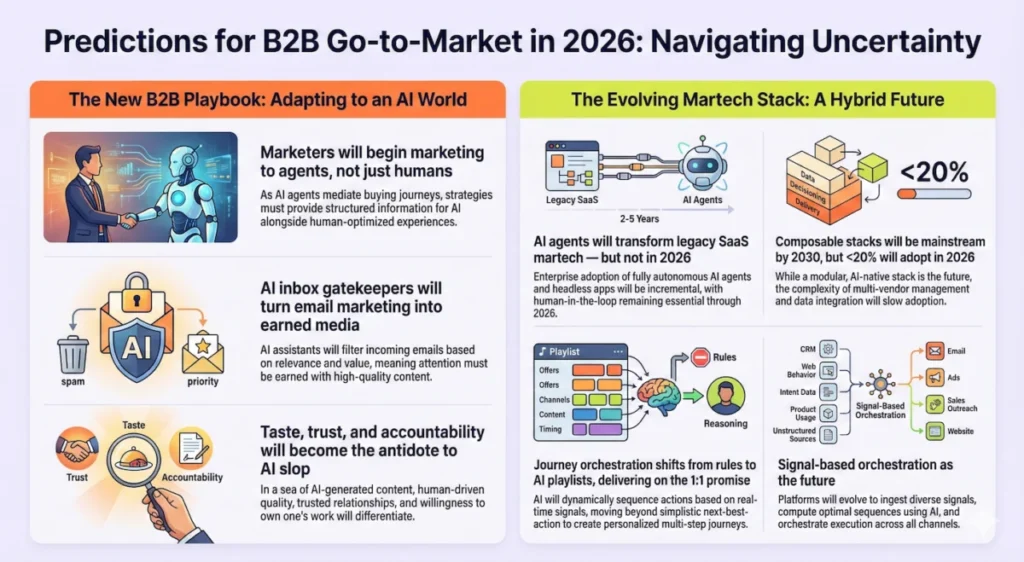
Navigating the Agentic Era: Jon Miller’s 2026 Blueprint for B2B Marketing
As the B2B landscape hurtles toward 2026, the industry finds itself at a critical inflection point. For nearly two decades, Jon Miller—co-founder of Marketo and a foundational architect of modern Account-Based Marketing (ABM)—has steered the discourse on how technology and strategy intersect. In his latest annual forecast, Miller posits that 2026 will not be defined by the "death of SaaS," but rather by a complex, hybrid transition into the age of AI agents and signal-based orchestration.
"2026 feels like a year where the vision of AI-powered marketing finally comes into focus," Miller writes. "But actual enterprise adoption will remain incremental. The gap between where we are going and what actually happens will be large."
The New Buying Committee: Marketing to Agents
The most significant paradigm shift identified by Miller is the evolution of the buying committee. It is no longer composed solely of human stakeholders; it now includes autonomous AI agents.
The Rise of AEO
Following the widespread adoption of "Answer Engine Optimization" (AEO) in 2025, where 90% of B2B buyers utilized LLMs for research, the pressure is on for marketers to provide structured, machine-readable data. Miller predicts that in 2026, "agent identification and tracking" will become a core competency. If an AI agent from a Fortune 500 company queries a firm’s pricing API, that interaction represents high-value intent that must be integrated into lead scoring.
Content Architecture for Dual Audiences
To survive, brands must adopt a "headless" content strategy. Humans will continue to require branded, emotionally resonant experiences, but agents demand direct access to services—such as dynamic quoting APIs and structured knowledge bases—to facilitate the evaluation process.
Chronology: From Static Rules to Reasoning Models
Miller outlines a clear developmental arc for the industry, moving from legacy automation to a more fluid, adaptive future:
- Pre-2025 (The Era of Rules): Marketing was dominated by deterministic, "if-this-then-that" logic. These systems were rigid, brittle, and required massive manual intervention when market conditions shifted.
- 2025 (The Year of AEO): The industry pivoted toward optimizing for AI search summaries, marking the beginning of the end for traditional keyword-stuffed SEO.
- 2026 (The Hybrid Year): An era of "Advanced Driver Assistance" for marketing. AI handles the heavy lifting of orchestration and pattern recognition, but humans remain in the loop, providing guardrails and strategic intent.
- 2030 (The Horizon): A fully modular, signal-driven, and composable martech stack becomes the industry standard.
Supporting Data: The Case for Caution
Miller’s projections are grounded in the sobering reality of current adoption rates. While the hype cycle suggests an immediate transition to autonomous departments, the data tells a different story:
- The 81% Gap: Currently, 81% of AI usage in marketing is "assist-only," with less than 10% of implementations allowing agents to act autonomously.
- The "Silent Freeze": According to Pave data, entry-level SDR roles have declined significantly as companies rely on AI to maintain productivity without backfilling junior positions. This creates a "hollowed-out" talent pipeline that could threaten the industry’s long-term health.
- The World Uncertainty Index: Global uncertainty is currently at record highs, surpassing both the 2008 financial crisis and the peak of the pandemic, complicating long-term capital investment for GTM teams.
Official Perspectives: The Conflict of Infrastructure
The transition to "composable" stacks—where marketers assemble a best-in-breed architecture rather than relying on a monolithic vendor—is central to the 2026 conversation. However, Gartner’s Mike Lowndes notes that "the challenges of adopting composable solutions are significant."
Most organizations lack the "digital maturity" to manage multiple vendors and complex API integrations. Miller agrees, predicting that while composable stacks are the future, fewer than 20% of B2B teams will achieve a fully composable architecture in 2026. Instead, most will adopt "composable lite"—a model where data warehouses act as the source of truth, but journey orchestration remains centralized within a primary platform.
Strategic Implications: Building Resilience
Miller emphasizes that the antidote to "AI slop"—the flood of generic, low-value content—is a return to "Taste, Trust, and Accountability."
The Three Pillars of Competitive Advantage
- Taste: The ability to discern high-quality, meaningful content from noise. This is a blend of editorial sensibility and storytelling that AI cannot yet replicate.
- Trust: In a fragmented landscape, B2B buyers are increasingly relying on personal networks and individual creators. Founder-led marketing and executive influence are no longer optional.
- Accountability: Just as a court reporter must sign off on a transcript to make it an "official record," marketers must be willing to stake their professional reputations on the outputs of their AI systems.
A Call to Action for Leaders
For GTM teams, the path forward is not to freeze, but to build resilience. Miller advises leaders to:
- Focus on Context Engineering: Treat the "why" behind your marketing data as a primary asset. Capture the tribal knowledge and strategic reasoning behind your campaigns, as this is the data that makes AI useful rather than generic.
- Embrace "Playlist" Orchestration: Move away from single-touch personalization. Use AI to curate sequences of actions—"playlists"—that look several steps ahead in the buyer’s journey, mimicking the sophisticated content-sequencing algorithms used by platforms like TikTok.
- Upskill the Workforce: Utilize AI as an on-demand coach to accelerate team growth. Shift organizational design from hyper-specialized silos to generalists who can fluidly navigate data, content, and strategy.
Final Outlook
As Miller concludes, "2026 won’t be predicted as much as navigated." The ground beneath the B2B marketing industry is shifting, and the winners will be those who stop viewing AI as a mere efficiency tool and start treating it as a partner in complex, multi-layered decisioning. By banking the efficiency gains of today, companies can secure the capital and the time required to pivot toward a truly signal-based, agentic future.
The era of the "batch-and-blast" email is officially over; the era of relevance, trust, and intelligent orchestration has begun.
