
Microsoft Expands AI Visibility Insights: A New Era for Bing Webmaster Tools
The landscape of search engine optimization (SEO) is undergoing its most significant transformation since the advent of mobile browsing. As generative AI becomes the primary interface through which millions of users interact with the internet, the metrics of success are shifting from simple "blue link" clicks to "AI citations." In a decisive move to maintain its lead in AI-integrated search transparency, Microsoft has announced a major expansion to its Bing Webmaster Tools AI Performance dashboard.
The tech giant is rolling out four sophisticated new features—Intents, Topics, Citation Share, and Compare—designed to provide publishers and SEO professionals with granular data on how Microsoft’s Copilot and Bing AI utilize their content. These tools, which began their global rollout this week, represent a shift toward "Generative Engine Optimization" (GEO), a discipline focused on visibility within AI-generated responses.
Main Facts: The Four Pillars of AI Performance
The update introduces four distinct analytical tools that aim to turn abstract AI interactions into actionable data. While the AI Performance dashboard previously focused on raw numbers, this update emphasizes context, competition, and historical trends.
1. Citation Share: Measuring Relative Authority
Perhaps the most significant addition is the Citation Share metric. Until now, webmasters could see the raw count of how many times their site was cited by Bing’s AI. However, raw numbers lack context. If a site is cited 50 times, is that a dominant performance or a negligible one?
Citation Share solves this by providing a percentage-based relative measure. It calculates your site’s share of all citations generated for a specific "grounding query"—the prompt the AI uses to verify its facts. For example, if a user asks about "the best sustainable investment strategies" and the AI generates ten citations to back up its answer, and three of those citations link to your domain, your Citation Share is 30%. Microsoft clarifies that this is an observational metric; it does not currently reveal competitor domains or provide direct traffic share data, but it offers a benchmark for brand authority within AI summaries.
2. Intents: Categorizing User Motivation
The Intents feature leverages machine learning to classify grounding queries into specific categories. Rather than forcing webmasters to analyze thousands of individual long-tail queries, the dashboard now groups them by the user’s underlying goal. Common classifications include:
- Informational: Users seeking facts or explanations.
- Commercial: Users investigating products or services with the intent to purchase.
- Research: Deep-dive queries involving comparisons or technical data.
This allows publishers to see exactly where their content is most influential. A tech blog might find it has a 70% citation share for "Research" queries but only 5% for "Commercial" queries, signaling a need to adjust their content strategy to capture more bottom-of-the-funnel traffic.
3. Topics: Thematic Clustering for Semantic SEO
In the age of AI, keyword-matching is becoming obsolete in favor of semantic relevance. The Topics feature reflects this by grouping related queries into thematic clusters. For instance, disparate queries such as "how do solar panels work," "photovoltaic cell efficiency," and "residential solar installation costs" would all be rolled up under a broader "Solar Energy" topic label.
This thematic grouping helps SEOs identify high-level content gaps. It moves the needle away from "keyword stuffing" and toward "topical authority," rewarding sites that provide comprehensive coverage of a subject rather than just targeting specific phrases.
4. Compare: Historical Benchmarking
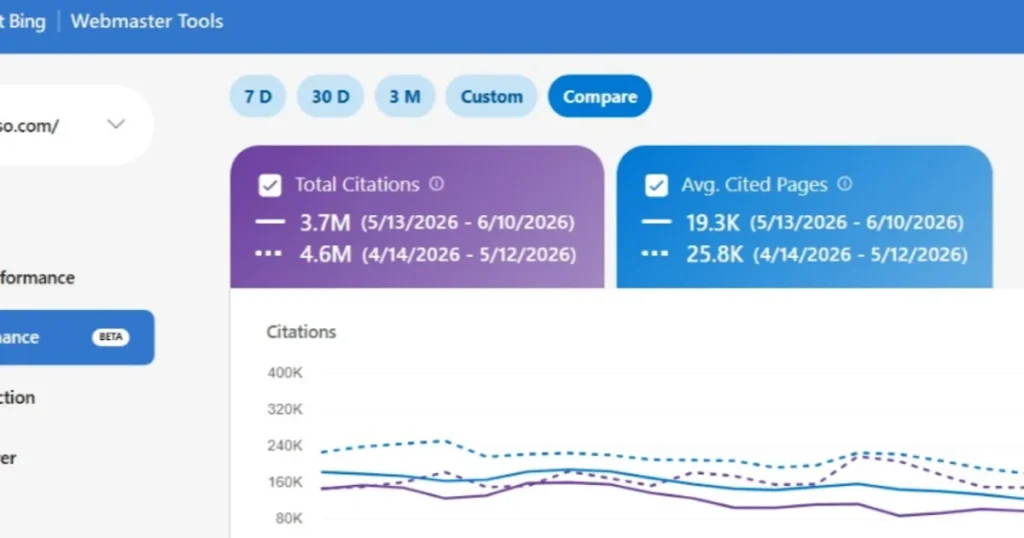
The Compare feature introduces time-period overlays to the AI dashboard. This allows users to visualize how their AI visibility has fluctuated over time. Users can compare the current 30-day period against the previous 30 days or select custom date ranges. This is critical for measuring the impact of new content deployments or algorithm updates, providing a visual representation of growth or decline in the AI ecosystem.
Chronology: The Evolution of Bing’s AI Reporting
The rollout of these features is not an isolated event but the latest step in a rapid development cycle that began in early 2024. Microsoft has been aggressive in providing transparency to publishers, likely as a strategy to encourage content creators to keep their sites crawlable by BingBot.
- February 2024: Microsoft launches the AI Performance dashboard in public preview. For the first time, publishers could see how often Copilot and Bing AI answers cited their content, providing a glimpse into the "black box" of generative search.
- March 2024: An update is released that maps grounding queries to specific cited pages. This was a turning point, as it allowed webmasters to see exactly which articles were performing well in the AI environment.
- June 2024 (SEO Week): Microsoft previews several new features at the industry-focused SEO Week, including Citation Share and a proposed "GEO-focused recommendations" engine.
- Late June 2024: The official global rollout of the four new features (Intents, Topics, Citation Share, and Compare) begins. Notably, the GEO-focused recommendations are omitted from this specific release, signaling that they may require further refinement.
Supporting Data and Technical Breakdown
To understand why these metrics are vital, one must understand the concept of "Grounding Queries." In the architecture of Bing’s AI, when a user enters a prompt, the AI doesn’t just "hallucinate" an answer from its training data. Instead, it performs a real-time search to find reliable sources—this is the grounding query. It then uses those sources to synthesize an answer, citing them in the process.
The Shift from CTR to "Citation Real Estate"
Traditional SEO focuses on Click-Through Rate (CTR). However, data from various SEO agencies suggests that AI-generated answers often satisfy user intent directly on the search results page (zero-click searches). In this environment, being the "cited source" is the new currency.
- Relative vs. Absolute: By introducing Citation Share, Microsoft is acknowledging that in an AI-driven world, "ranking #1" is replaced by "being the most trusted source."
- Data Maturation: Microsoft has noted that the "Intents" and "Topics" classifications are still in a maturing phase. As more data flows through the system, the accuracy of these machine-learning clusters is expected to improve, providing even more precise insights for high-volume publishers.
The "Missing" GEO Feature
A significant point of discussion within the SEO community is the absence of GEO-focused recommendations in this rollout. Originally previewed as a tool that would provide specific guidance on crawlability, structured data, and indexing to improve AI visibility, its omission suggests that Microsoft is still fine-tuning how it delivers actionable advice without giving away the "secret sauce" of its ranking algorithms.
Official Responses and Market Positioning
Microsoft’s approach to AI transparency stands in stark contrast to its primary competitor, Google. While Google has begun testing AI visibility reports in Search Console, they are currently limited in scope and available to a smaller subset of users.
Microsoft’s Perspective
In official communications, Microsoft describes Citation Share as an "observational metric." The company is careful to frame these tools as a way for publishers to understand their "contribution to the AI ecosystem" rather than a direct competitive leaderboard. By providing these tools, Microsoft is positioning Bing Webmaster Tools as the more "publisher-friendly" platform, hoping to win over the developer and SEO communities that have historically prioritized Google.
Industry Reaction
SEO experts have largely praised the move. "We are moving from an era of ‘Search Engine Optimization’ to ‘Generative Engine Optimization,’" says one industry analyst. "Microsoft is giving us the telescope we need to see into this new galaxy. Without these metrics, we are flying blind in a world where Copilot is answering the questions we used to get clicks for."
Implications: The Future of Digital Marketing
The introduction of these tools has profound implications for the future of digital marketing and content creation.
1. The Rise of "Topical Authority"
With the "Topics" feature, Microsoft is signaling that it values depth over breadth. To succeed in AI search, brands will need to move away from thin, keyword-focused content and toward comprehensive "pillar" content that covers a topic from every possible angle. If an AI can find everything it needs on one authoritative site, it is more likely to cite that site repeatedly, increasing that site’s Citation Share.
2. Strategic Content Alignment
The "Intents" data will force a re-evaluation of content ROI. If a company finds its Citation Share is high for "Informational" queries but zero for "Commercial" queries, its content is effectively training the AI without driving revenue. This will lead to a new wave of content strategy focused on "AI-Conversion Optimization"—writing content in a way that encourages the AI to cite the brand during the commercial decision-making phase of a user’s journey.
3. The Competitive Ecosystem
While Microsoft currently does not show competitor domains in the Citation Share tool, the mere existence of a percentage metric suggests that a "share of voice" battle is brewing. Marketing departments will soon be reporting "AI Citation Share" to their boards with the same gravity they currently report "Organic Market Share."
4. Preparation for GEO
Even though the GEO-focused recommendations were not included in this rollout, their eventual arrival is inevitable. Publishers should prepare by focusing on the fundamentals Microsoft has hinted at: high-quality structured data (Schema.org), impeccable site crawlability, and the use of clear, factual language that is easy for Large Language Models (LLMs) to parse and cite.
Conclusion
Microsoft’s update to the Bing Webmaster Tools AI Performance dashboard is a watershed moment for the search industry. By providing Intents, Topics, Citation Share, and Compare metrics, Microsoft is not just updating a dashboard; it is defining the vocabulary of the next decade of search.
As the digital world transitions from a library of links to a conversation with an intelligent assistant, the ability to measure, analyze, and optimize for AI citations will be the difference between digital relevance and obsolescence. For now, the ball is in the publishers’ court to take this data and reshape their strategies for the AI-first future.
