
Mastering the Meta Ecosystem: A Comprehensive Guide to Facebook Advertising in 2026
In the rapidly shifting landscape of digital marketing, Facebook advertising remains a cornerstone for businesses of all sizes. Despite the emergence of newer platforms, the Meta ecosystem—encompassing Facebook, Instagram, Messenger, and the Audience Network—continues to offer an unparalleled scale of reach. For the modern marketer, mastering the art of the Facebook ad is not merely an optional skill; it is a fundamental requirement for driving sustainable, measurable growth.

The Evolution of Facebook Advertising
Facebook advertising is the practice of running paid promotions across Meta’s family of applications. At its core, it functions as a highly sophisticated auction system. When a brand initiates a campaign, it defines an objective, a target audience, and a budget. Meta’s proprietary algorithm then evaluates these variables against thousands of potential ad placements, weighing bid amounts, estimated action rates, and ad quality to determine the most effective delivery.

This system is built on "Meta’s Advantage+" framework, an AI-driven approach that has fundamentally changed how campaigns are managed. By shifting from manual, rigid targeting to automated, machine-learning-optimized delivery, advertisers can now reach users who are statistically most likely to convert, rather than those who simply fit a specific demographic profile.
Chronology of Campaign Management
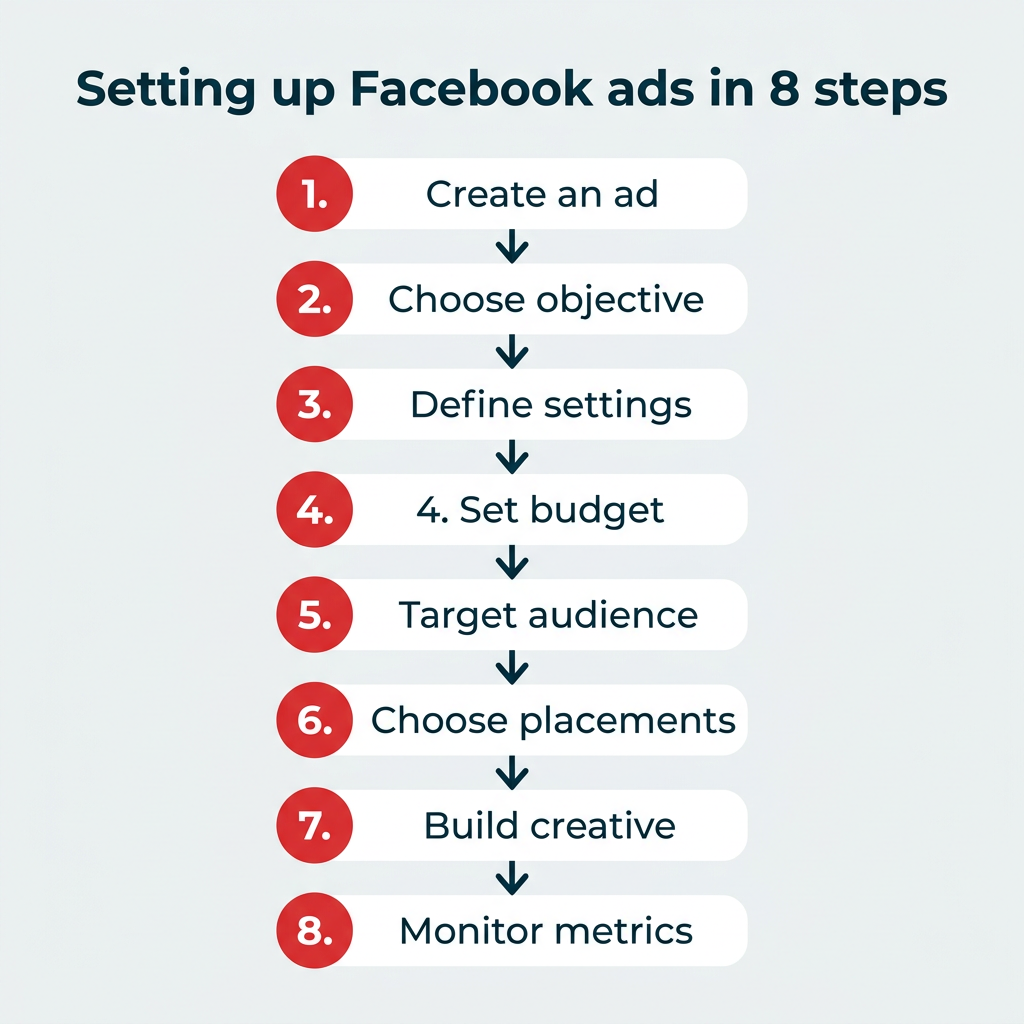
To understand the lifecycle of a successful campaign, one must look at the standard 8-step process within Meta Ads Manager:
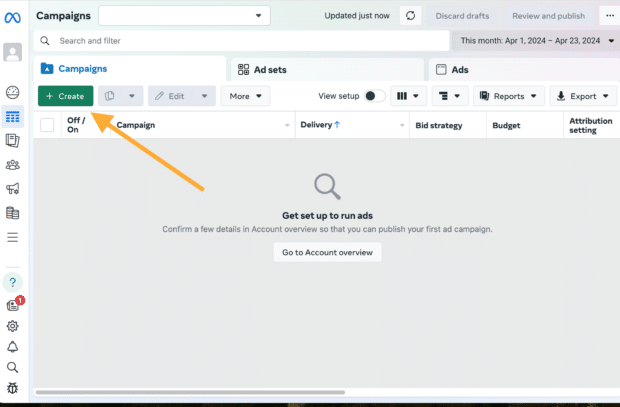
- Initiation: The campaign begins with the "Create" button in the Ads Manager dashboard.
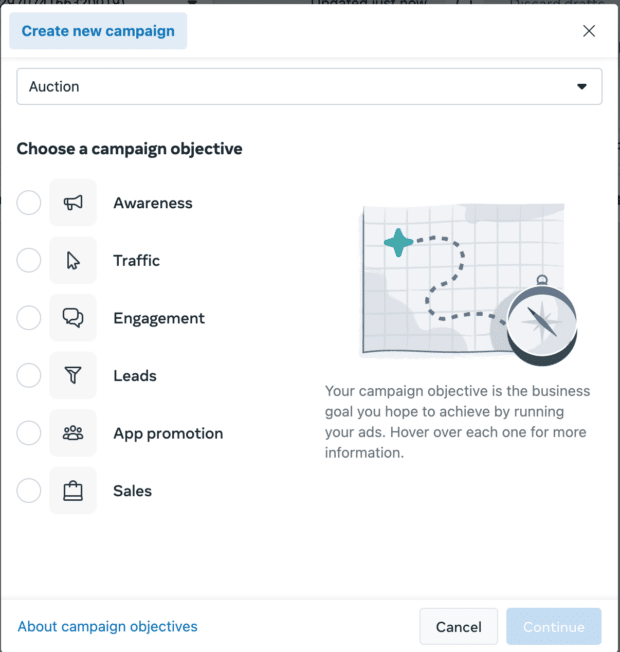
- Objective Selection: Advertisers must align their campaign with business goals, choosing from categories such as Awareness, Traffic, Engagement, Leads, or Sales.
- Campaign Configuration: Setting the framework, including identifying "Special Ad Categories" (housing, employment, credit) that require compliance with stricter non-discrimination policies.
- Budget Allocation: Determining whether to use a daily budget (for continuous, controlled spend) or a lifetime budget (for specific, time-bound events).
- Audience Precision: Leveraging a mix of core demographics, custom audiences (retargeting existing leads), and lookalike audiences (finding new users similar to current high-value customers).
- Placement Strategy: Deciding where ads appear, utilizing "Advantage+ Placements" to let the algorithm find the best real estate across the Meta ecosystem.
- Creative Execution: Uploading assets (images, video, or carousels) and crafting compelling copy that triggers action.
- Performance Monitoring: The final phase involves real-time analysis of ROAS (Return on Ad Spend) and cost-per-acquisition (CPA) to optimize or scale the campaign.
Supporting Data: Costs and Benchmarks in 2026
The financial barrier to entry for Facebook advertising is remarkably low, yet the ceiling for scale is infinite. As of 2026, the average Cost Per Click (CPC) generally fluctuates between $0.50 and $2.00, though this is heavily dependent on industry competitiveness.
| Campaign Objective | Avg. CPC | Avg. CPM (per 1,000) | Avg. Cost Per Lead |
|---|---|---|---|
| Awareness | $0.40–$0.90 | $5–$9 | N/A |
| Traffic | $0.50–$1.50 | $7–$12 | N/A |
| Engagement | $0.30–$1.00 | $6–$10 | N/A |
| Leads | $1.00–$2.50 | $9–$15 | $5–$25 |
| Sales | $0.80–$2.00 | $10–$18 | $10–$40 |
These figures serve as benchmarks. It is essential to note that a daily budget as low as $5 can be effective for localized testing or gathering early-stage audience insights, while $10 per day allows the algorithm enough data to begin meaningful optimization for small-to-mid-sized businesses.
Strategic Implications: Why Invest in Facebook Ads?
The primary implication of relying on Facebook ads is the ability to combine massive reach with granular, AI-backed control. Unlike traditional media, where audiences are broad and feedback is slow, Meta provides near-instantaneous feedback loops.
The Power of Formats
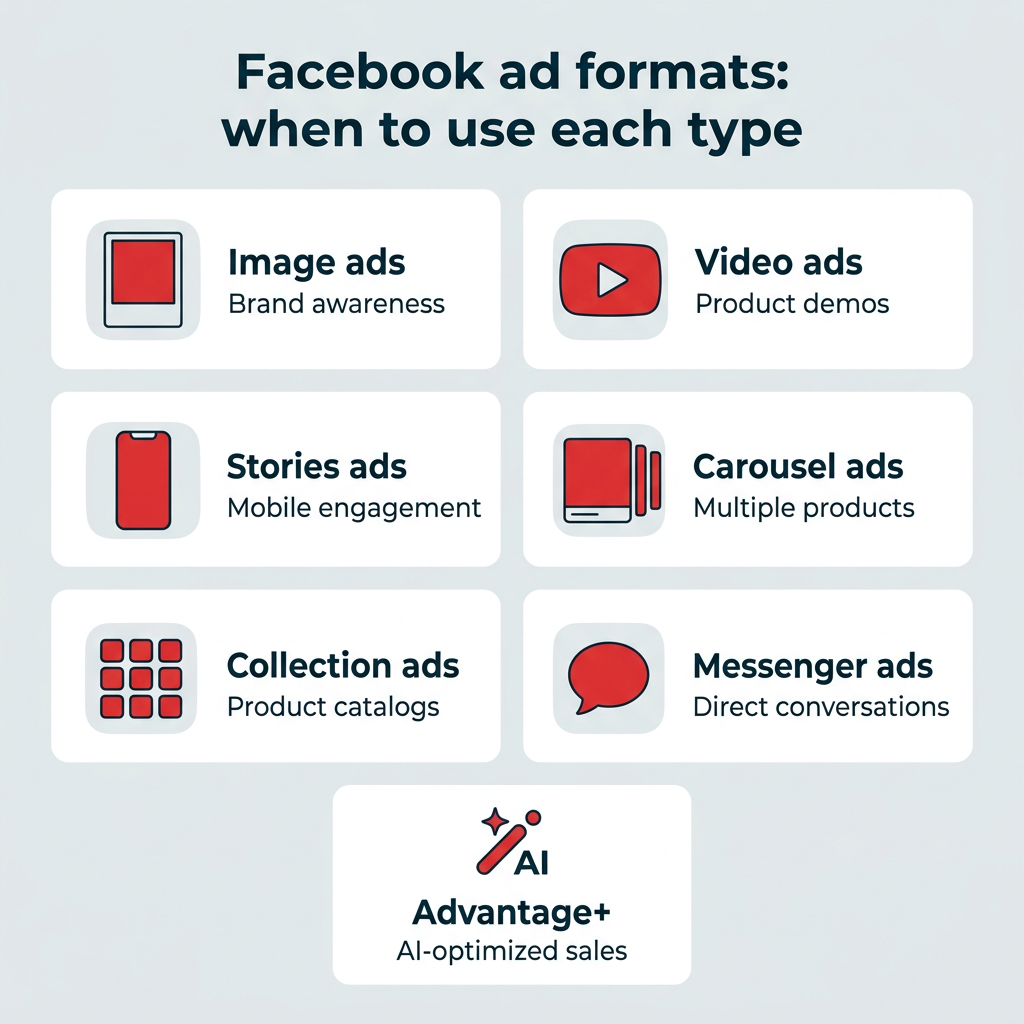
- Image Ads: The bedrock of simplicity. Ideal for brand awareness and quick product announcements.
- Video Ads: High-engagement tools. Best suited for tutorials and product demos, particularly when kept under 15 seconds.
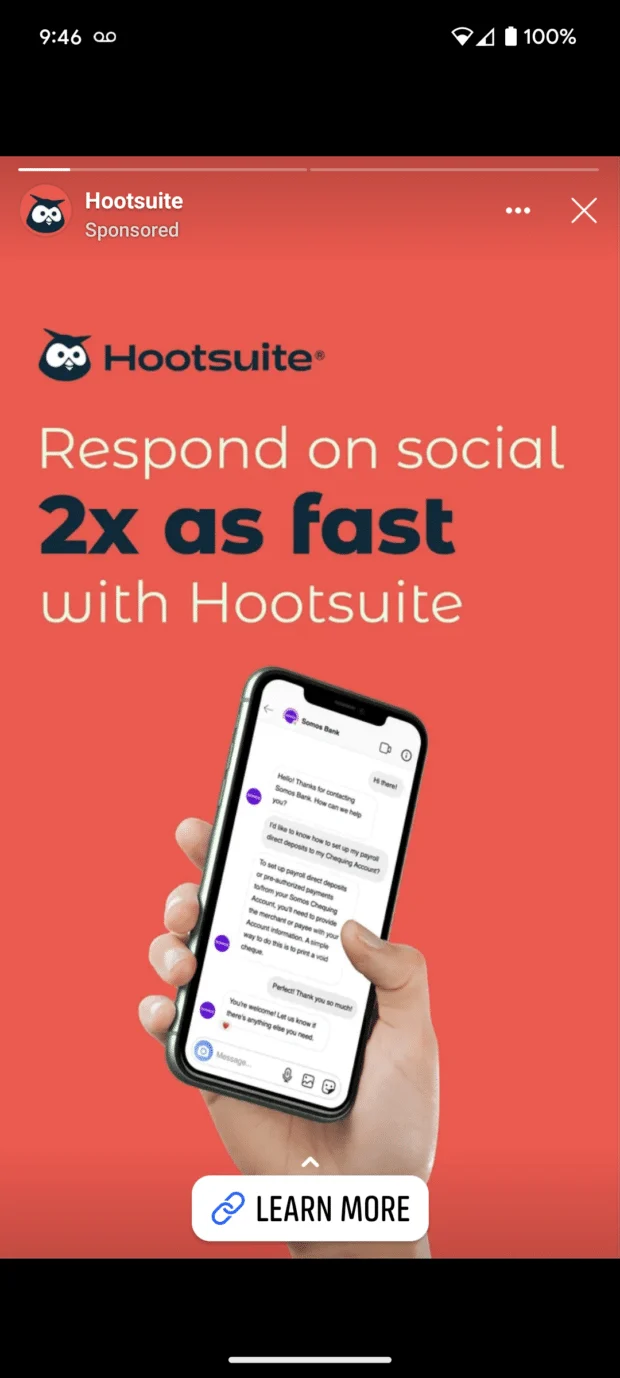
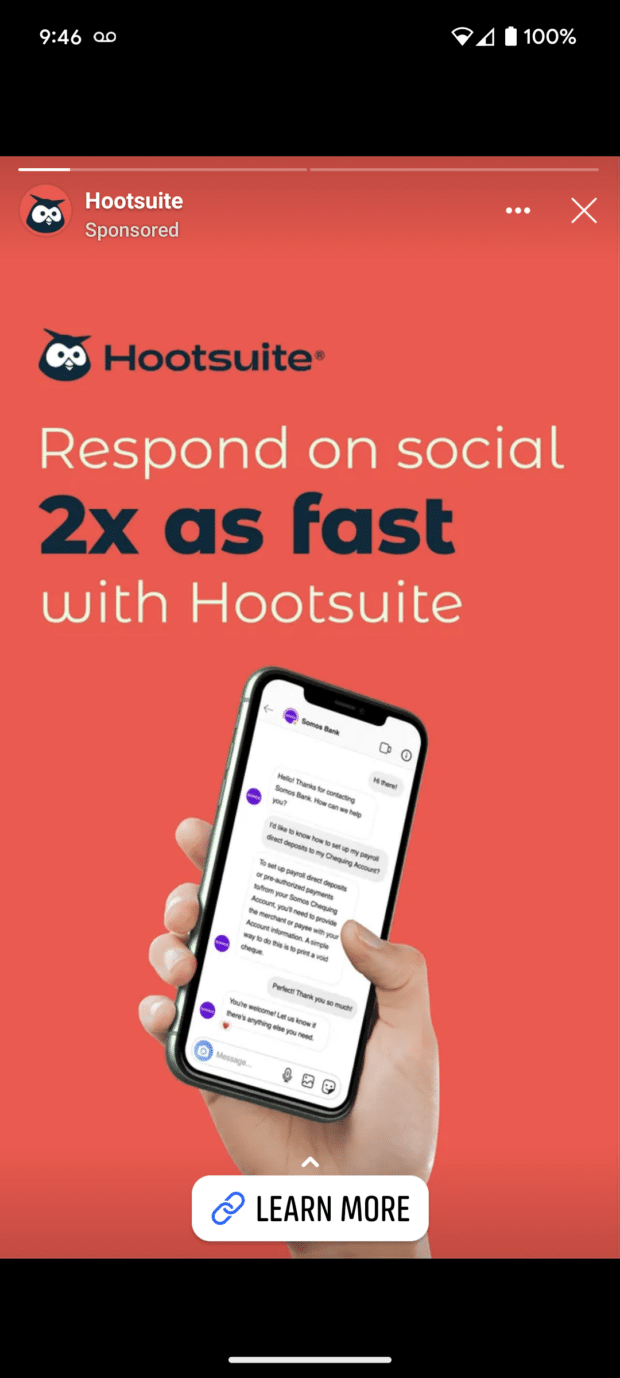
- Stories Ads: Leveraging vertical, full-screen real estate. These ads are highly effective for mobile-first audiences, with over 60% of US consumers reporting increased interest in brands after viewing a Story.
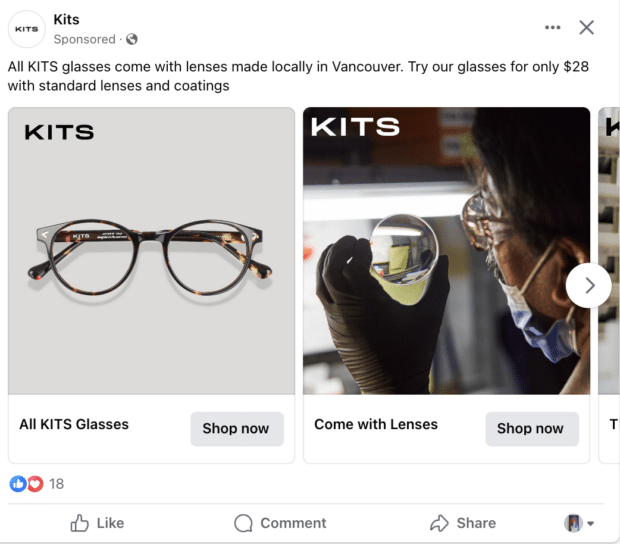
- Collection Ads: The "digital window shopping" experience. These ads allow users to browse product catalogs and make purchases without leaving the Facebook app, drastically reducing friction in the sales funnel.
- Advantage+ Shopping: The future of automation. These campaigns reduce the need for manual setup by automatically testing creative combinations and shifting budgets in real-time, often yielding a 20% lower cost-per-result.
Official Best Practices: Driving Results
Meta and industry experts advocate for a "mobile-first" mindset. Since the vast majority of users access the platform via smartphones, all creative assets must be designed for vertical, fast-paced consumption.
- The 3-Second Rule: Capture attention within the first three seconds of a video or the first glance of an image. If the user isn’t hooked immediately, they will scroll past.
- Sound-Optional Design: Because many users watch content in public spaces without audio, captions are mandatory for any video-based advertisement.
- A/B Testing: Never assume you know what will work. Test one variable—such as a headline, a CTA button, or a color palette—at a time. This scientific approach ensures that your scaling efforts are based on data, not intuition.
- Retargeting: It is significantly cheaper to convert a warm lead than to acquire a new one. Implementing pixel-based retargeting for website visitors who abandoned their carts is one of the most effective ways to lower your overall cost-per-acquisition.
Troubleshooting Common Underperformance
When ads fail to deliver, the issue is rarely the platform itself. It is usually one of three factors:
- Creative Fatigue: The audience has seen the ad too many times. Solution: Refresh the visuals and copy.
- Poor Audience Fit: The targeting is too narrow or too broad. Solution: Switch to "Advantage+ Audience" to let the algorithm broaden the search.
- Budget/Bid Mismatch: If the budget is too low for the objective, the ad cannot escape the "learning phase." Solution: Increase the daily budget or consolidate ad sets.
Conclusion: The Path Forward
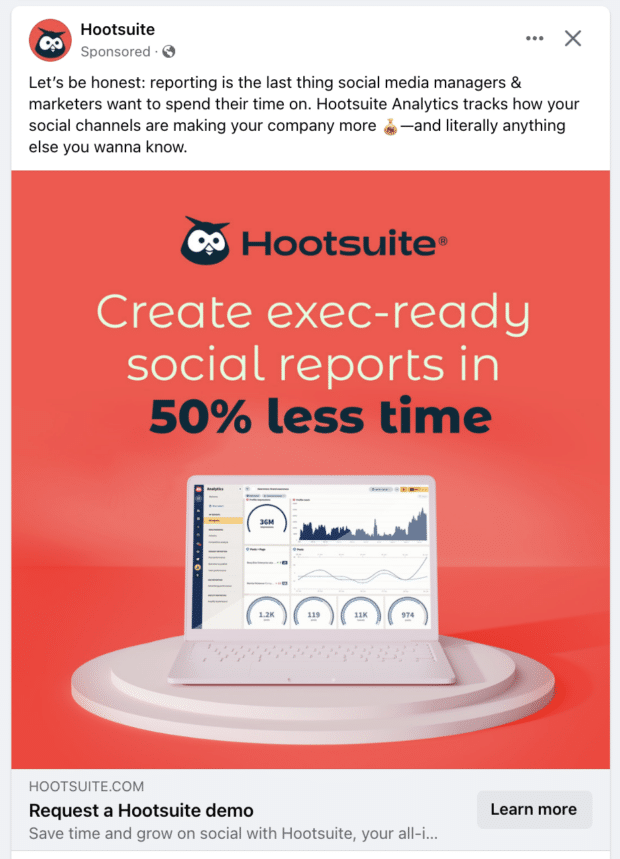
In 2026, the successful marketer is one who balances creativity with technical proficiency. By leveraging AI tools like Hootsuite’s "OwlyWriter AI" for copy generation and Meta’s Advantage+ suite for optimization, businesses can navigate the complexities of the Facebook advertising ecosystem with greater ease than ever before.
Whether you are a novice looking to run your first $5-a-day test or a seasoned professional managing an enterprise-scale budget, the formula for success remains consistent: define your goal, trust the data, respect the algorithm, and iterate constantly. The tools are powerful, the reach is global, and the potential for ROI remains among the highest in the digital marketing sphere.
