
HubSpot Service Hub vs. Zendesk: Navigating the Future of E-commerce Customer Support
In the modern digital economy, customer experience has transitioned from a backend necessity to a primary competitive advantage. As e-commerce businesses scale, the software powering their interactions with customers becomes the backbone of their operations. Among the myriad of solutions available, HubSpot Service Hub and Zendesk stand as the two undisputed titans.
While both platforms are designed to resolve customer inquiries, they approach the challenge from fundamentally different philosophies. HubSpot treats customer service as a vital component of a unified customer journey, whereas Zendesk treats it as a high-precision, high-volume operational engine. Choosing between them is not merely a feature-by-feature comparison; it is a strategic decision about how your business views its growth.
Main Facts: The Core Philosophies
To understand the divide between these two giants, one must look at their origins. HubSpot began as an inbound marketing pioneer, focused on attracting and retaining customers through meaningful content and data-driven personalization. Its expansion into CRM and Service Hub was a natural evolution, placing the customer record at the center of every action. When an agent opens a ticket in HubSpot, they aren’t just seeing a complaint; they are seeing a 360-degree view of that customer’s lifetime value, marketing interactions, and sales history.
Zendesk, conversely, was born in the world of IT help desks and high-volume contact centers. It is the gold standard for teams that live in queues. It is built to optimize the "velocity" of support—ensuring that the right agent gets the right ticket at the right time. For businesses where the sheer volume of incoming requests is the primary challenge, Zendesk offers a level of technical maturity and specialized workflow management that is, quite frankly, difficult to match.
Chronology and Market Evolution
The market for support software has seen massive shifts over the last decade, driven largely by the integration of Artificial Intelligence (AI).
- The Early Years: Zendesk dominated the mid-market by providing a "clean" interface that made complex ticketing feel manageable. HubSpot, meanwhile, focused on building the "Growth Stack," emphasizing that marketing, sales, and service should not exist in silos.
- The AI Pivot: Starting around 2023, both companies pivoted aggressively toward generative AI. HubSpot introduced Breeze AI, which focuses on automating the "contextual" side of service—using CRM data to draft responses that feel personal. Zendesk leaned into "Service AI," focusing on automated triage, sentiment analysis, and workforce management to handle massive scale.
- Current State: Today, the two platforms have reached a crossroads. Zendesk is aggressively attempting to move beyond "just tickets" to capture the broader customer experience market, while HubSpot is aggressively adding enterprise-grade support features to prove it can handle the scale of a global call center.
Supporting Data: Why It Matters
The financial and operational implications of this choice are profound. According to industry case studies, such as the implementation at Liquidity Services, companies that consolidate their tech stack onto a unified platform like HubSpot can see support costs plummet by as much as 50%. The reasoning is simple: when your sales, marketing, and support data live in one "Source of Truth," you eliminate the "swivel-chair effect"—the time wasted by agents toggling between three or four different browser tabs.
Conversely, Zendesk’s data advantage lies in its specialized metrics. For a contact center handling 50,000 tickets a month, the granularity of Zendesk’s reporting (Explore) is unmatched. It allows managers to track minute-by-minute performance, agent occupancy, and complex Service Level Agreements (SLAs) with a level of precision that HubSpot is still working to match in its most complex enterprise modules.
Deep Feature Comparison
Ease of Use and Onboarding
Zendesk provides an experience that feels like a well-oiled machine. Its interface is predictable, fast, and optimized for speed. A new agent can be onboarded into a Zendesk queue in a matter of hours. The platform is designed to be "out-of-the-box" ready.
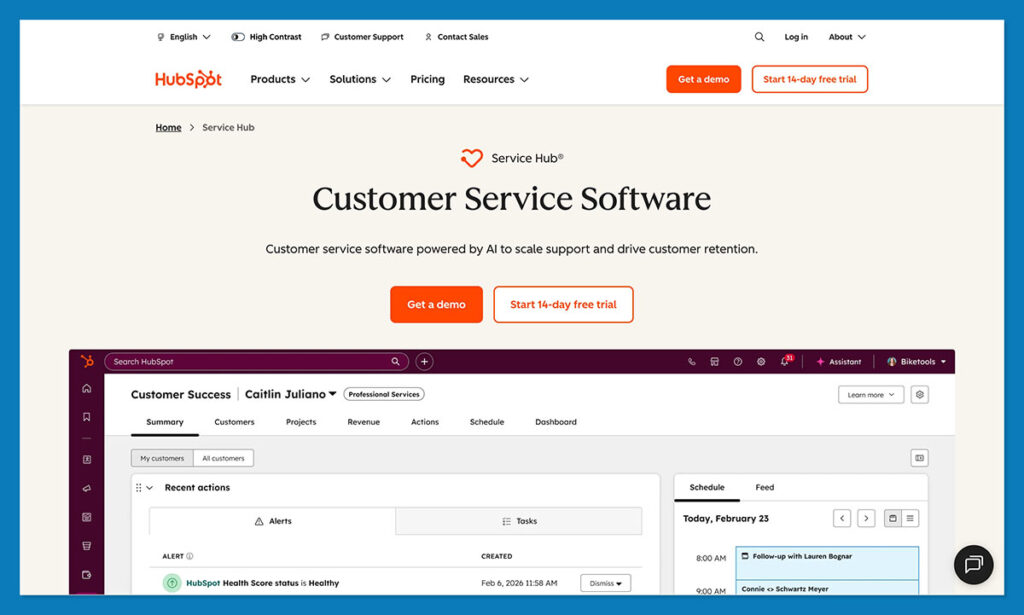
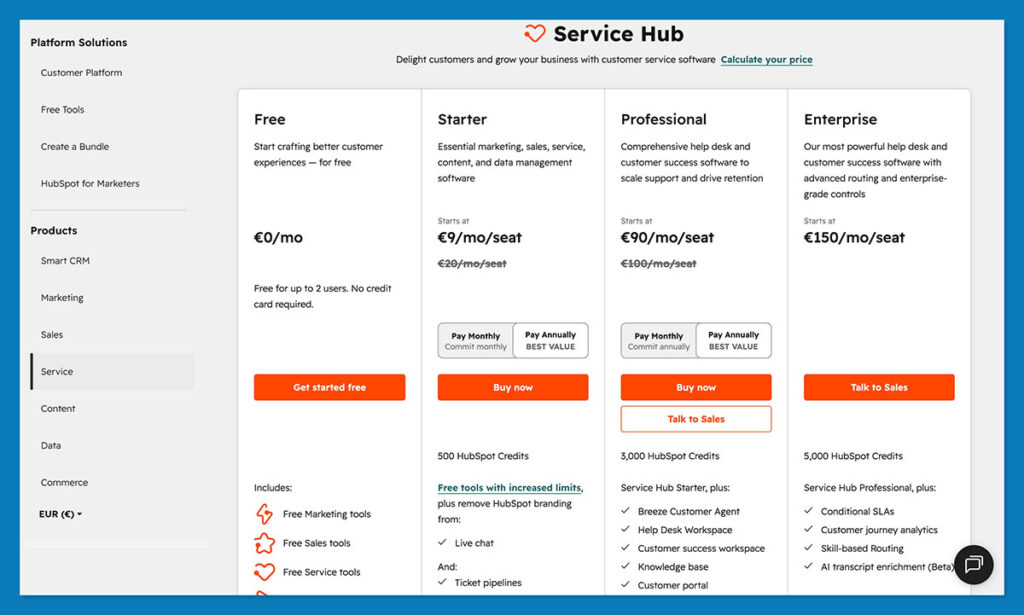
HubSpot offers a more "integrated" experience. While it is slightly more complex to configure initially because of the breadth of its features, the learning curve is mitigated by a consistent UI that spans the entire HubSpot platform. If your team is already using HubSpot for marketing or sales, the transition to Service Hub is nearly seamless.
AI and Automation
HubSpot’s Breeze AI is arguably the most powerful tool for e-commerce businesses that rely on repeat purchases. Because it is natively connected to the CRM, it doesn’t just answer questions; it understands if the user is a VIP, if they have an open invoice, or if they recently interacted with a marketing email.
Zendesk’s AI is the master of triage. It excels at taking a flood of unstructured, multi-channel inputs (SMS, chat, email, social media) and automatically routing them to the correct department based on language, sentiment, and urgency. If your goal is to reduce the "time-to-first-response" in a high-volume environment, Zendesk’s automation logic is unparalleled.
Omnichannel and CRM Connectivity
This is the "make or break" category for most e-commerce brands.
- HubSpot wins on context. The CRM is the foundation. Every channel (WhatsApp, email, chat) feeds into the same timeline.
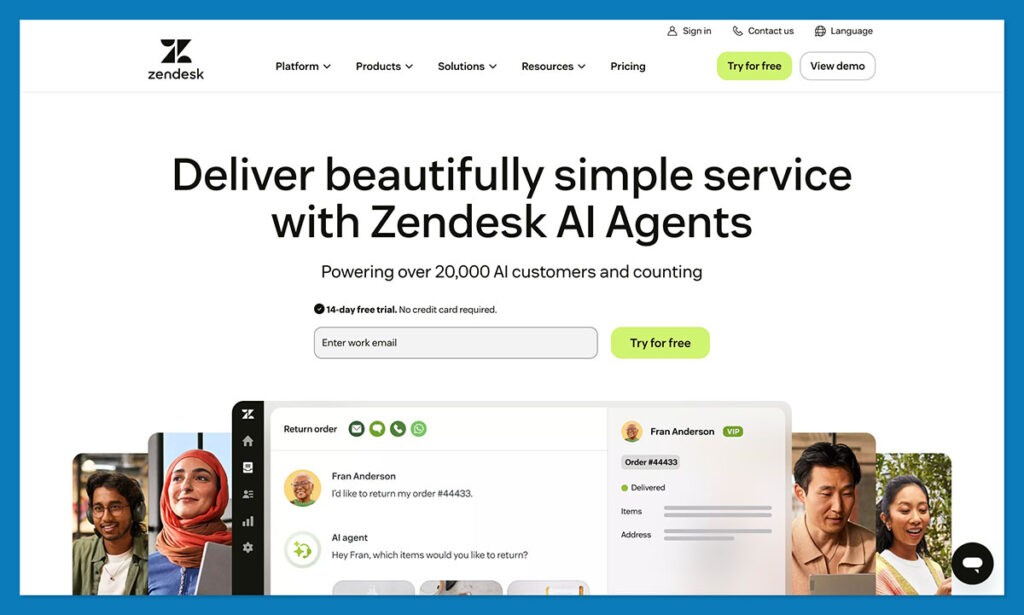
- Zendesk wins on channel breadth. It supports a wider variety of communication methods, including sophisticated voice integration and niche messaging apps, out of the box. However, without a deep, custom integration, Zendesk struggles to pull in the same level of granular purchase history that HubSpot does natively.
Official Perspectives and Strategic Implications
When speaking with industry leaders, the consensus often follows a predictable pattern:
"We chose Zendesk because our support volume grew by 300% in a single year, and we needed a platform that wouldn’t crash under the weight of 5,000 tickets a day," says one e-commerce operations manager. "We didn’t need the marketing features; we needed the ticketing stability."
"We moved to HubSpot because we were tired of our marketing team not knowing what our support team was doing," notes a Director of Customer Experience at a mid-sized fashion retailer. "Now, if a customer complains about a delivery, our marketing team pauses their automated promotions to that customer. That level of orchestration saved our brand reputation."
Implications for Your Business
The decision between HubSpot and Zendesk boils down to your Primary Pain Point:

-
Choose HubSpot Service Hub if: You are an e-commerce business that prioritizes customer retention, LTV, and cross-departmental collaboration. If you want your support team to be an extension of your marketing and sales efforts, HubSpot’s unified CRM is the clear winner. The ability to trigger automated workflows based on purchase behavior, subscription status, or marketing engagement is a massive competitive advantage.
-
Choose Zendesk if: You are running a high-volume support operation where the primary goal is efficiency, speed, and ticket resolution. If your team spends the majority of their day on the phone or managing massive queues of inquiries, Zendesk’s purpose-built, "service-first" architecture will provide the stability and reporting power you need to manage a large staff.
Final Verdict
Both platforms are at the top of their game. HubSpot has successfully transitioned from a "marketing tool" to a comprehensive business operating system, while Zendesk remains the industry standard for dedicated, high-intensity support teams.
For the average e-commerce brand looking to scale, HubSpot offers a more cohesive future. By breaking down the walls between the "ticket" and the "customer," it allows brands to treat support as a revenue-generating activity rather than a cost center. However, for the contact center manager dealing with high-volume, multichannel chaos, Zendesk remains the sturdy, battle-tested workhorse that will not let you down.
Quick Summary Checklist
- Need an All-in-One Growth Platform? Go with HubSpot.
- Need an Enterprise-Grade Ticket Factory? Go with Zendesk.
- Is CRM integration your #1 priority? Go with HubSpot.
- Is Voice/Phone support your #1 priority? Go with Zendesk.
Ultimately, the best way to decide is to utilize the free trials offered by both. Load them with a week’s worth of your real customer data. You will quickly discover which interface feels like a natural extension of your team’s daily workflow.
