
Beyond the Dashboard: Redefining Creator Economy Measurement for the AI Era
As we move deeper into 2026, the marketing industry is experiencing a long-overdue reckoning regarding how it evaluates the creator economy. For years, the industry has relied on a superficial suite of platform-native metrics—views, completion rates, and "vanity" engagement—to determine the success of influencer partnerships. While these metrics provide a window into distribution efficiency, they increasingly fail to capture the actual business value generated by creator content.
In the current climate, where influencer marketing has shifted from a peripheral experiment to a central pillar of corporate strategy, the reliance on single-scorecard evaluations is proving detrimental. To succeed in 2026, brands must abandon the "one-size-fits-all" measurement mindset and adopt a layered framework that accounts for the nuances of content intent, the rise of AI-driven consumer discovery, and long-term brand equity.
The Measurement Crisis: Why Old Metrics No Longer Suffice
The core issue facing modern marketing teams is a misalignment between content objectives and evaluation tools. Too often, a high-level awareness video—designed to spark cultural conversation—is measured using the same yardstick as a bottom-of-funnel shoppable post.
When a brand treats a narrative endorsement with the same expectations as a quick product demo, they walk away with skewed, incomplete data. This isn’t because the platform metrics (views, clicks, impressions) are inherently wrong; it is because they are being applied out of context.
"Standard platform metrics tell us important things about distribution efficiency and attention capture," says Paula Bruno, founder and CEO of Intuition Media Group. "They answer how far the content traveled and how many people stayed with it. Those signals are vital at the top of the funnel. The problem begins when teams stop there, effectively ignoring the deeper, more meaningful behavioral shifts that drive long-term growth."
A Layered Measurement Stack: A New Strategic Framework
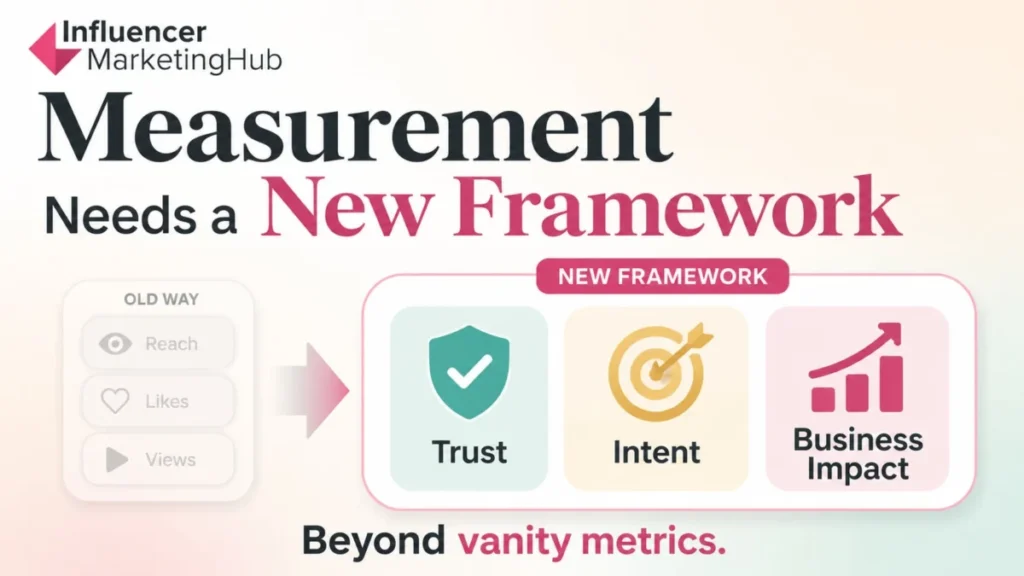
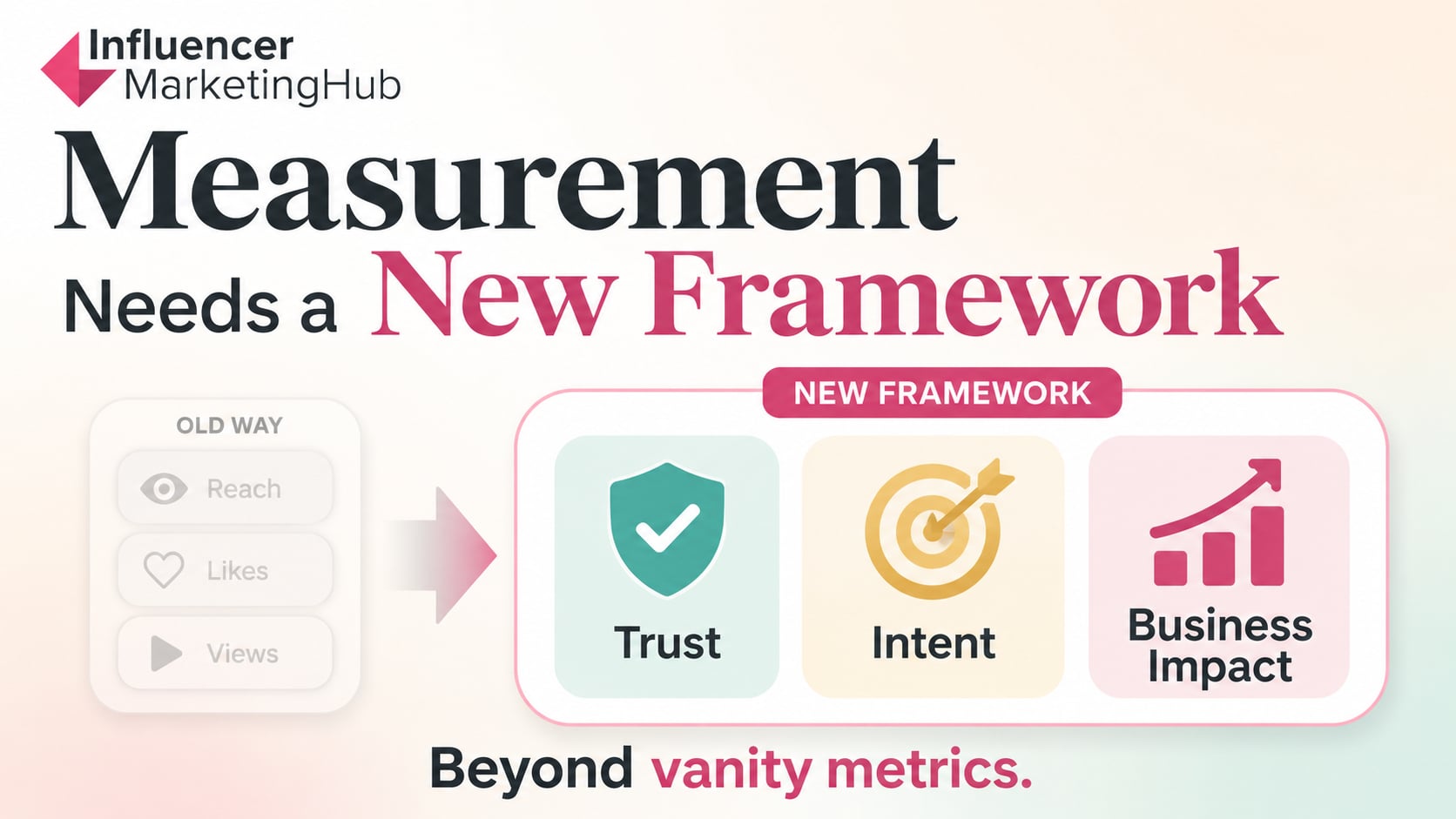
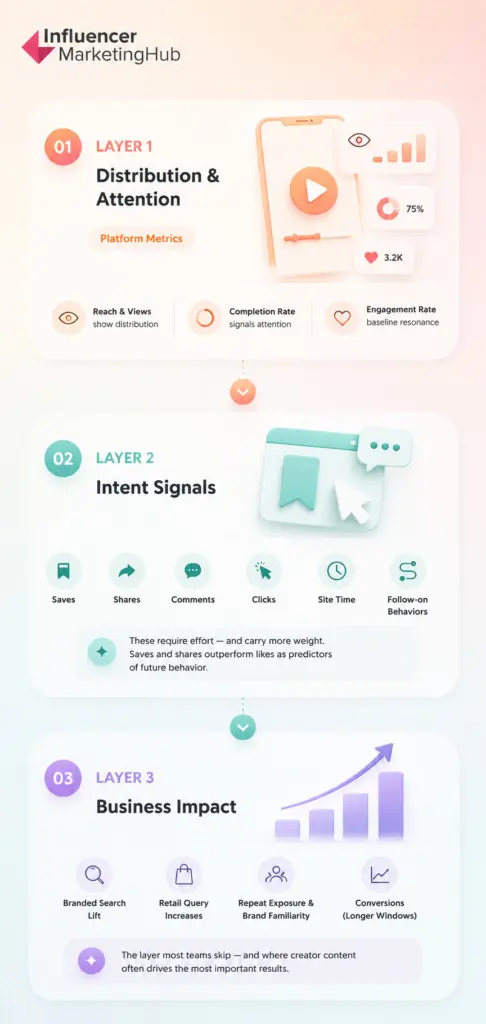
To move beyond the limitations of current dashboards, the most effective creator programs are implementing a three-tiered "Measurement Stack." This approach ensures that success is evaluated based on the specific role each piece of content plays in the customer journey.
Layer 1: Distribution and Attention (The Platform Baseline)
This foundational layer focuses on the reach and retention of the content. It answers the fundamental question: Did the content clear the first hurdle? By analyzing views and completion rates, brands establish a baseline for how effectively a creator’s audience—or the platform’s algorithm—received the message. This remains a crucial metric for measuring initial brand visibility.
Layer 2: Intent Signals (The Engagement Depth)
This layer carries significantly more weight than the first, as it requires active participation from the audience. In 2026, industry data consistently demonstrates that "saves" and "shares" are far more reliable predictors of future consumer behavior than simple "likes." When a user saves a post, they are essentially creating a digital bookmark for future reference; when they share it, they are providing a peer-to-peer endorsement. These actions are highly predictive of purchase intent, particularly for educational or high-consideration product categories.
Layer 3: Business Impact (The ROI Engine)
This is the layer that many organizations continue to overlook, yet it is where creator content does its most critical work. Business impact metrics look beyond the platform dashboard to track real-world results: coupon code redemptions, direct website traffic, brand search lift, and repeat retail visits. By isolating creator-driven traffic from other marketing channels, brands can begin to calculate true return on investment (ROI).
The Role of Content Segmentation
Not all creator content is designed to trigger the same reaction. Segmentation is now a non-negotiable part of the measurement process.
For instance, content built for mental availability—the ability of a brand to come to mind when a consumer is in a buying situation—does not always lead to an immediate conversion. Its success is often delayed, appearing in search trends, retail store inquiries, and long-term brand health trackers months after the initial exposure.
Conversely, performance-driven content is designed for immediate action. If a brand penalizes an awareness-building campaign for lacking high conversion signals, or overvalues a performance campaign based solely on reach, they are fundamentally misunderstanding the role of the creator. The framework must match the intent.
The Catalyst for Change: The AI-Driven Discovery Era
The urgency to overhaul measurement practices is being supercharged by a seismic shift in how consumers discover products: AI-driven search.
As of mid-2026, research indicates that more than 50% of U.S. consumers utilize large language models (LLMs) and AI-powered assistants to navigate their shopping journeys. When a consumer asks an AI tool to "recommend the best skincare routine for sensitive skin" or "find a reliable mid-size SUV," they are bypassing traditional search engines.
In these moments, the AI is not "inventing" opinions. It is synthesizing the existing, high-quality content ecosystem. This creates two vital shifts for brands:
- The "Trusted Content" Necessity: Brands must invest in high-quality, long-form, and helpful creator content that acts as the "source code" for AI models. If a brand’s presence in the creator ecosystem is thin or low-quality, the AI will simply recommend a competitor with more robust documentation.
- The "Dark Traffic" Phenomenon: Much of the influence exerted by creator content now occurs outside of trackable links. A consumer might watch a creator video, form an opinion, and then later search for the brand directly or visit a physical store. Because this path is fragmented, the conversion never shows up on a platform dashboard.
Consequently, brands are learning that they must correlate platform activity with aggregate business data, such as organic search spikes and regional retail sales, to truly measure the effectiveness of their creator programs.
Implications for 2026 and Beyond
As creator programs become more embedded in global business operations, the bar for accountability is rising. The most successful brands in 2026 are those that have moved past the era of the "single scorecard."
Key Shifts in Measurement Strategy:
- Integrating Offline and Online Data: Top-tier brands are now mapping creator campaign windows against physical retail point-of-sale (POS) data to identify lift that never appeared in social analytics.
- Adopting Predictive Modeling: By utilizing AI to analyze historical engagement patterns, teams are moving toward predictive measurement, identifying which creator partnerships are most likely to drive long-term brand equity before the campaign even launches.
- Standardizing "Intent" Metrics: Organizations are increasingly treating "saves" and "shares" as primary KPIs for high-intent marketing, shifting budget away from creators who generate "likes" but lack the authority to drive consumer behavior.
Conclusion: Honesty in Measurement
The new measurement framework is not necessarily more complex, but it is significantly more honest. It acknowledges that social media is no longer just a megaphone; it is a complex, multi-layered ecosystem that feeds into search, retail, and AI discovery.
As Intuition Media Group’s Paula Bruno notes, the goal is to build creator ecosystems that "compound." When brands design their programs for cultural relevance while building them for measurable business impact, they create a virtuous cycle. The platform metrics of yesterday have not become irrelevant, but they are insufficient. In 2026, the brands that win will be the ones that understand not just how many people saw their content, but what that content actually caused them to do.
