
Agentic Lovemarks: Reimagining Brand Equity in the Age of Intelligent Systems
For decades, the gold standard of brand building has been the “Lovemark”—a concept popularized by Kevin Roberts at Saatchi & Saatchi, which argued that brands must transcend functional utility to earn both love and respect. However, as the digital landscape undergoes a tectonic shift toward an “agentic economy,” this foundational philosophy is being forced to evolve.
A seminal new manifesto, Brand Constitutions: The Legible-Lovable Standard for Building Equity in an Agentic Economy by Thomas Marzano, has ignited an industry-wide re-examination of how brands survive in a world where intelligent agents—rather than humans—increasingly mediate the path to purchase. This article explores how the classic Lovemark model is being redefined to bridge the gap between human emotion and machine-driven logic.
The Shift: From Human Choice to Agentic Mediation
For years, the branding playbook was straightforward: earn respect through performance and win love through emotional resonance. This model assumed a human-led decision journey where consumers compared, evaluated, and ultimately chose based on personal interpretation.
In the emerging agentic age, that journey is collapsing. We are moving toward a reality where AI-driven agents—acting on behalf of users—decide which products or services enter the consideration set. Systems do not “feel” brand loyalty; they evaluate, verify, and filter based on pattern recognition, structural clarity, and data-driven reliability.
This creates an urgent strategic imperative: brands must now communicate simultaneously with two distinct audiences—the human heart, which craves meaning, and the machine algorithm, which requires legibility.
Chronology of the Lovemarks Evolution
- The Classic Era (Early 2000s): Kevin Roberts’ Lovemarks introduced the "Love-Respect Axis." Brands were urged to move beyond commodity status by injecting mystery, sensuality, and intimacy into their identity.
- The Digital Disruption: As e-commerce and search engines grew, the "funnel" became the dominant metaphor. Brands fought for visibility in digital marketplaces, often prioritizing search engine optimization (SEO) over emotional storytelling.
- The Agentic Turn (Present Day): With the rise of Generative AI and autonomous personal assistants, the decision-making process is becoming automated. The "funnel" is being compressed, and the criteria for entry are shifting from broad awareness to algorithmic "qualification."
- The Emergence of the Agentic Lovemark: As outlined by Marzano and further expanded in current discourse, the new standard requires brands to codify their emotional DNA into structural signatures that machines can verify.
Supporting Data: Why Emotion is Now a Competitive Requirement
McKinsey’s recent research into "Agentic Commerce" underscores that while AI excels at functional optimization—price, availability, and delivery speed—it struggles with the nuance of human preference. As AI commoditizes content and functional parity becomes the baseline, emotional distinction is no longer a "romantic luxury"; it is the ultimate differentiator.
When agents perform the heavy lifting of decision-making, they rely on "Machine Trust." Machine trust is the digital manifestation of respect. It is built on:
- Coherence: Does the brand behave consistently across every touchpoint?
- Metadata and Provenance: Can the system verify the brand’s origins and claims?
- Behavioral Consistency: Do the patterns of consumer interaction with the brand signal high engagement and stability?
Without this structural legibility, even the most beloved brand risks invisibility. A brand that is loved by humans but invisible to machines will never reach the consumer’s shortlist.
Official Perspectives: The "Organizing Idea" as a Bridge
The core of this evolution lies in the "Organizing Idea." For brands like Nike ("If you have a body, you are an athlete"), Apple ("Unleashing Creativity"), and IKEA ("Design for the many"), the organizing idea serves as a strategic compass.
In the agentic age, this idea must function as a dual-language translator. It must be:
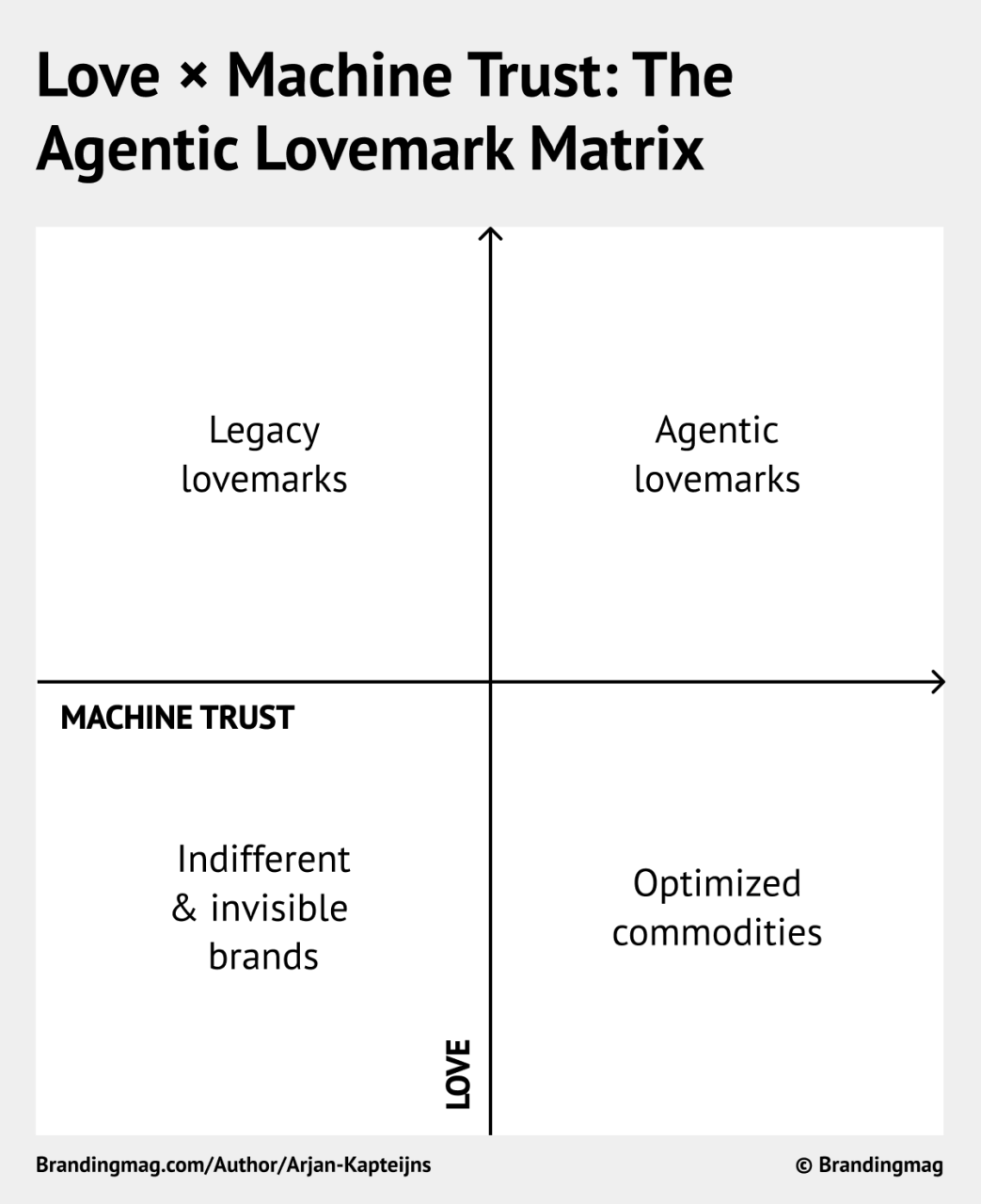
- Emotionally Deep: Resonating with the human desire for purpose, identity, and belonging.
- Structurally Clear: Providing a logic that can be encoded into metadata, interface design, service architecture, and consistent behavioral rituals.
Thomas Marzano argues that the "Brand Constitution" is the tool that codifies this. It is not a bureaucratic document but an intentional architecture that ensures a brand’s soul (love) and its system (legibility) are perfectly aligned.
Implications for the Future of Marketing
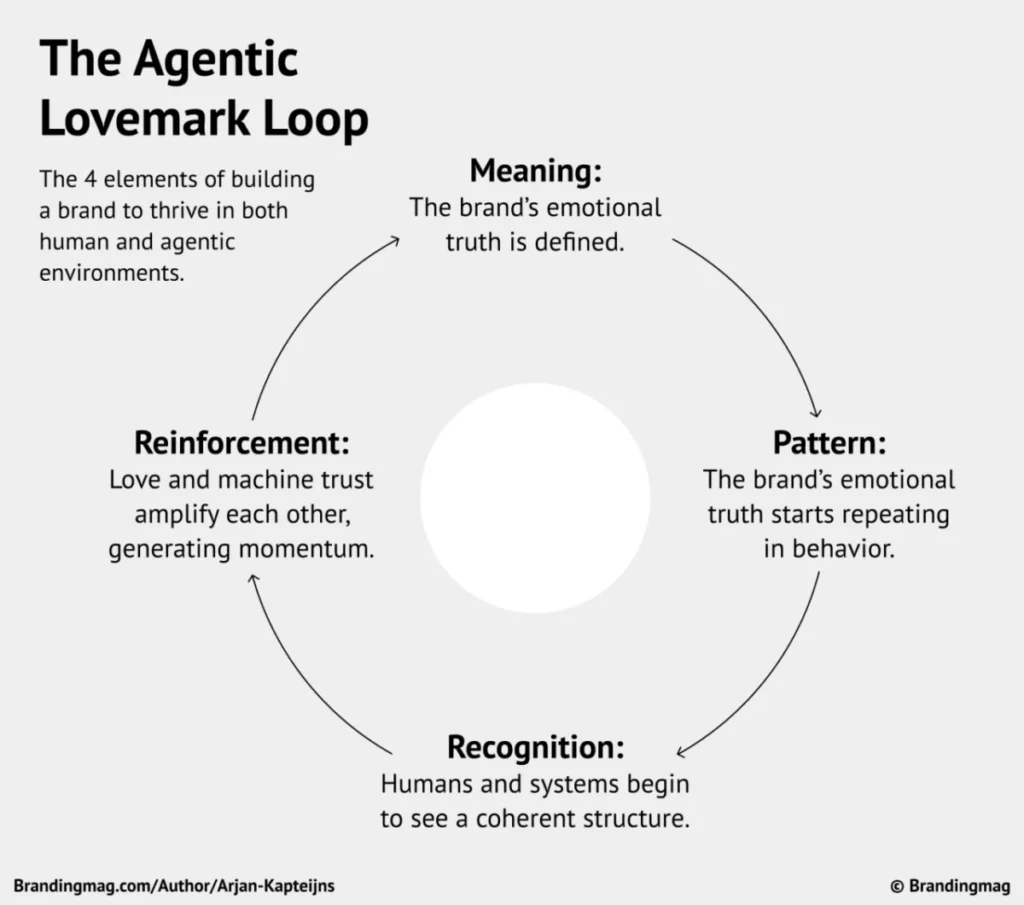
The "Agentic Lovemark" Loop
The future of branding lies in a self-reinforcing loop:
- Meaning: The brand defines a core emotional territory.
- Pattern: This meaning is codified into consistent behaviors, service moments, and design signatures.
- Recognition: Intelligent agents detect these behavioral patterns and recognize the brand as a "trusted" entity.
- Reinforcement: As agents surface the brand more frequently, humans engage with it more often, deepening their emotional connection and strengthening the behavioral patterns that the agents track.
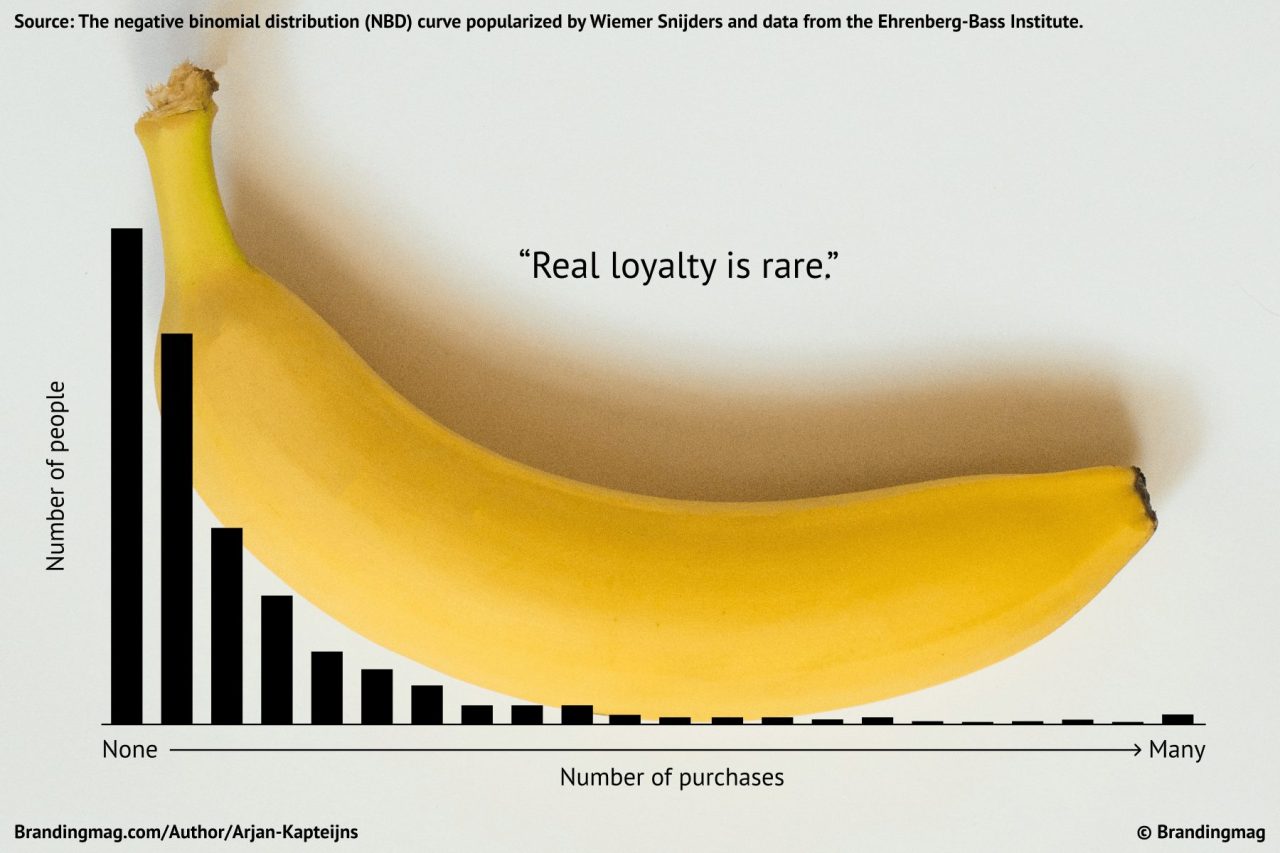
The Death of the "Banana Principle"?
Marketing science, notably the work of Byron Sharp and Ehrenberg-Bass, has long suggested that loyalty is a statistical byproduct of availability (the "Banana Principle"). However, in an agentic world, this may change. Because agents tend to stabilize preferences and reinforce repeated choices, the "randomness" of switching behavior may decrease. Loyalty will become more predictable, not just because humans are choosing the brand, but because the system is reinforcing that choice.
The Creative Fear: Soul vs. Optimization
A common concern among creatives is that the push for "machine legibility" will lead to a bland, optimized, and soulless environment. This is a critical distinction: Legibility is not the same as creativity.
The creative process—the "slightly crooked line" that makes work human—must remain the domain of human practitioners. AI cannot "fake" lived experience, failure, or the genuine struggle of creation. The task of the modern marketer is to keep the emotional core human while ensuring the delivery of that emotion is structurally optimized for an agent-mediated world.
Conclusion: The New Gold Standard
The rise of intelligent agents does not signal the end of brand emotion; it signals the end of brand ambiguity. To succeed in this new era, marketers must embrace a hybrid approach. An Agentic Lovemark is a brand with both a soul and a system. It is a brand that understands that while humans choose based on how they feel, machines choose based on how brands behave.
By reconciling these two worlds, brands can move beyond the fragmented, noisy digital environment of the past. They can evolve into entities that are not just "found" by an algorithm, but "chosen" by both the human heart and the machine mind. This is the new frontier of brand equity—where the most powerful brands are those that can be deeply felt by people and clearly read by the systems that serve them.
