
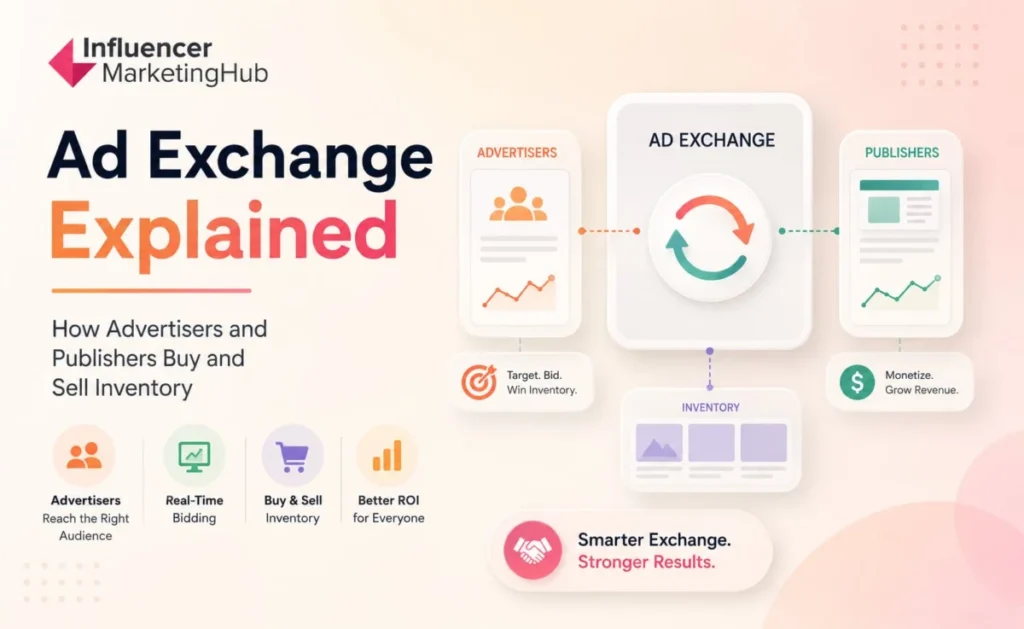
Ad Exchange Explained: How Advertisers and Publishers Buy and Sell Inventory
In the hyper-accelerated world of digital marketing, the process of connecting a brand with a consumer happens in a fraction of a second. While a user waits for a webpage to load, a complex, high-stakes auction occurs behind the scenes. This is the domain of the Ad Exchange, the digital marketplace that serves as the engine room of modern programmatic advertising.
As the industry moves away from legacy manual ad buying, understanding the mechanics of ad exchanges has become essential for brands, agencies, and publishers alike.
The Core Mechanism: What is an Ad Exchange?
An ad exchange is a digital marketplace that enables advertisers and publishers to buy and sell advertising inventory through real-time auctions. It acts as a neutral technology platform where Supply-Side Platforms (SSPs), used by publishers to manage their ad space, and Demand-Side Platforms (DSPs), used by advertisers to purchase that space, converge.
Unlike traditional ad networks—which act as intermediaries that aggregate inventory and resell it at a markup—ad exchanges provide a transparent, automated environment. They facilitate "Real-Time Bidding" (RTB), a process that ensures the most relevant ad reaches the most relevant user at the optimal price.
Chronology: The Evolution of Digital Trading
To understand why ad exchanges are the standard today, one must look at how the digital advertising landscape has evolved over the past two decades.
1. The Early Days (2000–2005)
Digital advertising was rudimentary. Publishers sold ad space directly to advertisers via sales teams. Deals were negotiated manually, and contracts were cumbersome. Inventory was often sold in bulk, leading to significant wastage.
2. The Rise of Ad Networks (2005–2009)
Ad networks emerged to bridge the gap. They acted as brokers, buying unsold inventory from publishers and selling it to advertisers. While this improved efficiency, it created a "black box" scenario where pricing transparency was minimal and middleman fees were high.
3. The Programmatic Revolution (2010–2015)
The introduction of Real-Time Bidding (RTB) changed everything. The first ad exchanges (such as DoubleClick, now part of Google) began to automate the process, allowing for granular targeting based on user behavior rather than just site content.
4. The Era of Transparency and Automation (2016–Present)
Today, ad exchanges are highly sophisticated. They incorporate Artificial Intelligence (AI) and Machine Learning (ML) to predict ad performance, manage fraud, and ensure brand safety. With the phasing out of third-party cookies, the focus has shifted toward privacy-first, first-party data integration within these exchanges.
Supporting Data: The Scale of the Market
The shift toward programmatic buying via ad exchanges is not merely a trend; it is the dominant mode of digital commerce. According to recent market analysis:
- Market Penetration: Over 85% of all digital display advertising is now transacted programmatically.
- Speed: A typical ad exchange auction process takes approximately 100 milliseconds—faster than a human blink.
- Efficiency Gains: Advertisers using programmatic exchanges report a 20–30% reduction in customer acquisition costs compared to manual buying, primarily due to the elimination of human-negotiated overhead and improved targeting precision.
- Privacy Shift: Projections indicate that by 2027, over 70% of programmatic spend will rely on contextual or first-party data signals, as ad exchanges adapt to the sunsetting of third-party tracking.
How the Auction Works: The Technical Workflow
The magic of the ad exchange happens through a synchronized dance between three primary entities:
1. The Publisher (The Seller)
Publishers use an SSP (Supply-Side Platform) to upload their available ad slots. They set "floor prices"—the minimum amount they are willing to accept for an impression.
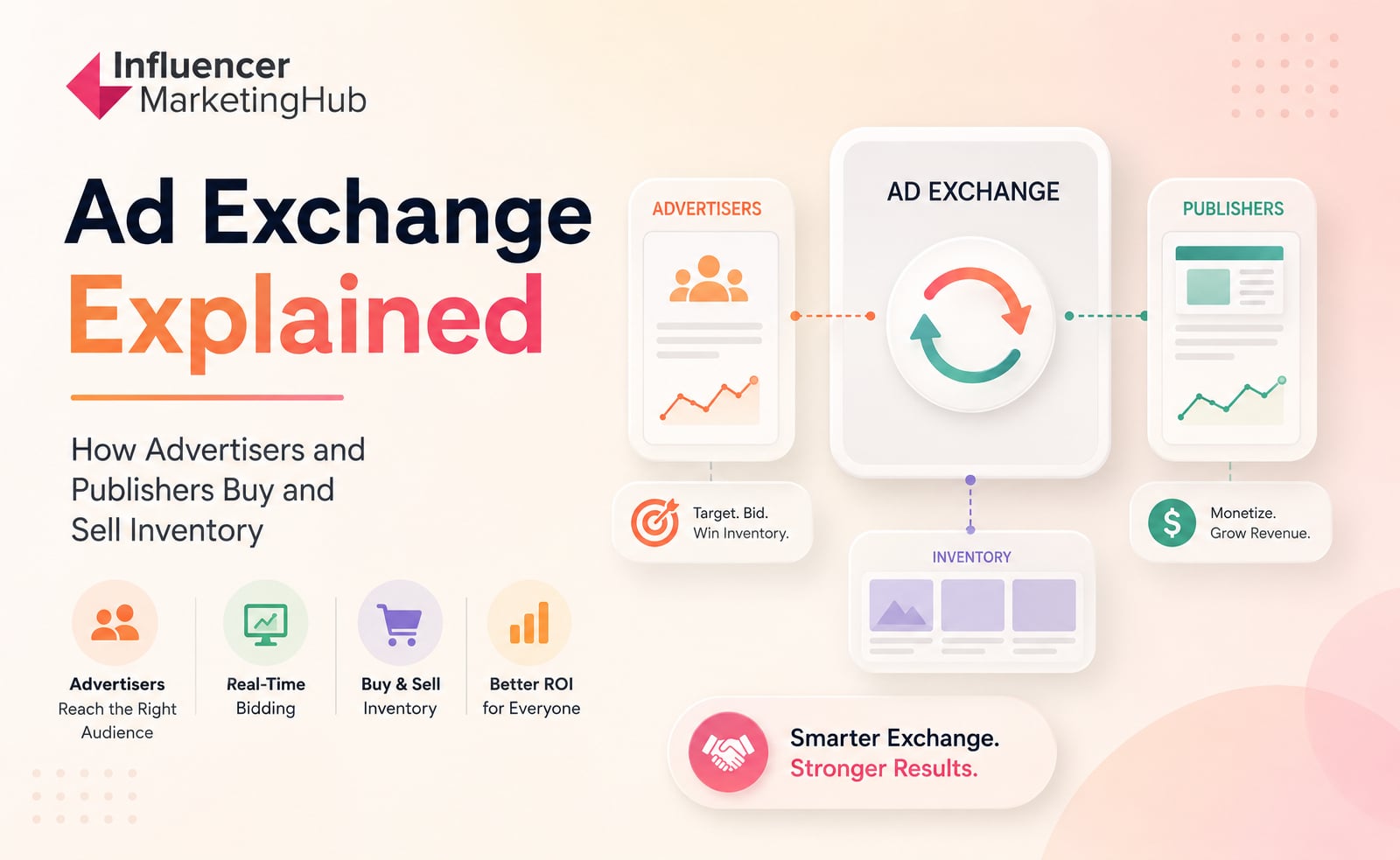
2. The Advertiser (The Buyer)
Advertisers use a DSP (Demand-Side Platform) to define their target audience, budget, and campaign goals. When a user visits a site, the SSP sends a request to the exchange with data about the user and the page.
3. The Exchange (The Matchmaker)
The exchange runs a lightning-fast auction. DSPs analyze the user data and bid on the impression. The highest bidder wins, and their ad is instantly served to the user.
Official Industry Perspectives
The adoption of ad exchanges has drawn commentary from major industry stakeholders regarding the future of the web.
On Transparency:
The Interactive Advertising Bureau (IAB) has long championed the "Ads.txt" initiative, an industry-wide effort to combat ad fraud by allowing publishers to publicly list the companies authorized to sell their inventory. Official reports from the IAB emphasize that ad exchanges have become the primary defense against unauthorized inventory resale.
On Privacy:
Google and other major exchange operators have released official statements highlighting the transition toward the "Privacy Sandbox." The consensus among industry leaders is that the future of the ad exchange lies in "Federated Learning"—where the exchange learns from user behavior without ever exposing the individual user’s personal identity.
Strategic Implications: Why This Matters
For marketers and publishers, the reliance on ad exchanges has profound strategic implications.
For Advertisers:
- Scalability: You can reach millions of users across thousands of websites through a single platform.
- Data-Driven Decisions: Real-time feedback loops allow for constant campaign optimization. If an ad isn’t performing, the exchange allows you to shift budget in real-time.
- Brand Safety: Modern exchanges offer sophisticated filtering tools that prevent ads from appearing on sites with offensive or irrelevant content.
For Publishers:
- Yield Maximization: By opening up inventory to multiple bidders simultaneously, publishers ensure they receive the highest possible market price for their ad space.
- Reduced Overhead: Automation eliminates the need for massive sales teams to manually traffic and manage ad campaigns.
- Inventory Control: Publishers can use "private marketplaces" (PMP) within the exchange to offer premium inventory only to select, high-value advertisers, keeping their brand image intact.
The Future Landscape: Challenges and Opportunities
While ad exchanges have revolutionized digital marketing, they face significant headwinds.
1. The Death of the Third-Party Cookie
The most significant challenge is the privacy-centric evolution of the web. As browsers like Chrome and Safari restrict tracking, ad exchanges are pivoting toward Contextual Advertising. Instead of targeting "User X," exchanges are now using AI to analyze the content of a page and place ads relevant to the topic of the article, rather than the history of the reader.
2. Ad Fraud and Viewability
Despite the security measures like Ads.txt, "bot traffic" remains a concern. Sophisticated ad exchanges are now integrating blockchain-based verification and advanced AI fraud detection to ensure that human beings—not bots—are viewing the advertisements.
3. The Consolidation of Tech
We are seeing a move toward "Supply Path Optimization" (SPO). Advertisers are increasingly looking to consolidate the number of ad exchanges they use to reduce "ad tech tax"—the portion of the budget that goes to middlemen rather than the publisher.
Conclusion
The ad exchange is far more than a technical utility; it is the infrastructure that supports the free, content-rich internet as we know it today. By enabling a fair, transparent, and high-speed marketplace, exchanges allow brands to connect with their audiences with unprecedented accuracy while providing publishers with the revenue necessary to create content.
As we look toward 2026 and beyond, the winners in this space will be those who master the delicate balance between data-driven targeting and the growing consumer demand for digital privacy. Whether you are a publisher looking to monetize your audience or an advertiser looking to scale your reach, the ad exchange remains your most vital tool in the digital age.
