
Beyond the Pilot: Why Marketing Teams Must Shift from AI Adoption to AI Adaptation
In the rapid-fire landscape of modern marketing, the "AI gold rush" has largely concluded. Most marketing organizations have moved past the initial phase of skepticism, successfully rolling out generative AI tools across their departments. From content creation platforms to data analytics suites, the infrastructure of the future is now firmly in place. However, a glaring disconnect has emerged: while the tools have been adopted, the work remains largely unchanged.
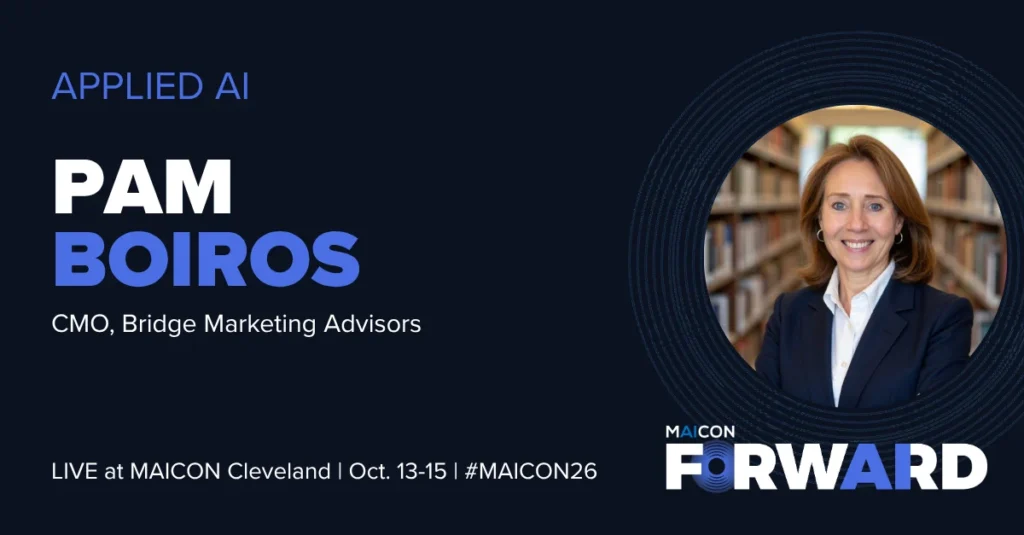
This gap between technical adoption and organizational adaptation is the defining challenge for CMOs and marketing leaders in 2026. Addressing this critical juncture, industry strategist Pam Boiros—fractional CMO at Bridge Marketing Advisors and co-founder of Women Applying AI—is set to headline MAICON 2026. Her session, "AI Adaptation: The People Side of Scale," argues that the true transformation of the marketing function does not lie in the software, but in the radical redesign of human workflows.
The Chronology of the AI Evolution
The journey toward AI-integrated marketing has followed a predictable, if incomplete, trajectory over the last three years:
- The Phase of Novelty (2023): Teams experimented with LLMs as a novelty. Individual contributors tested prompts, often in secret, to handle menial tasks like email drafting or basic brainstorming.
- The Phase of Tool Proliferation (2024-2025): Organizations formally adopted enterprise licenses. Training sessions were held, policies were drafted, and "AI implementation" became a line item on corporate budgets.
- The Current Plateau (2026): Many leaders have hit a wall. While the tools are active, productivity gains are uneven, and the "AI-driven" workflow often looks suspiciously like the manual workflow, just performed with more expensive software.
Boiros, who has led marketing organizations at industry giants like Skillsoft and meQuilibrium, notes that this plateau is a natural byproduct of treating AI as a "separate initiative" rather than a foundational change to the nature of labor.
Defining the Adaptation Threshold
According to Boiros, the transition from adoption to adaptation is marked by a fundamental shift in perception. "You know you’ve moved from AI adoption to AI adaptation when AI stops feeling like a separate initiative and starts changing how the work itself gets done," she explains.
In an adoption-heavy environment, an employee might use a tool to write a blog post, but the internal approval process, the strategic briefing, and the measurement metrics remain tied to legacy models. In an adapted environment, the entire workflow is re-engineered. Humans move into roles of editors, curators, and strategic directors, while the machine handles the heavy lifting of synthesis and production.
This shift is quantifiable. Leading organizations are no longer measuring "number of prompts run" or "number of seats assigned." Instead, they are asking deeper questions:
- Are we spending more time on work that requires genuine human judgment, emotional intelligence, and complex relationship-building?
- Have we established repeatable, scalable workflows that are resilient to the rapid evolution of AI models?
- Is the quality of output objectively higher, or are we simply producing more noise?
The Overlooked Pillar: Organizational Culture
While technology architecture and data governance are common focus areas for CTOs, Boiros identifies a more elusive, yet critical, building block: Culture.
In many corporate environments, culture is defined by a reward system that prioritizes "polished answers" and "certainty." This is the enemy of AI adaptation. AI requires an environment where employees feel safe failing, where they can openly discuss what they don’t know, and where they are encouraged to dismantle workflows they spent years mastering.
When the culture is rigid, employees fall into one of two dangerous traps: they either reject the technology entirely to avoid the risk of error, or they experiment in silos, keeping their innovations hidden from the team. To move forward, leaders must signal that curiosity is a professional asset. This involves leaders being vulnerable about their own AI journey—sharing their failures and demonstrating their own learning process—which effectively democratizes the tool and turns it from a "productivity hack" into a collective team capability.
Analyzing the Resistance: Why Fear Wears Many Masks
Three years into the AI cycle, the resistance to change has become more sophisticated. It is rarely expressed as a blanket refusal to use technology; instead, it manifests as subtle, logical-sounding objections.
"I don’t have time to learn another tool," "This doesn’t apply to my specific role," or "I tried it once and the output was poor," are the common refrains. Beneath these statements, however, lies a deeper, existential anxiety. Employees are worried about their long-term relevance, their career trajectories, and the possibility that they are already falling behind.
Boiros warns that simply throwing more training at the problem is a mistake. "What works better is creating space for people to learn without feeling like they’re taking on a second job," she asserts. The most successful teams prioritize "small wins." By integrating AI into existing, high-friction tasks, teams experience immediate relief. Once a marketer realizes that AI can solve a specific, painful problem in their current workflow, the conversation shifts from "Why do I have to use this?" to "Where else could this help me?"
Implications for the Future of Marketing
The implications of this shift are profound for the organizational structure of marketing departments. As AI takes over repetitive cognitive tasks, the value of the human worker shifts upward. The "junior" tasks that once served as the training ground for new marketers are disappearing. This requires a rethink of how we mentor talent and how we structure career paths.
Furthermore, the "guardrails" mentioned by Boiros are not merely legal or brand-safety checklists. They represent a new philosophy of management. Managers must evolve into "AI-assisted coaches" who set quality expectations not just for the final product, but for the quality of the interaction between the human and the machine.
Preparing for MAICON 2026: The Path Forward
The upcoming MAICON 2026 conference aims to bridge the gap between abstract AI strategy and daily execution. Pam Boiros’s session is specifically designed to provide a tactical playbook for leaders who feel they have successfully "deployed" AI but have yet to see the desired transformation in team output and morale.
Attendees at the session will explore:
- Building Confidence and Trust: How to move teams past the fear of obsolescence and toward a mindset of augmentation.
- Systematizing Creativity: Turning the "scattered experimentation" of the early years into rigorous, repeatable, and scalable workflows.
- Burnout Mitigation: Ensuring that the integration of AI tools reduces cognitive load rather than simply increasing the volume of output.
- Strategic Governance: Setting guardrails that foster creativity rather than stifling it.
For marketing leaders, the goal of MAICON 2026 is to move beyond the hype cycle and into the era of operational maturity. The tools are no longer the story; the story is the team. By focusing on the people side of scale, leaders can ensure that their organizations don’t just survive the transition, but thrive as they redefine the very nature of marketing excellence.
As Boiros prepares to share these insights with an audience of global industry leaders, the message is clear: The "easy" part of the AI transition is over. The hard, human work of adaptation has just begun.
For more information on the evolving landscape of AI in marketing, and to join industry experts at the upcoming event, visit the Marketing AI Institute website to register for MAICON 2026.
