

The Great AI Traffic Illusion: Why Optimizing for ChatGPT is a Distraction from the Real Return on Investment
By Search Industry Analysts
Published: October 2026
Main Facts: The Reality of Modern Web Traffic
For the past several years, digital marketers, content creators, and enterprise SEO professionals have been gripped by a singular panic: the rise of Large Language Models (LLMs) and Generative Engine Optimization (GEO). The prevailing narrative suggested that traditional search engines like Google were on their deathbeds, and that brands failing to secure citations inside ChatGPT, Claude, or Perplexity would soon become invisible.
However, a comprehensive, eye-opening data analysis conducted across 100 distinct websites over a 12-month period—encompassing more than 145 million sessions—reveals a starkly different reality.
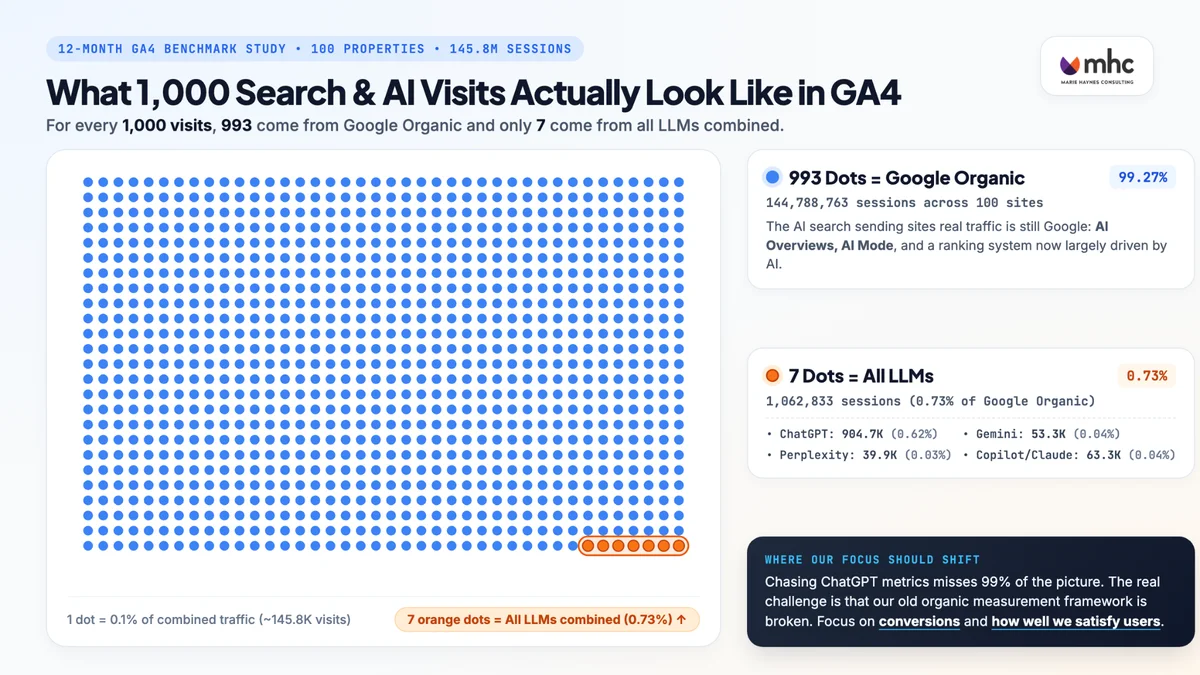
The data shows that referral traffic from standalone LLM tools like ChatGPT accounts for an astonishingly minor fraction of web traffic. Specifically, ChatGPT sessions amounted to a meager 0.62% of the volume driven by Google Organic search. Even when all other major LLMs were aggregated into the dataset, the total combined AI referral traffic ticked up to just 0.73%.
While AI is fundamentally rewriting how the internet operates, the marketing industry’s laser focus on chasing LLM visibility misses where actual consumer intent and economic return on investment (ROI) reside. As the web rapidly transitions from a passive library of links into an active, automated "agentic web," the obsession with GEO is proving to be an expensive distraction.
Chronology: The Rise, Plateau, and Pivot of AI Search
To understand how the SEO and digital marketing community arrived at this strategic blind spot, it is necessary to examine the timeline of AI search adoption over the last several years.

Phase 1: The Exponential Illusion (Late 2022 – Mid 2025)
When OpenAI launched ChatGPT to the public in late 2022, it sparked a gold rush. In the initial months and years, early adopters and forward-thinking publishers monitored referral clicks originating from LLM chat interfaces. Because the growth curve looked exponential, analysts projected that if the trajectory continued unchecked, standalone AI tools would eventually eclipse Google as the primary traffic-driving engine of the web. Agencies began standing up dedicated "GEO" departments, raising millions of dollars in venture capital to track brand mentions inside AI models.
Phase 2: The Inflection Point and Plateau (August 2025)
The narrative shifted dramatically in August 2025. Coinciding with major model rollouts—such as the release of GPT-5—the exponential growth curve of ChatGPT referral sessions abruptly flattened. Long-term tracking across the 100 properties in the recent study indicates that referral visits from ChatGPT actually entered a phase of decline. Rather than sending more traffic to external websites, LLMs became increasingly self-contained, answering user queries directly within the chat interface without driving clicks to source publishers.
Phase 3: The Era of the Agentic Web (2026 and Beyond)
By 2026, search technology evolved past simple conversational text boxes. Platforms like Google integrated artificial intelligence directly into core ranking systems, AI Overviews, and dedicated AI Modes. Concurrently, industry leaders began laying the groundwork for true agentic commerce—introducing technologies like the Universal Cart, the Universal Commerce Protocol (UCP), and Web Model Context Protocol (WebMCP). Search stopped being a mere directory of links and began transforming into an "agent manager," executing multi-step tasks and transactions on behalf of users without requiring them to browse traditional web pages.
Supporting Data: What the GA4 Analytics Reveal
To quantify the gap between hype and reality, analysts dove deep into 12 months of Google Analytics 4 (GA4) data from 100 websites varying widely in size and niche.
1. The Traffic Discrepancy
- Google Organic Traffic: 99.27% of the baseline search-and-referral volume.
- Combined LLM Traffic (ChatGPT, Gemini, Perplexity, etc.): 0.73% of the volume.
- ChatGPT Standalone Traffic: 0.62% of Google Organic volume.
Put simply, for every single visitor arriving via an AI chatbot, roughly 135 to 160 visitors are arriving via traditional Google organic search.
2. The Conversion Paradox
A common counterargument from proponents of GEO is that while AI traffic volume is low, the quality of the visitor is exceptionally high. The GA4 data partially supports this hypothesis—but with crucial caveats.
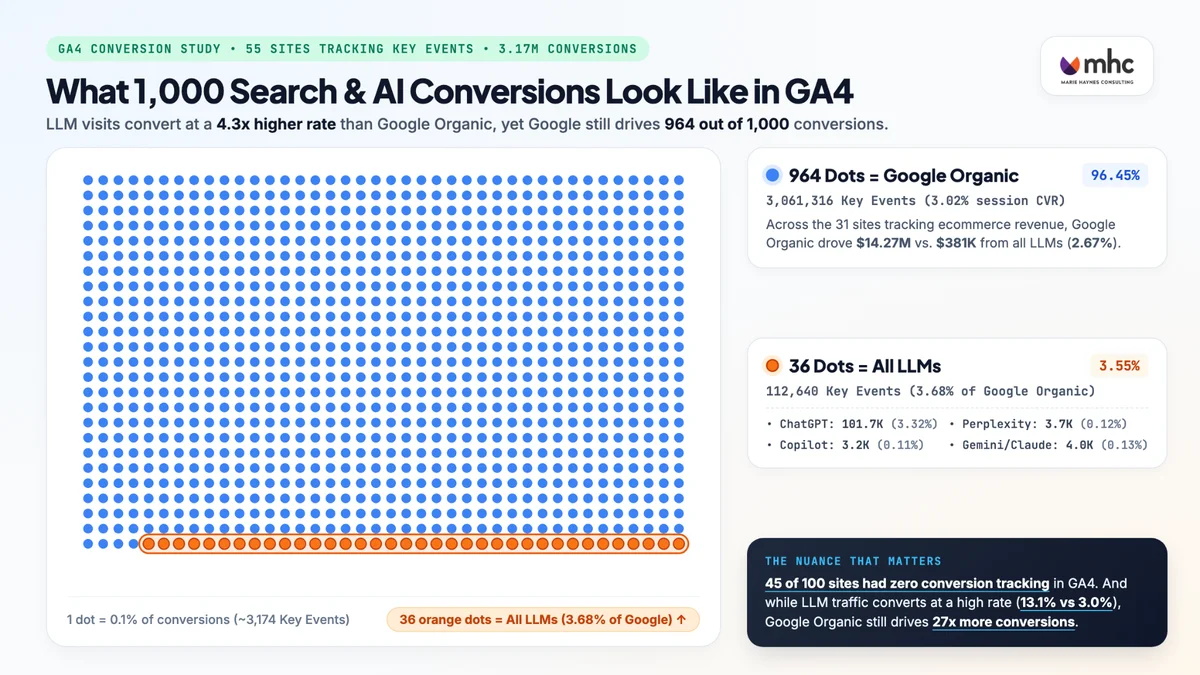
Of the 100 sites analyzed, 55 were actively tracking conversions (key events) in GA4. The data confirmed that visitors arriving from ChatGPT converted at a rate more than 4.5 times higher than standard Google organic visitors.
However, volume matters. Because Google organic traffic dwarfs LLM traffic by orders of magnitude, Google still accounted for 96.5% of total conversions across all analyzed channels. In this dataset, Google organic drove 27 times more total conversions than all LLM platforms combined. Furthermore, the study highlighted a foundational analytics flaw: 45 out of the 100 randomly sampled websites were not tracking key events or conversions at all, leaving businesses completely blind to their actual digital ROI.
Official Responses and Industry Perspectives
The rapid evolution of search has prompted introspection and commentary from leading architects of the modern web.
During interviews and keynotes at major tech conferences, Google leadership has made it clear that the paradigm of typing keywords into a search box and scrolling through blue links is a relic of the past. Google CEO Sundar Pichai famously noted that "Search will become an agent manager," signaling a pivot toward autonomous task execution.
At developer conferences, tech visionaries have echoed this sentiment regarding the structural transformation of the internet:
- Sergey Brin, when asked at Google I/O about the state of the web a decade into the future, admitted, "I don’t think we really know what the world looks like in 10 years."
- Demis Hassabis provided a glimpse into the agent-first architecture, stating, "The web is going to change quite a lot if you think about an agent-first web, like it doesn’t necessarily need to see renders and things like we do as humans using the web. So I think things will be pretty different in a few years."
Industry experts emphasize that while the anxiety over declining informational clicks in Google’s SERPs is valid—with some studies showing AI Overviews cutting organic clicks by upwards of 38%—lamenting the shift will not alter consumer behavior. Instead of chasing fleeting mentions in chat logs, modern SEO strategies must pivot toward user satisfaction and technical readiness for agentic frameworks.

Implications for Businesses and Marketers
The data makes it unmistakably clear: optimizing exclusively for ChatGPT visibility is a misallocation of resources. Google remains the undisputed titan of search-driven discovery, whether users are interacting with traditional links, AI Overviews, or embedded deep-learning ranking systems.
To thrive in this new era, digital strategies must adapt to four emerging pillars of the agentic web:
1. Google’s Universal Cart and Merchant Center
Google’s Universal Cart aggregates products from multiple vendors into a unified checkout within Google Wallet, monitoring prices, promotions, and inventory in real time.
- The Opportunity: Brands must master Google Merchant Center and leverage its built-in AI assistants. Ensuring product data feeds are pristine allows automated shopping systems to bundle and recommend products directly at the point of intent.
2. Universal Commerce Protocol (UCP)
Governed by giants like Google, Shopify, and Stripe, UCP provides an open discovery layer that enables AI agents to compare inventory and purchase natively, keeping the merchant as the record holder.
- The Opportunity: Technical SEO must expand to encompass agentic discovery endpoints—such as configuring
/.well-known/ucpprofiles and optimizing how product options are exposed via Merchant Center.
3. WebMCP (Model Context Protocol)
WebMCP allows websites to expose interactive functions—such as custom calculators, booking schedulers, and multi-step forms—directly to AI agents via declarative markup and imperative APIs.
- The Opportunity: While still in its infancy, businesses should begin experimenting with how autonomous agents might interact with their proprietary tools on behalf of consumers.
4. Intelligent Eyewear and Multimodal Search
Google’s push into "Intelligent Eyewear" running Android XR (spanning audio frames to micro-LED displays) introduces ambient, multimodal search into the physical world.
- The Opportunity: Brands must prepare for scenarios where consumers interact with physical products and services through augmented reality—asking smart glasses to find, compare, or purchase items instantly in their immediate environment.
Conclusion: Stop Chasing the Wrong Target
AI is fundamentally rewriting the mechanics of the internet, but the metrics do not lie. Spending exorbitant budgets on standalone LLM tracking tools and "Generative Engine Optimization" is a distraction from where real business value is created.
Organizations must stop chasing the illusion of ChatGPT referral traffic and instead focus on two vital fronts:
- Optimizing for Google’s deep-learning ranking ecosystem by prioritizing deep user satisfaction and rigorous conversion tracking.
- Preparing technical infrastructure for the agentic web through protocols like UCP, WebMCP, and advanced merchant data feeds.
The businesses that succeed in this unfamiliar era will not be those that win a mention in a chatbot’s text output, but those whose products, services, and digital touchpoints can be seamlessly discovered, managed, and transacted by the AI agents of tomorrow.
