
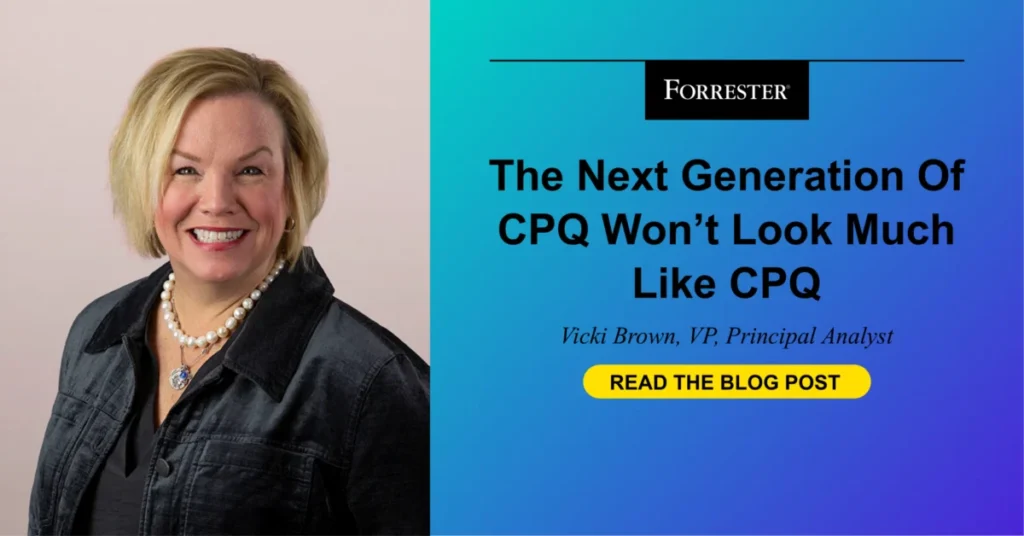
The Evolution of Configure, Price, Quote (CPQ): How Artificial Intelligence and Omnichannel Demands Are Rewriting Enterprise Software
Main Facts
The enterprise software landscape for Configure, Price, Quote (CPQ) systems is undergoing a monumental, disruption-driven transformation. According to the newly released The Forrester Wave™: Configure, Price, Quote Solutions, Q4 2026, traditional CPQ software—long utilized strictly as a back-office tool for sales representatives to configure complex products, calculate custom pricing, and generate structured quotes—has effectively outgrown its original mandate.
Today, CPQ is rapidly evolving into an intelligent commercial engine designed to support multiple paths to revenue. Rather than serving purely as a seller-facing utility, modern CPQ architectures orchestrate pricing and product logic across direct sales channels, partner ecosystems, and customer-facing digital self-service portals.
Concurrently, artificial intelligence (AI) has shifted from a peripheral feature set to a core engine driving market leadership. AI is no longer merely assisting users with basic data entry or error checking; it is actively guiding commercial workflows, predicting optimal pricing strategies, and automating complex tasks behind the scenes. This technological pivot has significantly altered the vendor landscape.
The Q4 2026 Forrester evaluation of 11 significant CPQ providers demonstrates that agility, intelligent automation, and omnichannel support are now critical differentiators. Several agile new market entrants have leapfrogged legacy competitors, while others have fallen out of the evaluation entirely due to an inability to keep pace with modern architectural and AI demands. Consequently, enterprise software buyers can no longer rely on yesterday’s vendor shortlists when evaluating commercial operations software.
Chronology of a Market Shift: From Static Catalogs to Intelligent Engines
To understand the weight of the Q4 2026 Forrester Wave findings, one must examine the evolutionary trajectory of the CPQ category over the past two decades.
Phase 1: The Siloed Rules Engine (Early 2000s–2010s)
In its infancy, CPQ technology was developed primarily to solve a narrow mechanical problem: preventing sales representatives from selling impossible configurations or unprofitable bundles. These systems relied on rigid, rule-based database engines. They were heavily customized, difficult to maintain, and strictly confined to internal sales teams. If a buyer wanted a custom quote, they had to go through a human sales representative, who in turn wrestled with cumbersome legacy user interfaces.
Phase 2: Cloud Migration and CRM Integration (2010s–2020s)
As enterprise software migrated en masse to the cloud, CPQ solutions became deeply integrated with Customer Relationship Management (CRM) platforms, most notably Salesforce and Microsoft Dynamics. This era transformed CPQ from a standalone quoting utility into an essential component of the quote-to-cash continuum. However, the operational model remained fundamentally tied to the seller. CPQ was still viewed as an internal sales enablement tool rather than a comprehensive commercial strategy hub.
Phase 3: The Omnichannel Imperative and Early AI Experiments (Early 2020s–2025)
As B2B buyers increasingly adopted consumer-grade digital behaviors, the cracks in seller-centric CPQ architectures began to show. Enterprise buyers demanded seamless self-service experiences on digital commerce platforms, while partner ecosystems required robust capabilities to configure complex solutions without constantly escalating to vendor sales reps. At the same time, early generative and predictive AI capabilities were introduced to suggest cross-sells and upsells. However, AI during this period was largely additive rather than transformative.
Phase 4: The Intelligent Commercial Engine Era (Q4 2026 and Beyond)
The release of The Forrester Wave™: Configure, Price, Quote Solutions, Q4 2026 marks the official codification of a new era. CPQ is no longer just about putting the right products together at the right price for a single sales rep. It is now an omnipresent commercial engine. AI is fundamentally redefining which vendors lead the pack by turning raw data into practical commercial intelligence and automating end-to-end workflows across all revenue channels. The market has shifted from static rule enforcement to dynamic, intelligent revenue orchestration.
Supporting Data and Market Analysis
The empirical findings within the latest Forrester evaluation underscore the profound volatility currently shaking the enterprise tech stack. Evaluating 11 significant providers, the report highlights stark contrasts between legacy systems struggling with technical debt and modern platforms built from the ground up for omnichannel agility and AI integration.
The Omnichannel Reality
Data cited within the evaluation reveals a dramatic shift in how CPQ logic is consumed:
- Direct Sales: While still representing a core use case, internal sales teams now account for a smaller percentage of total unique CPQ interactions compared to historical baselines.
- Partner Networks: Indirect channels—including value-added resellers (VARs), distributors, and system integrators—increasingly rely on vendor CPQ engines to build accurate, compliant proposals autonomously.
- Customer Self-Service: B2B buyers leveraging e-commerce portals now expect real-time configuration and dynamic pricing of highly complex, engineered-to-order products without human intervention. Crucially, these self-service workflows draw upon the exact same underlying product, configuration, and pricing logic utilized by enterprise sales teams.
The AI Adoption Gap
The evaluation points to a widening chasm between vendors paying lip service to artificial intelligence and those embedding deep commercial intelligence into their core architecture. Traditional vendors that treated AI as a superficial add-on—such as basic natural language search bars or rudimentary text generators—have seen their competitive standing plummet.
Conversely, vendors that leverage AI for deep commercial analytics, automated margin optimization, guided selling recommendations, and proactive error detection have surged ahead. These AI-driven systems analyze historical win-loss data, market fluctuations, and customer behavior to guide human users in real-time, executing background tasks that drastically shorten sales cycles and minimize quote errors.
Vendor Shakeup
The turbulence in the Q4 2026 Wave is tangible evidence of this market realignment. The appearance of aggressive new entrants who have successfully leapfrogged established market stalwarts demonstrates that legacy brand recognition is no longer a protective moat. Furthermore, the complete removal of certain legacy vendors from the evaluation reflects a failure to adapt to modern API-first architectures, headless commerce requirements, and advanced machine learning models.
Official Responses and Industry Perspectives
Industry analysts, software architects, and market strategists have increasingly spoken out regarding the urgent need for enterprises to re-evaluate their commercial technology stacks in light of these findings.
Leading voices in enterprise architecture emphasize that organizations clinging to outdated vendor evaluations risk severe operational friction. When a company relies on a legacy CPQ tool that is incapable of supporting partner self-service or multi-channel pricing harmonization, revenue leakage is virtually guaranteed.
Furthermore, analysts stress that the integration of AI into commercial engines is moving faster than most corporate IT departments anticipated. Experts note that executive leadership teams often assume their current software vendors will naturally upgrade their systems over time. However, the architectural leap required to transform a traditional rule-based CPQ tool into an intelligent, AI-guided commercial engine is substantial. Many legacy platforms are simply built on aging codebases that cannot support advanced machine learning models or high-velocity omnichannel API calls without massive, costly re-platforming efforts.
As a result, industry guidance for enterprise procurement teams has shifted decisively. Experts strongly advise organizations to discard legacy shortlists and utilize rigorous, contemporary evaluation frameworks—such as The Forrester Wave™: Configure, Price, Quote Solutions, Q4 2026—to audit potential software partners. Organizations are also urged to engage in targeted advisory sessions with market analysts to map their unique go-to-market strategies against current vendor capabilities, ensuring long-term alignment with the future of intelligent commerce.
Implications for Enterprise Buyers and Strategy Leaders
The maturation of CPQ into an intelligent commercial engine carries profound strategic, operational, and financial implications for enterprise organizations across industrial manufacturing, high-tech, telecommunications, healthcare, and financial services.
1. Re-Evaluating Vendor Partnerships
The traditional approach to software procurement—where buyers simply default to the market leaders of five years ago—is now a high-risk gamble. Because new entrants have rapidly leapfrogged stagnant legacy vendors, procurement teams must look beyond market share and focus heavily on architectural adaptability, native AI capabilities, and omnichannel scalability. A vendor that excels at internal sales quoting but lacks robust APIs for customer self-service portals will inevitably become a bottleneck to growth.
2. Bridging the Silos Between Sales, Partners, and Customers
For years, companies struggled with disparate pricing and product configuration logic across different departments and channels. Sales reps used one system, e-commerce customers encountered another, and channel partners relied on manual spreadsheets or entirely separate portals. This fragmentation led to pricing discrepancies, lost deals, and frustrated buyers. The modern CPQ imperative demands a single, unified source of truth for commercial logic. By deploying an intelligent engine that powers direct sales, partner channels, and digital self-service simultaneously, enterprises can ensure absolute consistency in pricing, discounting guardrails, and product configurations.
3. Embracing AI-Driven Commercial Operations
Artificial intelligence in CPQ is no longer an experimental luxury; it is a baseline competitive requirement. Enterprises must assess how prospective CPQ platforms utilize AI to:
- Guide Users: Provide real-time, context-aware recommendations to sales reps and buyers regarding optimal bundles, cross-sells, and pricing thresholds.
- Automate Background Work: Streamline approvals, validate complex engineering constraints, and reconcile multi-tier discounting rules without manual intervention.
- Optimize Profitability: Continuously analyze market dynamics and historical win rates to suggest margin-maximizing pricing strategies.
4. Future-Proofing the Revenue Architecture
Ultimately, the evolution of Configure, Price, Quote solutions reflects a broader truth about modern business: revenue generation is no longer linear. As businesses adopt increasingly complex subscription models, usage-based pricing, and hybrid product-as-a-service offerings, the software underlying their commercial operations must be equally dynamic.
Organizations that successfully modernize their CPQ strategies will unlock unprecedented operational agility, shorten sales cycles, elevate customer satisfaction, and protect their margins in an increasingly competitive global marketplace. Those that fail to heed the warning signs of market disruption risk being sidelined by more agile, digitally mature competitors.
