
Navigating Dropshipping in 2026: A Comprehensive Comparative Analysis of Doba and Spocket
Executive Summary & Market Context
As the global ecommerce landscape matures in 2026, the dropshipping market stands at an estimated valuation of $543.53 billion. While consumer demand remains robust, the barrier to entry has evolved. Heightened competition means that modern digital merchants can no longer rely on superficial product curation or generic storefronts to capture market share. Sustainable success now relies heavily on supply chain resilience, automation, and operational efficiency—making the choice of a dropshipping technology partner one of the most critical decisions an online retailer can make.
For years, platforms like Shopify, WooCommerce, and various third-party marketplaces have fueled the search for reliable supplier networks. Within this ecosystem, Spocket and Doba have emerged as two of the most dominant integration hubs, particularly for U.S. and European markets.
While both platforms bridge the gap between merchants and wholesale fulfillment networks, their philosophies diverge significantly. Spocket acts as a boutique curator focused on local suppliers and streamlined usability, whereas Doba functions as an enterprise-grade central operations hub, complete with advanced automation, multi-channel marketplace scaling, and sophisticated artificial intelligence agents.
Evolution and Chronology of the Modern Dropshipping Tech Stack
The Shift from Static Supplier Directories to Autonomous Operations Hubs
Historically, dropshipping platforms served as static directories—digital phone books of manufacturers and wholesalers where merchants manually sourced products, exported CSV files, and pasted listings into their online storefronts.
- The Early Era (Pre-2020): Platforms focused primarily on aggregate SKU volume. Success depended on beating competitors to viral products, often via long-tail shipping from overseas manufacturers.
- The Regional Pivot (2020–2024): Supply chain disruptions forced a structural shift toward domestic (U.S. and EU) warehousing. Curation, vetting standards, and localized delivery timelines became core product features.
- The Autonomous Era (2025–2026): In the current market, finding products is no longer the primary bottleneck. The modern dropshipping challenge is operational overhead: syncing inventory across TikTok Shop, Amazon, and Shopify; managing real-time price fluctuations; and processing asynchronous post-purchase support. Both Doba and Spocket have responded to this shift, though through distinct operational strategies.
Doba’s recent technological milestones—specifically the evolution of its proprietary AI agent, Doba Pilot—exemplify this chronological pivot. Originally designed as a conversational product search assistant, Pilot has matured into an end-to-end operational agent capable of handling market research, automated multi-channel listing, inventory synchronization, and post-sales dispute resolution.
Core Feature Comparison: Doba vs. Spocket
| Comparison Point | Doba | Spocket |
|---|---|---|
| Primary Target Audience | Growing dropshippers, multi-channel sellers, U.S.-focused enterprises | Beginners, single-store owners focused on local supplier curation |
| Monthly Entry Pricing | $29.99 (Limited Plan) | $39.99 |
| Catalog Scale | Over 1 million SKUs (heavy emphasis on U.S. warehouse inventory) | Nearly 1 million curated products (U.S. & EU prioritized) |
| Store Connections | Up to 15 (depending on tier) | Multiple stores manageable per account, but requires separate subscription per store |
| Sample Acquisition | Test orders available via individual supplier coordination | Dedicated sample button with strict unit caps |
| Branding & Packaging | Blind shipping standard; packaging options vary by supplier | Branded invoices supported on higher-tier plans |
| Key Channel Integrations | Shopify, Amazon, Walmart, eBay, TikTok Shop, WooCommerce, Temu, and others | Shopify, Wix, WooCommerce, BigCommerce, Squarespace, Amazon, eBay |
| Advanced Control Tools | Doba Pilot AI agent (Market Scout, Smart Sourcing, Fulfillment), API, FTP, bulk migration | Supplier direct chat, premium product lines, bulk checkout features |
| Primary Drawback | Steeper initial learning curve despite AI guidance | Prohibitive subscription costs for multi-store portfolios |
Pricing Models and Total Cost of Ownership
Evaluating dropshipping software requires looking beyond the monthly sticker price. Merchants must factor in base product costs, subscription tiers, multi-store scaling penalties, and optional AI add-ons.
Doba’s Tiered Architecture
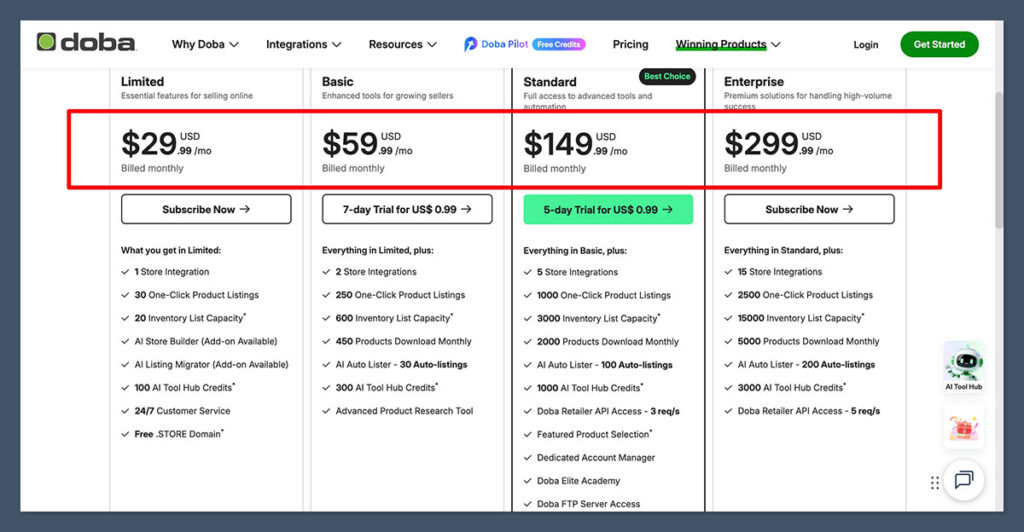
Doba provides a more accessible entry point for bootstrapping retailers, alongside high-capacity enterprise tiers:
- Limited Plan ($29.99/month): Includes 1 store integration, 30 one-click product listings, a 20-item inventory list capacity, 100 AI Tool Hub credits, and a complimentary
.storedomain. Quarterly and annual prepayments offer discounts of 5% and 15% respectively. - Basic Plan ($59.99/month): Expands integrations to 2 stores with proportional increases in capacity and AI credits.
- Standard / Enterprise Plans (up to $149.99/month): Unlocks maximum SKU capacity, API access, FTP server access, dedicated account management, featured product selections, and admission to the Doba Elite Academy.
Spocket’s Subscription Structure
Spocket starts at $39.99 per month, with steep annual discounts available for first-time subscribers. The base tier provides full catalog access, AliExpress dropshipping compatibility, and multi-store dashboard visibility.
However, Spocket introduces a structural expense for scaling operators: every newly connected storefront requires its own separate paid subscription. For merchants operating a portfolio of niche web properties, this policy increases fixed overhead.

Note: Neither platform’s subscription covers the wholesale cost of physical inventory. Merchants remain responsible for purchasing stock per customer transaction.
Usability, Onboarding, and the AI Advantage
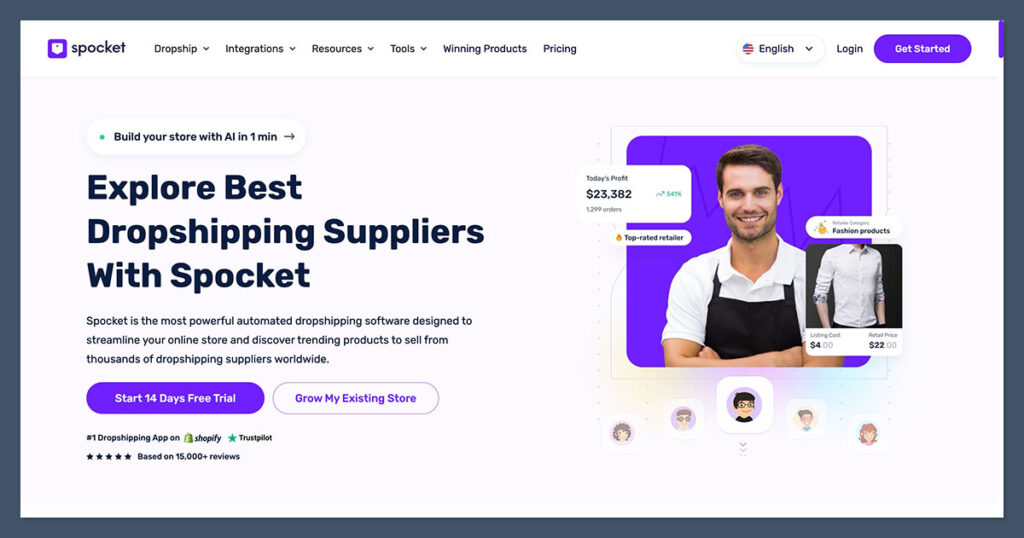
Spocket: Simplicity and Streamlined Curation
For absolute beginners, Spocket offers a gentler onboarding curve. The platform deliberately constrains complexity:
- Browse the curated catalog of U.S. and EU suppliers.
- Transfer desired items to a centralized import list.
- Edit titles, pricing, and descriptions.
- Publish directly to the storefront.
While straightforward, Spocket requires manual intervention during bulk operations, as products generally must be reviewed individually before catalog ingestion.
Doba: Feature-Rich Operations and Doba Pilot
Doba presents a more extensive feature set, historically accompanied by a steeper learning curve. However, the rollout of Doba Pilot has redefined its onboarding process.
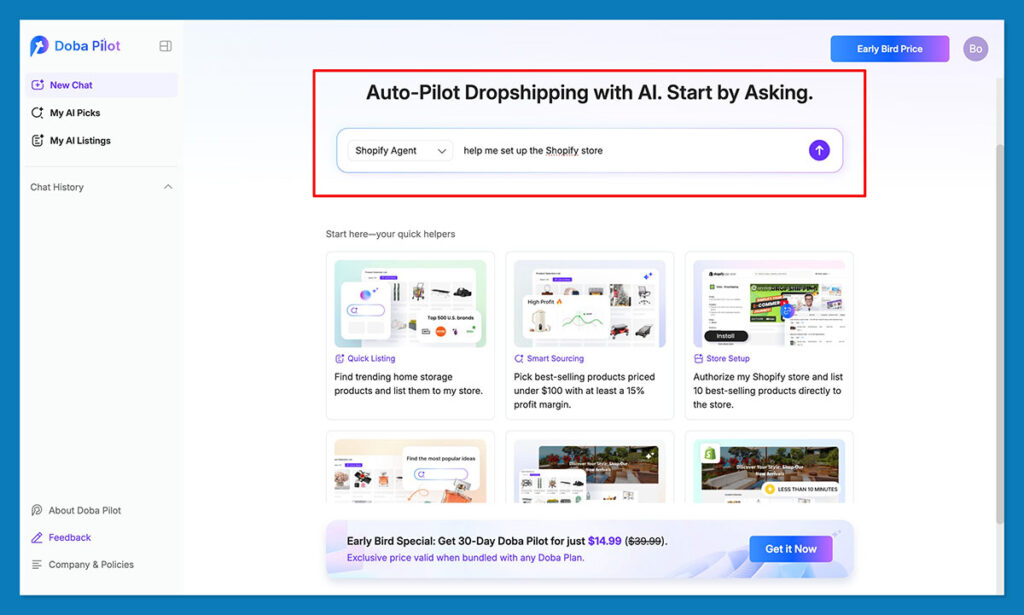
Doba Pilot serves as an interactive conversational agent that guides users through initial setup, niche research, and store connection. Instead of navigating dense system settings, users can interact with Pilot to execute complex workflows:
- Market Scout: Analyzes demand signals, competitive density, pricing benchmarks, and seasonality before capital deployment.
- Smart Sourcing: Accepts natural language parameters (category, price ceiling, regional shipping origin) and filters wholesale databases instantly.
- Automated Publishing: Executes bulk uploads and listing migrations across Shopify, BigCommerce, Wix, Walmart, TikTok Shop, and eBay.
Product Quality, Vetting Standards, and Supply Chain Integrity
Both platforms maintain catalogs approaching one million SKUs, but their vetting philosophies differ fundamentally.
- Doba’s Broad-Spectrum Approach: Doba aggregates over a million SKUs across diverse categories including homeware, automotive, and beauty. While suppliers undergo vetting, quality varies across manufacturers. To mitigate this, Doba flags U.S.-warehouse stock—covering roughly 90% of its catalog—enabling merchants to prioritize domestic fulfillment and avoid international transit delays.
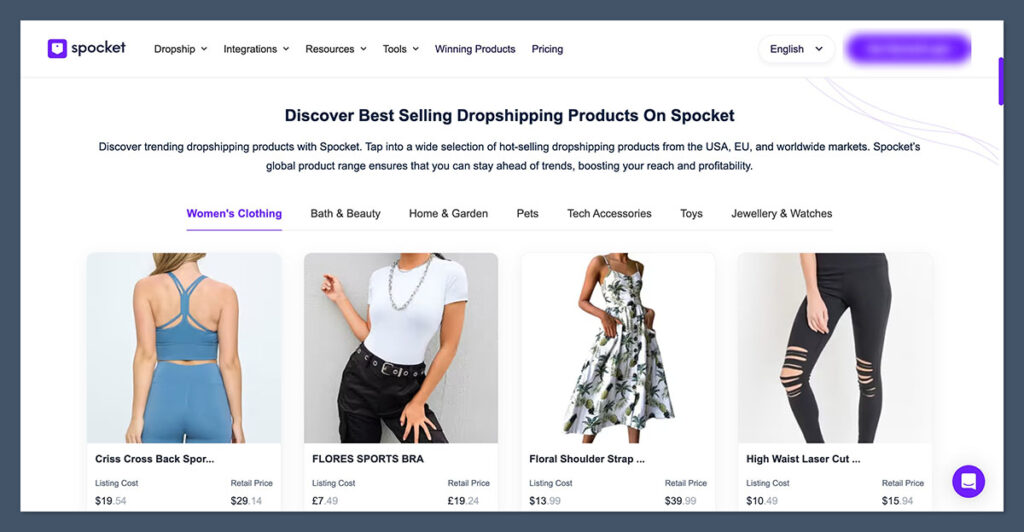
- Spocket’s Strict Curation: Spocket enforces rigorous compliance rules. Approved suppliers must physically manufacture or warehouse their inventory locally, and must extend at least a 25% discount off public retail pricing. This strict gating protects merchants from dealing with middleman brokers, though it narrows the overall breadth of niche manufacturing options compared to Doba.
Shipping, Fulfillment, and Post-Purchase Policies
Fast domestic shipping is essential for customer retention in modern ecommerce. Both Doba and Spocket provide robust U.S. and European delivery networks, though their governance mechanisms diverge.
Doba’s Risk Mitigation and Guarantees
Doba enforces strict service-level agreements (SLAs) on its vendor network:
- Fulfillment Deadlines: Suppliers must refund orders not dispatched within stated processing windows.
- Returns & Quality Assurance: Damaged items require prepaid return labels upon submission of photographic evidence. Invalid tracking numbers trigger automatic refunds if uncorrected by the supplier.
- After-Sales Protection: Optional protection services cover non-defective remorse returns and packages marked as delivered but not received.
Spocket’s Supplier Accountability
Spocket mandates that suppliers maintain a 95% order success rate, provide valid tracking numbers within strict delivery windows, and respond to merchant inquiries within 24 to 47 hours. However, individual suppliers retain the right to author their own return policies—meaning some manufacturers may refuse returns entirely, shifting liability to the retailer.
Integrations, Multi-Channel Scalability, and APIs
As merchants outgrow single-store models, multi-channel distribution becomes a necessity.
- Doba’s Multi-Channel Edge: Doba is structurally optimized for marketplace diversification. It connects smoothly to Shopify, WooCommerce, Wix, and BigCommerce while providing native listing synchronization for high-intent marketplaces like Amazon, eBay, Walmart, TikTok Shop, and Temu. Its centralized dashboard syncs inventory and pricing data in real-time, preventing overselling.
- Spocket’s Storefront Focus: Spocket integrates reliably with core website builders (Shopify, Wix, Squarespace, BigCommerce) and supports major marketplaces like Amazon and eBay. However, its API is optimized primarily for streamlined storefront checkout and inventory tracking rather than heavy data streaming or multi-channel marketplace routing.
Official Responses & Industry Implications
As the dropshipping industry adapts to regulatory pressures regarding consumer transparency, platform safety, and delivery speed, third-party integration software providers are redefining their value propositions.
Industry analysts note that software providers are pivoting away from simple directory listings toward Software-as-a-Service (SaaS) operational infrastructure. By embedding AI agents like Doba Pilot into the supply chain lifecycle, platforms aim to reduce the administrative friction that causes high failure rates among first-time ecommerce entrepreneurs.
Implications for Online Retailers
- Margin Compression vs. Efficiency: While subscription and AI tool costs are rising, the automation of inventory synchronization and dispute resolution saves countless operational hours, allowing lean teams to manage larger product catalogs.
- Channel Diversification: Relying solely on a single Shopify store is increasingly risky. Merchants must utilize platforms that facilitate native multi-channel publishing to capture fragmented consumer traffic across social commerce channels like TikTok Shop and traditional marketplaces like Walmart.
Final Verdict: Which Platform Should You Choose?
Choose Spocket If:
- You are a beginner operating a single storefront (typically on Shopify or Wix).
- You prioritize local European and U.S. supplier curation over raw product volume.
- You require straightforward sample ordering and branded invoicing options with minimal software complexity.
Choose Doba If:
- You are operating a growing, multi-channel retail business scaling across Amazon, Walmart, TikTok Shop, and custom storefronts.
- You require advanced automation tools and AI agents (Doba Pilot) to handle market research, bulk listings, and post-sales dispute management.
- You want lower entry-level subscription costs coupled with high-capacity enterprise features, API access, and robust domestic fulfillment vetting.
