
Navigating the Future: Why the "Martech for 2026" Report is Essential Reading for Modern Marketing Leaders
As the calendar turns toward the end of another whirlwind year, the marketing technology landscape finds itself at a critical inflection point. For the past several years, industry veterans Frans Riemersma and Scott Brinker have become the standard-bearers for pragmatic, data-driven analysis in a sector often clouded by buzzwords and "fever-dream" predictions. Their upcoming release, Martech for 2026, promises to cut through the noise, offering a granular look at the reality of marketing operations as we head into the new year.
This isn’t just another set of speculative trends; it is a deep dive into the architecture of modern marketing stacks and the practical application of emerging technologies. Scheduled for release on Tuesday, December 2, the report and its accompanying virtual event aim to equip professionals with the insights necessary to navigate an increasingly complex digital ecosystem.
The Core Objective: Pragmatism Over Hype
In an era where "prediction season" is often characterized by hyperbolic claims and unrealistic timelines, Riemersma and Brinker have carved out a niche for themselves by focusing on what is actually happening. Their methodology centers on identifying real-world patterns—observed shifts in how companies build their tech stacks, manage their data, and deploy AI—to extrapolate what the next 6 to 12 months will look like.
The upcoming Martech for 2026 report is the culmination of months of research. It moves beyond the surface-level chatter to address the fundamental questions keeping CMOs and marketing operations (MOps) leaders up at night: Where is the ROI in AI? Which tools are actually scaling? And how should our current stack evolve to accommodate the rise of autonomous agents?
Chronology: The Road to 2026
To understand the significance of this year’s findings, one must look at the progression of the martech industry over the last three years.
- 2023: The Year of Discovery. Following the sudden explosion of Generative AI, organizations spent the year experimenting with LLMs. The focus was on "what can we do?" rather than "how do we integrate this?"
- 2024: The Year of Integration. As the novelty faded, the focus shifted toward integrating AI tools into existing workflows. Companies began to grapple with data privacy, governance, and the complexities of prompt engineering.
- 2025: The Year of Scaling. This year saw a move toward production-grade AI. Businesses began moving away from standalone chatbots and toward specialized, multi-agent frameworks that perform distinct tasks within the marketing lifecycle.
- 2026: The Year of Optimization and Autonomy. As we look toward the upcoming release, the narrative is shifting toward "Agentic Workflows." The question is no longer just about using AI for content creation, but about AI agents managing entire segments of the marketing funnel autonomously.
Supporting Data: The AI Agent Frontier
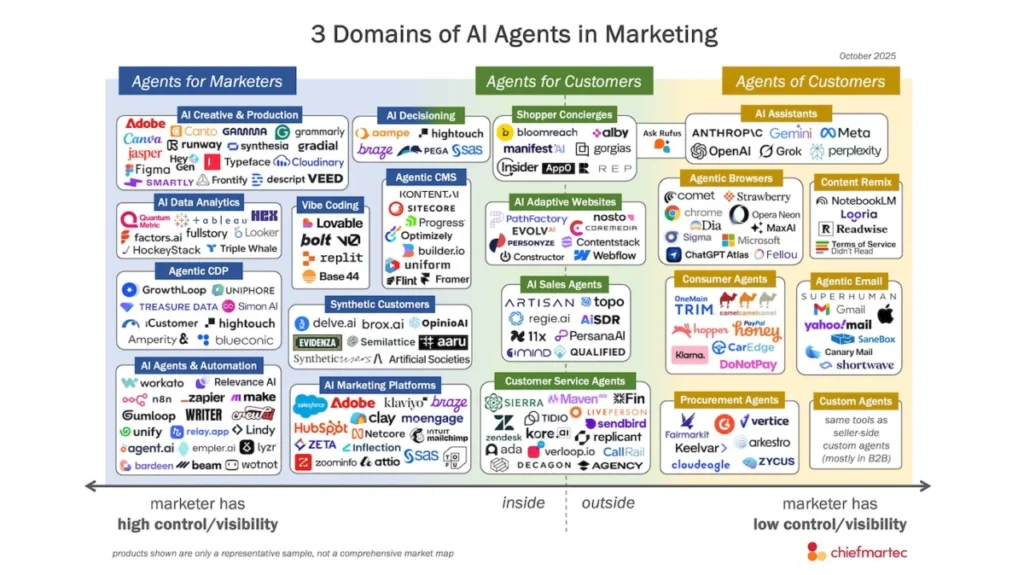
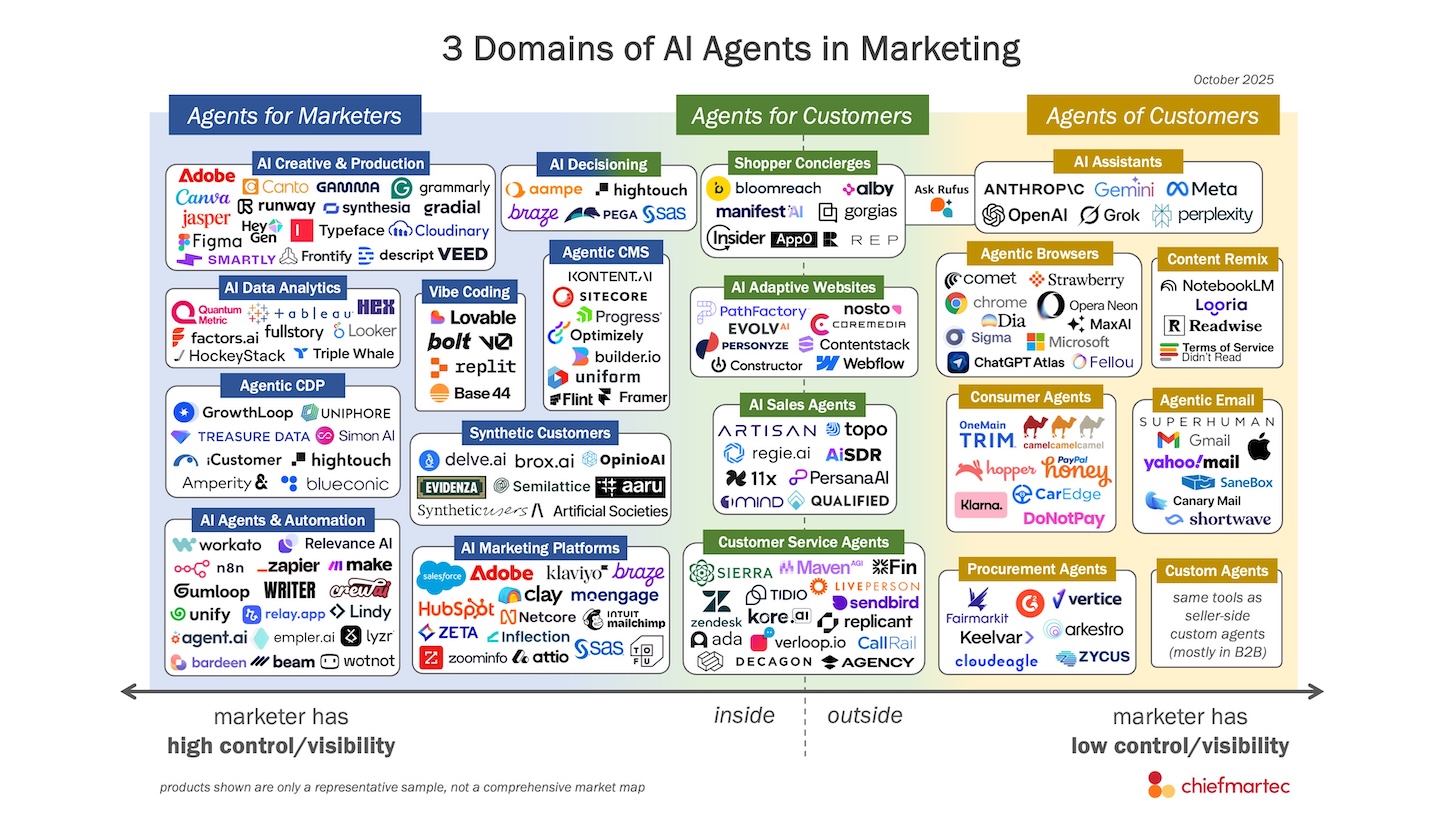
A central pillar of the Martech for 2026 report is the detailed analysis of the AI agent landscape. The authors have utilized findings from their AI & Data in Marketing survey to distinguish between technologies that are ready for prime time and those that are still effectively in the "science fair" stage.
The Three Domains of AI Agents
The report categorizes the current generation of AI agents into three distinct domains. By dissecting these categories, Brinker and Riemersma provide a framework for marketers to evaluate their own investments:
- Content and Creative Agents: These agents focus on generative output, from copy generation to design assets. They have the highest adoption rate but are currently facing a "commodity plateau."
- Operational and Workflow Agents: These are the "glue" agents. They focus on executing tasks between applications—triggering a campaign in one system based on an action in another.
- Strategic and Analytical Agents: These represent the cutting edge. They ingest massive datasets to provide predictive insights, customer journey mapping, and resource allocation recommendations.
The research suggests that while many organizations are "playing" with all three, the most successful companies are those that have begun to codify "context engineering." This is the process of feeding proprietary, high-quality data into these agents to ensure their outputs are aligned with brand voice and strategic goals.
Official Perspectives: A Candid Dialogue
One of the most anticipated segments of the December 2nd event is the post-keynote panel discussion. Rather than hosting standard sales-focused webinars, the organizers have curated a series of interviews with senior leadership from key industry players, including GrowthLoop, Hightouch, Intuit Mailchimp, MetaRouter, Progress, SAS, and Treasure Data.
The goal of these sessions is to bypass the marketing jargon and engage in candid, "no-holds-barred" discussions. These leaders will share what they are seeing in the trenches:
- How their own customers are integrating these new AI agents.
- The challenges of data silos that still plague mid-to-large enterprises.
- The tension between augmenting existing SaaS platforms versus replacing them with custom, AI-native workflows.
By bringing these stakeholders to the table, the report aims to provide a 360-degree view of the industry, balancing the analysts’ macro-perspective with the product leaders’ micro-execution insights.
Strategic Implications: The Future of the Martech Stack
Perhaps the most pressing question for the marketing community is: What happens to our current software stack?
The Martech for 2026 report explores three potential paths for existing SaaS platforms:
- Augmentation: The platform integrates AI to become more efficient, keeping the core value proposition intact.
- Replacement: The AI agent performs a task so effectively that the legacy application becomes redundant.
- Evolution: The application pivots to become an orchestration layer for these new AI agents, moving from a "tool" to a "platform."
For the average marketer, this creates a high-stakes environment for purchasing and renewal decisions. The report suggests that the "tech stack" of 2026 will be less about the number of tools and more about the quality of the data pipeline feeding the agents. Organizations that fail to clean their data or bridge their silos will find themselves unable to deploy the agentic workflows that their competitors are already utilizing.
Why You Should Participate
The release on December 2nd is structured to be both educational and accessible. The report, which exceeds 100 pages, is designed to be a reference document for the year ahead. Combined with an hour-long, high-energy presentation, it serves as a comprehensive guide for anyone responsible for marketing strategy, operations, or technology procurement.
Key takeaways for attendees include:
- Benchmark Data: Understand where your organization stands in relation to industry peers regarding AI adoption.
- Context Engineering: Learn the technical requirements for making AI agents work for your specific business case.
- Future-Proofing: Identify which legacy platforms are likely to remain essential and which may be eclipsed by newer, agentic alternatives.
- Strategic Clarity: A 6-12 month roadmap to help leaders prioritize projects during the busy Q1 planning season.
The event is entirely free, thanks to the support of the aforementioned industry sponsors. Attendees have the flexibility to watch live or access the recordings on-demand throughout the month of December. This is an intentional choice by the organizers, acknowledging that the holiday season is a busy time for marketing teams looking to close out the year strong.
Conclusion: Preparing for 2026
The transition into 2026 marks a maturation period for marketing technology. The era of "AI as a toy" is ending; the era of "AI as an engine" has begun. For marketing professionals, the path forward is clear: move away from the noise of ephemeral trends and toward the rigorous, evidence-based assessment of tools and processes.
By providing a clear-eyed analysis of the current market—what works, what doesn’t, and what is merely smoke and mirrors—the Martech for 2026 report serves as an essential manual for the modern marketer. Whether you are a CMO looking to set the strategic direction for your department or a marketing operations professional tasked with the heavy lifting of implementation, the insights provided in this report will be invaluable.
Don’t miss the chance to get ahead of the curve. Register for the event, download the report, and ensure that when the clock strikes midnight on January 1, your team is equipped with the knowledge to thrive in the year of the AI agent.
To secure your copy of the report and register for the event, visit the official Martech for 2026 registration page. The event takes place on Tuesday, December 2, with full access available on-demand throughout the remainder of the year.
