
The Great Rewiring: How AI Agents Are Fundamentally Altering the Martech Landscape for 2026
The marketing industry stands at a critical juncture. As we approach 2026, the promise of artificial intelligence has moved beyond the hype cycle of generative text and image creation, settling into a more formidable reality: the rise of the autonomous AI agent.
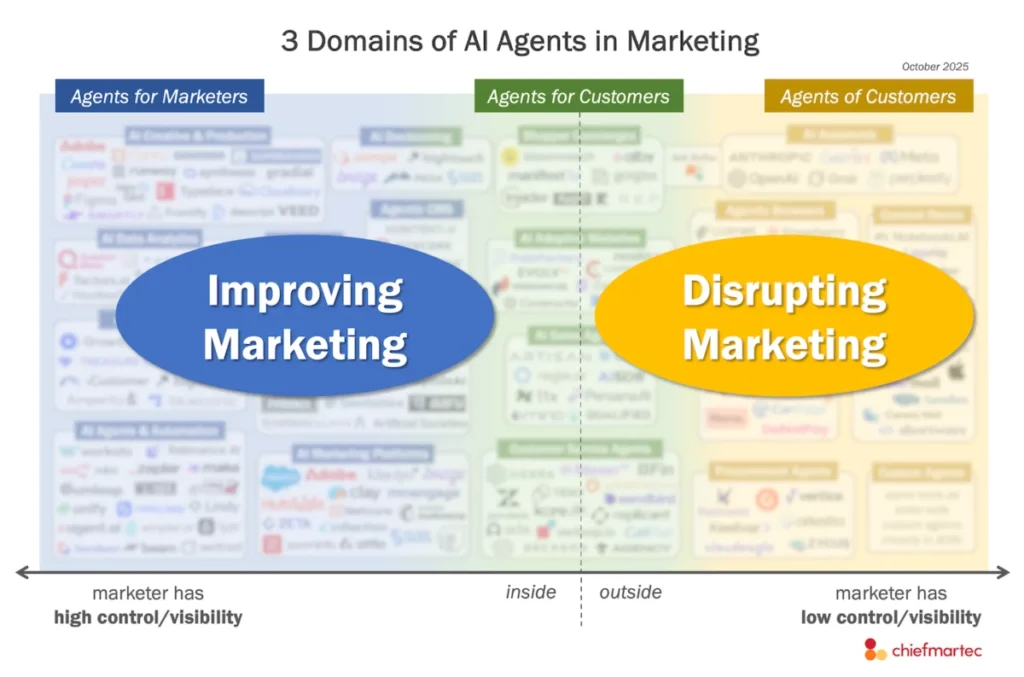
According to the forthcoming Martech for 2026 report, the integration of AI agents is no longer a peripheral experiment for the tech-obsessed; it is an operational imperative. With over 90% of marketing professionals currently deploying agentic technology within their stacks, the focus is shifting from "how to build" to "how to navigate" a world where the traditional buyer’s journey is being systematically dismantled and rebuilt by software.
The State of Play: AI Agents Everywhere
The data from the AI & Data in Marketing study paints a clear picture: 90.3% of participants—representing some of the world’s most sophisticated B2B and B2C brands—are now utilizing AI agents. These are not starry-eyed enthusiasts; these are pragmatic operators tasked with maintaining competitive parity.
The primary function of these early-stage agents has been the augmentation of the marketer. These tools assist in brainstorming, content production, campaign distribution, and complex data analysis. While these agents have undoubtedly driven efficiency—allowing teams to "do more with less"—the prevailing consensus is that these gains remain largely incremental. They are tools designed to improve existing processes, not necessarily to reinvent the underlying mechanics of commerce.
Chronology of the Agentic Shift
To understand where we are going, one must look at the rapid evolution of the last 18 months:
- Early 2024: The "GenAI" phase. Marketers focused on prompt engineering and basic text-to-content generation.
- Late 2024: The rise of outbound "AI SDRs." Companies began deploying agents to automate lead generation, flooding inboxes with personalized outreach to maximize sales efficiency.
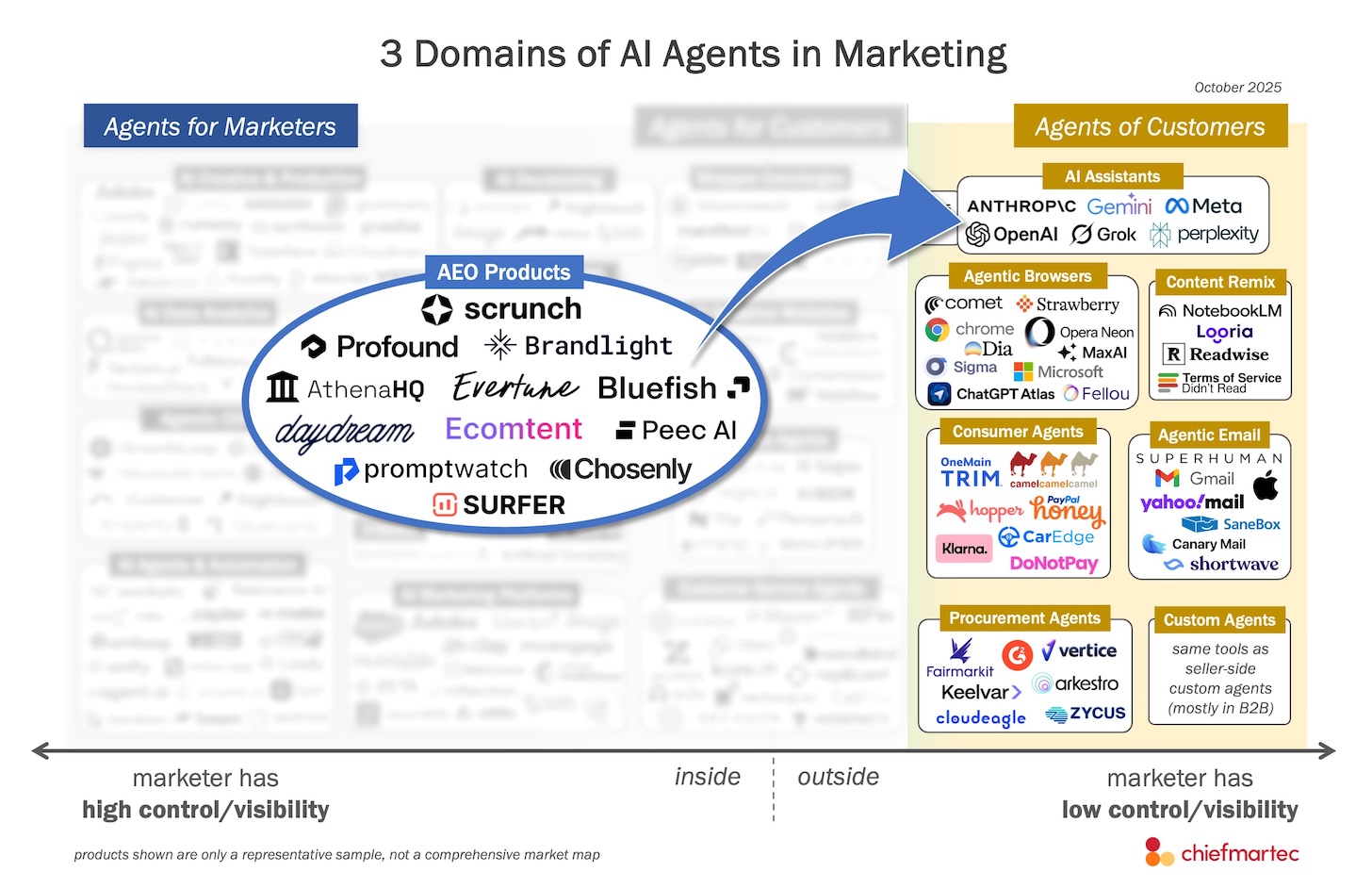
- Mid-2025: The "Agentic Web" emerges. Platforms like OpenAI, Google, and Anthropic began embedding agentic capabilities directly into consumer-facing search and chat interfaces.
- Late 2025 (The Current Turning Point): The shift from informational search to "Action Engines." AI assistants, such as ChatGPT and Gemini, began facilitating direct transactions—buying products, booking services, and negotiating with human entities on behalf of the user.
- December 2025/January 2026: The industry pivots toward "Agent-to-Agent" (A2A) infrastructure, moving away from human-in-the-loop interactions to machine-negotiated outcomes.
Supporting Data: The Disconnect Between Awareness and Action
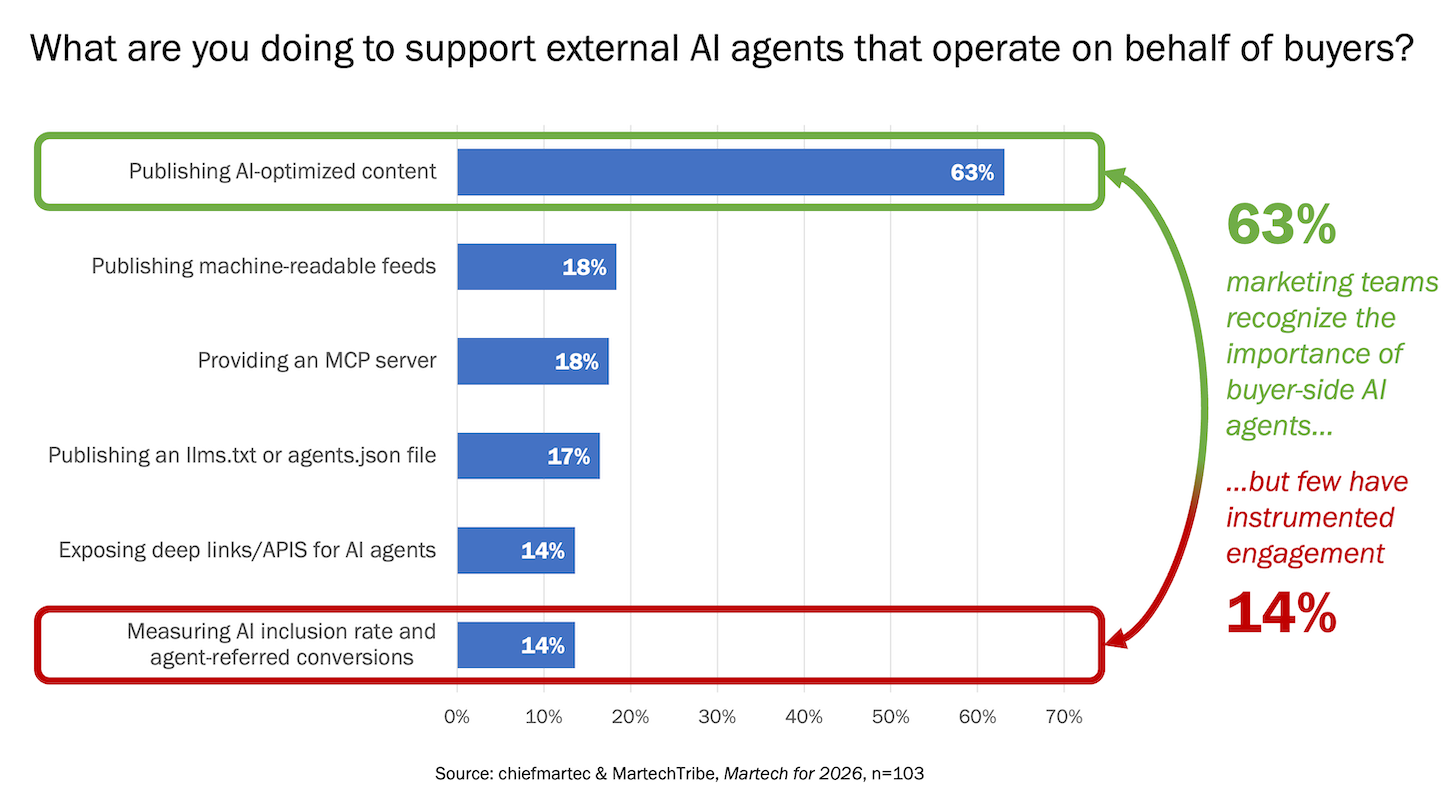
While the industry recognizes the seismic shift, there remains a significant "instrumentation gap."
In the Martech for 2026 research, 63% of marketing teams acknowledged that their buyers are shifting their search behaviors toward AI assistants rather than traditional search engines. They understand that the "SEO playbook"—the strategy that dominated marketing for 25 years—is losing its efficacy. However, only 14% of these teams have successfully instrumented their platforms to account for this change.
This gap represents the single greatest risk to marketing ROI for the coming year. Teams are watching the train leave the station, but they are still trying to board using the old platform technology.

The Buyer-Side Disruption: A Turning of the Tables
The most profound shift is the migration of power from the seller to the buyer. For decades, marketers controlled the "funnel." We provided the content, we optimized the landing pages, and we dictated the pace of the discovery process.
Today, that control is evaporating. When a consumer uses a tool like Perplexity or ChatGPT to research a purchase, they are not visiting your website. They are not clicking your ads. They are receiving a synthesized, neutral (or algorithmically curated) answer from an AI that has "read" your content but has effectively abstracted away your brand identity.
This is the "Great Rewiring of the Buyer’s Journey." The rise of transactional features—such as OpenAI’s "Instant Checkout" for Shopify and Etsy, or Google’s "agentic checkout" that tracks pricing and makes purchases automatically—bypasses the traditional vendor-controlled experience entirely.
The "Spa" Effect: Efficiency for the Buyer
Perhaps the most ironic development is the emergence of AI agents that perform administrative labor for the buyer. Google’s latest Gemini update, which allows the AI to make voice calls to local businesses to verify stock or pricing, is the antithesis of the outbound sales trend.
For the past year, sales teams have celebrated the ability to use AI to harass prospects with automated emails. Now, the table has turned. The buyer now has an agent capable of calling the salesperson. The salesperson, once the "hunter," is now the "hunted," fielding an increasing volume of calls from automated agents. This is a fragile, transitional state; it is inefficient for both parties and will inevitably be replaced by direct API-to-API communication.
Official Perspectives: Implications for 2026
Industry experts suggest that the next 6 to 12 months will be defined by the transition from "human-to-agent" interaction to "agent-to-agent" commerce.
"We are entering an era where the customer is no longer a human interacting with a website," notes the Martech for 2026 report. "The customer is an AI agent acting on behalf of a human, and the seller is an AI agent acting on behalf of a brand."
Strategic Implications for Marketers:
- AEO (AI Engine Optimization) is the New SEO: Brands must pivot their content strategy to be "readable" and "actionable" for AI models. It is no longer enough to rank for a keyword; you must provide the authoritative data that an AI agent deems credible enough to pass along to the end user.
- The Death of the Static Landing Page: As transactions move into chat interfaces (like ChatGPT Apps), the traditional web experience becomes secondary. Marketers must invest in the APIs and data structures that allow their products to be bought or booked within third-party environments.
- Prioritizing Agent-Ready Data: Data hygiene becomes a competitive moat. If your product information, pricing, and availability are not structured in a way that machine agents can ingest, you will be invisible in the 2026 marketplace.
- Operationalizing the Shift: With only 14% of teams currently instrumented for this change, the first movers who prioritize "Agent-side support" will likely capture a disproportionate share of the market throughout 2026.
Conclusion: Preparing for the Agentic Future
The findings in the Martech for 2026 report serve as both a warning and an invitation. The era of the "do-it-yourself" marketing website is fading. We are moving toward a distributed, agent-led economy where brand visibility is determined by an AI’s preference rather than a human’s search intent.
As we look toward the December 2 launch of the full report, the message is clear: The most successful marketers of 2026 will not be those who simply use AI to automate their own workflows, but those who learn how to speak the language of the agents that their customers are using to navigate the world.
The transition will be uncomfortable, but for those willing to abandon the legacy playbooks of the last quarter-century, it offers an unprecedented opportunity to redefine how brands and buyers connect.
To gain access to the full 100+ page Martech for 2026 report, join the upcoming webinar on December 2. The report is provided free of charge, thanks to the support of partners including GrowthLoop, Hightouch, Intuit Mailchimp, MetaRouter, Progress, SAS, and Treasure Data.
