

Data, Disruption, and Distinction: How Global CPG Giants Are Rewriting the Social Video Playbook
In the high-stakes arena of fast-moving consumer goods (CPG), traditional marketing playbooks are gathering digital dust. Today’s consumers are scrolling faster, filtering content more aggressively, and demanding authenticity that polished, traditional advertising simply cannot deliver. To cut through the algorithmic noise, some of the world’s most recognizable CPG brands are tearing up the old rules of engagement—and they are doing it with data-backed audience insights.
From cross-platform optimization and video duration management to radical creator partnerships, modern enterprise marketing is no longer driven by gut instinct. Every decision—from cross-platform strategy to post timing—is informed by hard data, and every strategic move is deliberate.
While heavyweights like Red Bull, Heineken, Charlotte Tilbury, and Old Spice have taken drastically different paths to social video success, a unified pattern emerges beneath the surface: bold, unconventional decision-making anchored tightly by deep audience intelligence.
Main Facts: The New Anatomy of CPG Social Video Success
The contemporary digital landscape rewards precision, flexibility, and a willingness to defy conventional category boundaries. Modern CPG success stories share several foundational truths:
- Data Over Assumptions: High-performing brands prioritize empirical engagement metrics over legacy market assumptions when selecting distribution platforms and structuring campaign budgets.
- Cultural Fit Trumps Category Fit: The most lucrative creator partnerships often occur outside a brand’s traditional product category, leveraging shared cultural affinities rather than direct product alignment.
- Smart Publishing Over Volume: Flooding a platform with content no longer guarantees growth. Strategic, targeted publishing combined with high-impact formats (such as short-form video) yields superior reach and retention.
- Unlocking Audience Overlap: Strategic brand partnerships—such as beauty brands teaming up with motorsports leagues—tap into latent consumer segments that traditional advertising cannot reach.
Chronology: The Evolution of Data-Led CPG Marketing
To understand how global CPG brands arrived at their current social video dominance, it is necessary to examine how digital marketing strategies have transformed over recent years.
Phase 1: The Era of Volume and Broadcasting (Pre-2023)
For years, CPG marketing operated on a broadcast model. Brands treated social media channels primarily as digital billboards. Success was measured by sheer output, frequency, and aggregate follower counts. Content was largely uniform, pushed identically across YouTube, Facebook, and Instagram, with little regard for the distinct behavioral nuances of individual platform audiences.
Phase 2: The Short-Form Revolution and Platform Fragmentation (2023–2024)
The explosive rise of TikTok fundamentally altered consumer consumption habits, triggering an industry-wide pivot toward short-form video. By 2025, global data (such as insights from Tubular Labs) revealed that 77% of global YouTube views were driven by videos under a minute long. Brands realized they had to adapt quickly to shrinking attention spans. However, early efforts were often clumsy, treating short-form video as a one-size-fits-all tactic rather than a nuanced format requiring platform-specific optimization.
Phase 3: The Data-Driven Disruption Era (2025–Present)
Today, leading CPG brands have moved past simple format adoption. They are utilizing advanced audience intelligence platforms to look beneath surface-level metrics like views and likes. By analyzing search affinity, shopping behavior, and granular audience overlaps, brands are executing highly calculated, unconventional campaigns—collaborating with niche creators, cross-pollinating with unexpected industries, and selectively timing their uploads for maximum impact.
Supporting Data & Case Studies: Breaking Down the Strategies
A closer look at how individual market leaders utilize data reveals actionable roadmaps for enterprise brands looking to scale their digital footprints.
1. Red Bull: Platform Nuance and the Short-Form Paradox
Red Bull is globally renowned for its high-octane content, but its cross-platform strategy highlights a vital marketing lesson: your highest-volume platform is not automatically your highest-impact platform.
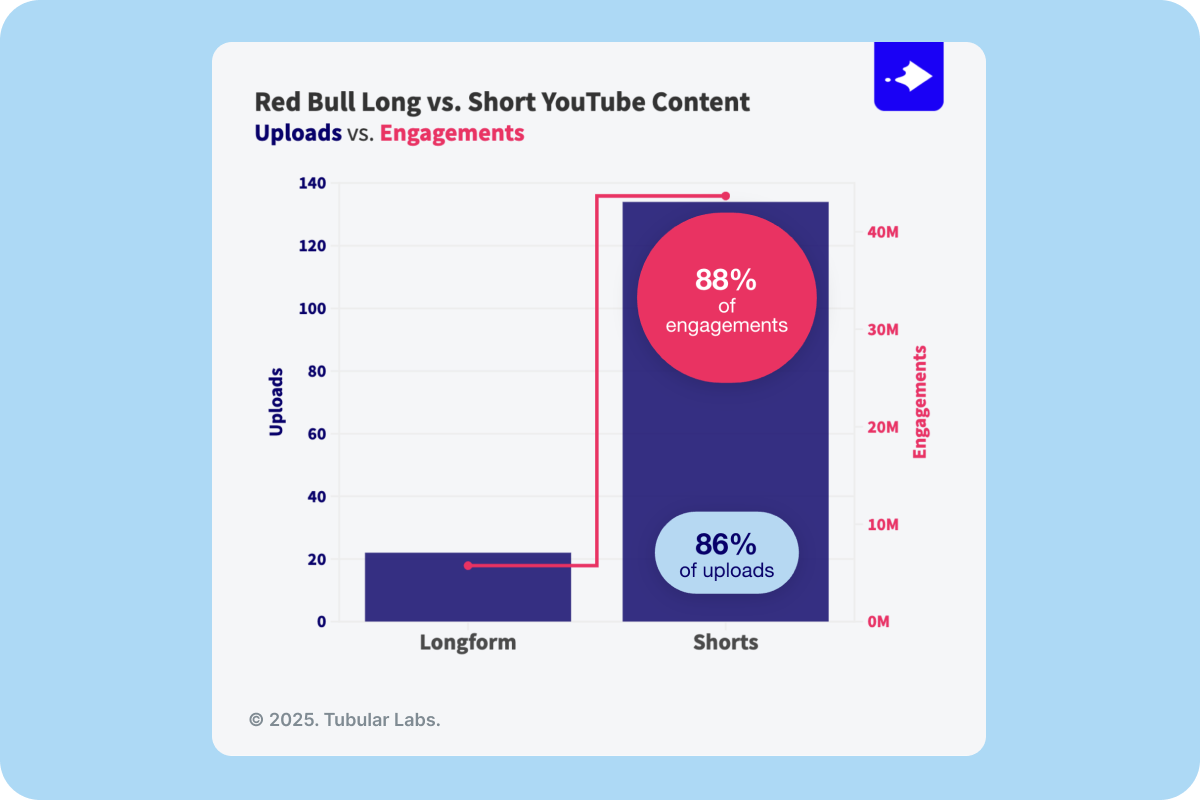
With 77% of global YouTube views in 2025 originating from short-form content, Red Bull aggressively scaled its short-form video output. However, performance data exposed a stark contrast in audience behavior:
- YouTube: Engagement on both short- and long-form videos aligned relatively closely with their baseline upload volume.
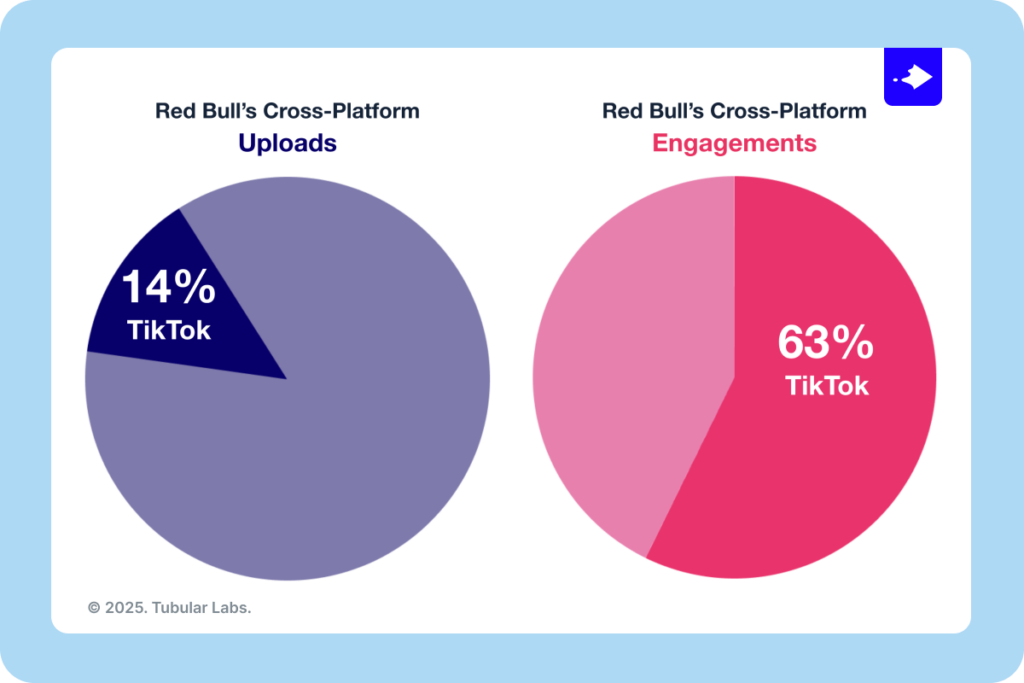
- TikTok: Despite accounting for a modest 14% of Red Bull’s total cross-platform uploads, TikTok videos generated an astounding 63% of their total cross-platform engagement.
The Takeaway: Video duration optimization and performance metrics fluctuate wildly from platform to platform. CPG brands must analyze platform-specific audience preferences rather than applying a blanket distribution strategy.
2. Heineken: Redefining Influencer Value Through Cultural Fit
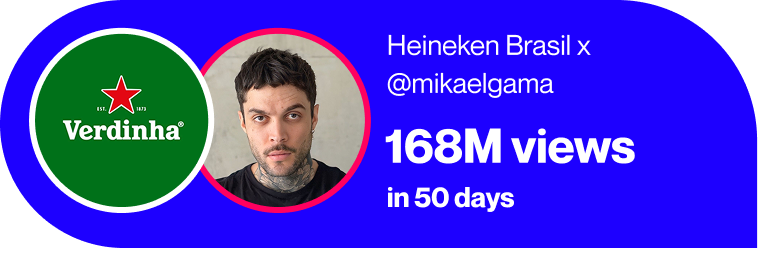
Traditional CPG marketing dictates that a beverage brand should partner exclusively with lifestyle, food, or entertainment influencers who fit neatly within the beverage category. Heineken shattered this convention by partnering with Brazilian men’s fashion creator Mikael Gama (@mikaelgama).
Despite Mikael starting with a relatively modest following of 136,000, the campaign delivered staggering results: 168 million views and 1 million engagements in just 50 days, propelling him to become the #1 most-viewed Brazilian influencer in the first half of 2025.
- Why it worked: Mikael’s visual aesthetic aligned naturally with Heineken’s premium brand identity, and his audience deeply trusted his taste. Cultural alignment vastly outperformed traditional category fit.
The Takeaway: Relying solely on follower counts and vanity metrics introduces massive blind spots. Brands must factor in search affinity and audience overlap to predict true campaign ROI.
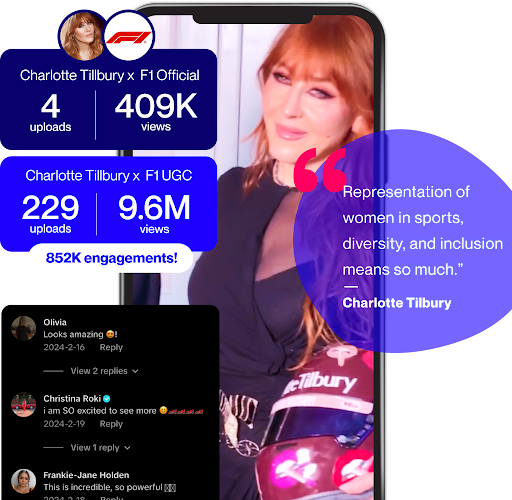
3. Charlotte Tilbury & F1 Academy: Expanding Reach via Unexpected Partnerships
Luxury beauty brand Charlotte Tilbury made history by becoming the first female-founded beauty brand to partner with Formula 1’s F1 Academy. At first glance, cosmetics and high-speed motorsport might seem like strange bedfellows.
However, the partnership was built on a data-backed bet regarding the audience overlap between motorsports enthusiasts and beauty consumers.
- The Impact: The collaboration triggered an immediate surge in user-generated content (UGC) on TikTok and fostered mutual audience growth across both brands, proving that demographic crossover insights can unlock entirely new consumer pipelines.
The Takeaway: Strategic brand partnerships with seemingly unrelated entities can rapidly accelerate audience expansion into untouched market segments.
4. Old Spice: Scaling Reach Without Flooding the Feed
In the pursuit of digital growth, many brands assume they must constantly increase posting frequency. Old Spice proved otherwise, cementing its status as one of YouTube’s top CPG brands by views and global reach through disciplined, targeted publishing.
Instead of overwhelming the platform with constant uploads, Old Spice focused on high-impact formats—such as YouTube Shorts—and purposeful, highly targeted messaging designed to appeal to adjacent demographics.

The Takeaway: Sustainable audience growth relies on strategic publishing quality and high-impact formats rather than endless content saturation.
Official Industry Responses & Perspectives
Industry analysts and brand strategists emphasize that the CPG sector is undergoing a permanent structural shift. Speaking on the integration of audience intelligence into modern marketing workflows, leading digital researchers note:
"The era of guessing what content will resonate based purely on historical intuition is officially over. Modern consumers inhabit fragmented digital ecosystems where attention is currency. The brands winning today are those treating audience intelligence not as an auxiliary tool, but as the core engine driving creative and media decisions alike."
Furthermore, digital commerce experts point out that retail media networks and social video platforms are increasingly intertwined. As shopping behaviors evolve directly inside social feeds, CPG brands must align their video strategies with bottom-funnel purchase intent, moving far beyond brand awareness to drive measurable commerce.
Implications for the Future of CPG Marketing
The successes achieved by Red Bull, Heineken, Charlotte Tilbury, and Old Spice carry profound implications for the broader fast-moving consumer goods industry:
- The Death of Traditional Demographic Targeting: Broad age and gender brackets are no longer sufficient. Marketers must leverage behavioral data, search affinities, and cultural intersections to identify micro-segments that traditional research misses.
- Agile Creative Production: Brands must build flexible content pipelines that allow them to pivot quickly based on real-time engagement data, tailoring creative assets explicitly to the algorithmic demands of TikTok, YouTube, Instagram, and emerging platforms.
- Reimagining Creator Ecosystems: Enterprise brands will increasingly look outside their comfort zones, partnering with niche creators and unexpected enterprise collaborators to capture new cultural mindshare.
- Efficiency Over Exhaustion: The pressure to constantly churn out volume will be replaced by a focus on high-impact, targeted content execution that maximizes return on ad spend (ROAS) and viewer retention.
In a fast-moving digital economy, social video waits for no one. The CPG brands that continue to lead the pack will be those that let rigorous, data-driven audience insights lead the way—transforming passive viewers into active brand advocates.
