
The New Currency of Authority: Why Traditional PR is Being Replaced by Entity-Led Digital Strategies
In the landscape of modern marketing, the rules of engagement have fundamentally shifted. For decades, the public relations playbook was written in stone: cultivate relationships with journalists, pitch compelling narratives, and secure high-profile placements in legacy media. While these human connections remain vital, they no longer represent the totality of brand visibility. Today, a new gatekeeper determines whether a company is recommended to a potential buyer: the Artificial Intelligence model.
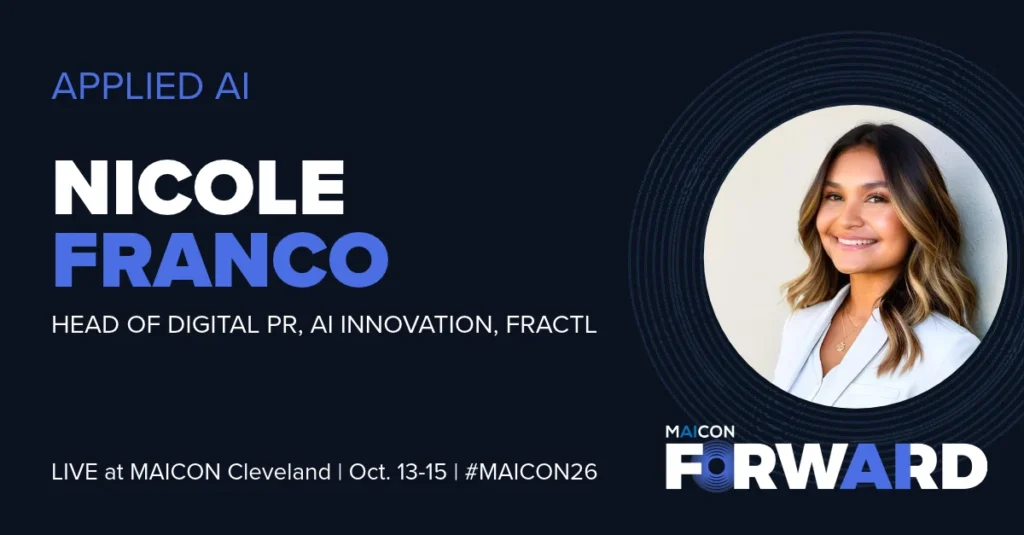
As consumers increasingly turn to ChatGPT, Gemini, and Google’s AI Overviews for product recommendations and brand research, the old PR model faces an existential crisis. To address this, Nicole Franco, Head of Digital PR and AI Innovation at Fractl, is set to headline a pivotal session at MAICON 2026. Her presentation, "Entity-Led Digital PR Workflows: Using Commentary, AI Prompts, and Media Partnerships to Build SME Authority in Search," promises to redefine how marketing leaders approach visibility in an era dominated by large language models (LLMs).
The Paradigm Shift: PR as an "Entity Engine"
The core challenge facing modern communications teams is the disconnect between traditional outreach and the way AI interprets authority. In the age of AI, a brand is not merely a collection of press releases; it is a complex web of "entities"—subject matter experts (SMEs), specific product lines, and the brand identity itself.
Franco argues that PR must transition from a reactive pitching process to an "entity-led engine." In this framework, every piece of content—from a LinkedIn update and a thought-leadership byline to an expert quote in a breaking news story—must be part of a singular, integrated system.
"The best way to think about this is to identify a cohesive metric across your entities and see how you can create and repurpose content across all media," says Franco. By treating these assets as interconnected nodes, marketers can build a consistent, authoritative signal that AI models are trained to recognize and, crucially, to cite.
Chronology of a Disrupted Industry
To understand the urgency of this transition, one must look at the evolution of search.
- The Pre-Algorithm Era: PR was judged by circulation numbers and the prestige of the publication.
- The SEO Boom: PR became subservient to backlink acquisition and domain authority (DA) metrics, often at the cost of narrative quality.
- The AI Overviews Era: We have entered a stage where the "click" is becoming secondary to the "answer." If an AI summarizes a topic and provides a recommendation, the user may never visit the brand’s website. Therefore, being the source cited by the model is the new zenith of digital PR.
This shift marks a departure from the "spray and pray" pitching methods of the past. Teams that fail to adapt their workflows to feed the specific data needs of LLMs will find themselves invisible, regardless of how many traditional media hits they secure.
The Myth of "Big Media" and the Contextual Authority Model
One of the most provocative aspects of Franco’s research involves challenging the industry’s obsession with top-tier media outlets. Conventional wisdom suggests that a mention in a national business publication is the gold standard. However, Fractl’s proprietary data reveals a more nuanced truth: authority is highly contextual.
"High-authority media is great, but in the context of your brand," Franco explains.
For instance, a food tech brand might gain more "AI visibility" by securing a feature in a niche, high-traffic vertical site like All Recipes than in a massive, general-interest business magazine. When an LLM parses data to answer a query about food technology, it pulls from sources that the model identifies as highly relevant to that specific vertical.
For the PR professional, this means the strategy must shift from "chasing the biggest logo" to "chasing the most relevant context." If the goal is to be the recommended expert in a specific niche, the team must identify the publishers that the AI models prioritize for that specific vertical. By aligning brand placement with the sources the LLMs trust for specific topics, brands can effectively "prime" the model to include them in future recommendations.
Transforming Commentary into Structured Data Assets
Perhaps the most significant tactical change Franco proposes is the treatment of expert commentary. Traditionally, PR firms view quotes as "filler" or secondary to the journalist’s narrative. Franco suggests a radical reversal: treat expert quotes as "structured data assets."
In the context of generative AI, the "slop"—generic, polished, or overly promotional corporate speak—is ignored or filtered out. Journalists and AI models alike are looking for substance. They crave "raw, uncut, candid sound bites" that offer genuine insight.
"They don’t want the same commentary or AI slop that many PRs might be sharing," Franco notes. "They want raw, uncut, candid sound bites that will add substance to their stories."
This requires a change in internal workflows. Rather than tasking teams with churning out generic responses to breaking news, marketing leaders should build a system where SMEs are prompted to provide distinct, data-driven, and emotionally resonant commentary. When this commentary is treated as a structured data point, it becomes far more likely to be indexed by search engines and cited by LLMs as the definitive answer to a user’s query.
Official Responses and Strategic Implications
As the marketing industry braces for the full impact of AI-integrated search, leaders are beginning to recognize that PR and SEO are no longer separate silos. The implications for leadership are clear:
- Unified Teams: PR, content marketing, and SEO departments must merge into a singular "authority-building" unit.
- SME Empowerment: Subject matter experts must be coached not just for interviews, but for the clarity and substance required by algorithmic crawlers.
- Measurement Overhaul: Metrics must move beyond simple "media hits" to include "share of voice" in AI-generated answers and the presence of brand entities in AI-sourced citations.
For those attending MAICON 2026, Franco’s session is designed to be more than a theoretical lecture. It is a tactical playbook. Attendees will gain actionable insights on how to build an entity-led framework, access data on which publishers truly drive AI visibility, and learn the specific workflows required to produce high-value commentary at scale.
Looking Ahead: The Human-Machine Synthesis
The goal of the modern PR professional is no longer just to influence the human reader; it is to influence the machine that informs the human reader. By focusing on entity authority—the sum total of a brand’s verified, relevant, and consistent digital footprint—companies can ensure they remain relevant in an AI-driven economy.
Nicole Franco’s work at Fractl stands at the forefront of this evolution. By prioritizing the structural needs of LLMs without sacrificing the human-centric nature of storytelling, she provides a roadmap for brands to navigate the future of digital visibility.
As we move toward MAICON 2026, the industry is at a crossroads. The choice is between clinging to outdated PR tactics that rely on legacy relationships or embracing an entity-led strategy that builds authority for both human audiences and the machines that now shape their world.
For marketing and communications leaders tasked with navigating this transition, the path forward is increasingly technical, data-informed, and highly strategic. Join Nicole Franco and more than 50 other AI and business leaders at MAICON 2026 to learn how to future-proof your brand’s authority.
Register today to secure your spot at the forefront of the AI-marketing revolution.
