
The Credibility Crisis: Why Visibility Without Trust Is a Dead End in the AI Era
In the fast-paced world of digital marketing, the mantra for the last decade has been "more." More content, more channels, more clicks, and more visibility. However, as we stand on the precipice of an AI-driven search revolution, a growing chorus of industry leaders is warning that the pursuit of sheer volume is not just misguided—it is fundamentally dangerous to brand authority.
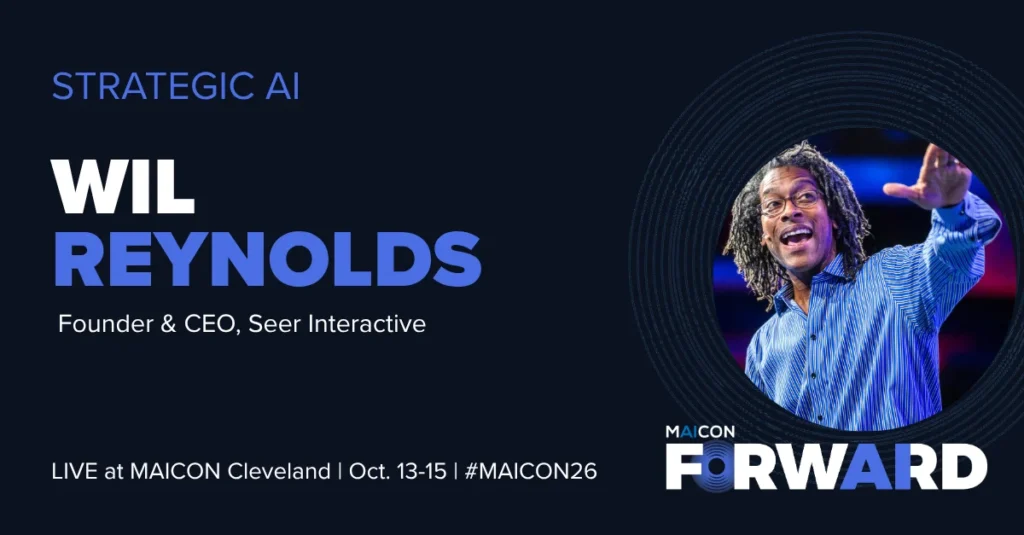
Leading this charge is Wil Reynolds, the founder and CEO of Seer Interactive. Since launching his agency in 2002, Reynolds has evolved from a grassroots SEO practitioner into one of the industry’s most respected voices on search architecture and artificial intelligence. As a featured speaker at MAICON 2026, Reynolds is preparing to deliver a sobering, necessary message to marketing leaders: the era of "output-at-all-costs" is coming to a crashing halt, and those who prioritize visibility over credibility will be the first to fall.
The Illusion of Scale: Why Faster Is Not Better
Every marketing team today is under immense pressure from stakeholders to leverage AI tools like ChatGPT and Gemini to streamline workflows. The pitch from software providers is seductive: produce ten times the content in half the time with a fraction of the headcount.
While this promises operational efficiency, Reynolds argues that it creates a catastrophic misalignment between brand strategy and audience expectation.
"Every tool on the market is promising the same thing: more content, faster, with fewer people," Reynolds notes. "That approach can work, but it has gone off the rails. More output does not automatically mean more trust. More visibility does not automatically mean more pipeline. And more AI-generated content does not automatically make a brand more useful, authoritative, or chosen."
The core of the issue lies in how modern search engines function. We are no longer operating in a world where keywords alone dictate visibility. Today, AI models are "deciding" who to cite based on a complex web of brand signals and historical authority.
"ChatGPT and Gemini are now using brands they already see associated with a topic, then running searches to retrieve information based on those brands and brand signals," Reynolds explains. If a brand has spent years flooding the internet with low-effort, AI-generated noise, they are signaling to these models that they are not a reliable source of truth. Consequently, brands that have taken shortcuts to drive quick visibility are finding that they are essentially invisible to the new AI-driven discovery engines. "Winning in AI is going to be harder than ever for them," he adds.
Defining the Line: The Role of AI in Thought Leadership
One of the most compelling aspects of Reynolds’s philosophy is his rigid boundary regarding where AI belongs in his personal workflow. In an industry currently obsessed with full-scale automation, Reynolds is refreshingly analog in his creative process.
"I use AI to think, challenge, and connect dots between ideas and articles I’ve read," he says. "It does not auto-produce anything for me personally. No emails, no video edits—those are my two biggies."
This distinction is vital. Reynolds recognizes that AI is a tool for augmentation, not replacement. By using the technology to synthesize information, challenge his own biases, and iterate on complex strategy, he uses AI to elevate the quality of his thinking. Conversely, many marketers use AI to mimic a human voice, churning out generic content that eventually dilutes the brand’s unique value proposition.
For Reynolds, the goal is not to "save time" by automating his own voice, but to use that time to deepen the substance of his work. This is the central tension of the modern marketer’s dilemma: are you using AI to raise the quality of your output, or are you using it to flood the channel with content that erodes the trust you spent years building?
The KPI Problem: A Divergence of Metrics
Perhaps the most significant, and often most uncomfortable, aspect of the shift to AI is the way it has broken traditional measurement models. Reynolds has been particularly vocal about a phenomenon he observed within his own organization: a noticeable, sustained decline in organic search traffic, coupled with an actual increase in his sales pipeline.
This divergence is the "smoking gun" of the new digital economy. Historically, marketers were trained to treat traffic as a proxy for success. If the traffic numbers went up, the team was winning. But in the AI era, where search queries are often answered directly on the search engine results page (SERP), high-volume, low-intent traffic is evaporating.
"Metrics is the biggest issue of all these days when it comes to AI visibility," Reynolds observes. "Everyone wants to be more visible AND tie the results down to a specific ROI, or else. It’s early innings and these things are not even close to being settled."
This creates a dangerous environment for marketing leaders. Those who are "scared" are clinging to outdated KPIs—vanity metrics like total page views or keyword rankings—because they fear having the difficult conversations required to justify a new strategy.
"Scared marketers will stick to outdated KPIs instead of having the tough conversations we need to have," he warns. "Things are harder to track than ever."
For Reynolds, the realization that traffic was no longer a reliable indicator of revenue was a "gift." It forced him to move beyond the surface-level metrics and examine the actual customer journey, providing him with a head start in adjusting his client strategies before the broader market caught on to the shift.
Implications for the Industry: The Path to Being "Chosen"
As we approach MAICON 2026, the industry is at a crossroads. The upcoming session, titled "Seen. Believed. Chosen: AI Optimization That Builds Visibility and Credibility," will offer attendees a framework to navigate this turbulence.
1. The "Seen, Believed, Chosen" Framework
Reynolds intends to move beyond abstract theory, providing a concrete framework for assessing AI optimization. He will guide attendees through:
- Visibility: How to signal authority to AI models rather than just gaming the algorithm.
- Believability: The art of maintaining human-centric content in an age of synthetic text.
- Chosen: How to ensure that once a brand is found, it is the one the consumer trusts enough to convert.
2. Scaling with Integrity
The session will specifically address the "scaling" problem. How can a business grow without sacrificing the authority that keeps them in business? Reynolds will share insights on how to identify what tasks should be automated, which should be slowed down, and which should be abandoned entirely.
3. The Future of Measurement
Attendees will walk away with a better understanding of how to communicate value to stakeholders when traditional traffic numbers are no longer the North Star. This includes shifting the focus toward "pipeline-led" marketing and prioritizing lead quality over quantity.
Preparing for MAICON 2026
The professional journey of Wil Reynolds serves as a case study for modern leadership. Growing Seer Interactive from a one-person operation into a 200-plus-person agency has required constant adaptation, but the core value—the importance of deep, expert-driven insight—has remained unchanged.
For marketers currently feeling the pressure to "do more with less" using AI, the temptation to succumb to the noise is high. However, the path forward is not about out-pacing the AI; it is about out-thinking it. By focusing on the intersection of visibility and credibility, marketers can build a sustainable brand that remains relevant, regardless of how search engines evolve.
The message for those planning to attend MAICON 2026 is clear: the strategies that worked yesterday will not sustain you tomorrow. Whether you are a CMO looking to overhaul your team’s approach or an SEO specialist trying to make sense of the changing landscape, Reynolds’s insights provide the necessary clarity to move from the chaotic, noisy middle of the pack to being the brand that is not just seen, but ultimately chosen.
As the industry prepares for the next phase of the AI revolution, the brands that win will be those that have the courage to stop chasing the algorithm and start building trust. The question is no longer "How can we be everywhere?" but "How can we be the only choice that matters?"
Join Wil Reynolds and over 50 other business leaders at MAICON 2026 to engage in the hard, necessary conversations that will define the next decade of digital marketing. The future belongs to those who prioritize substance over scale. Are you ready to make the shift?
