
Peak Martech: Has the Great Expansion Finally Hit the Ceiling?
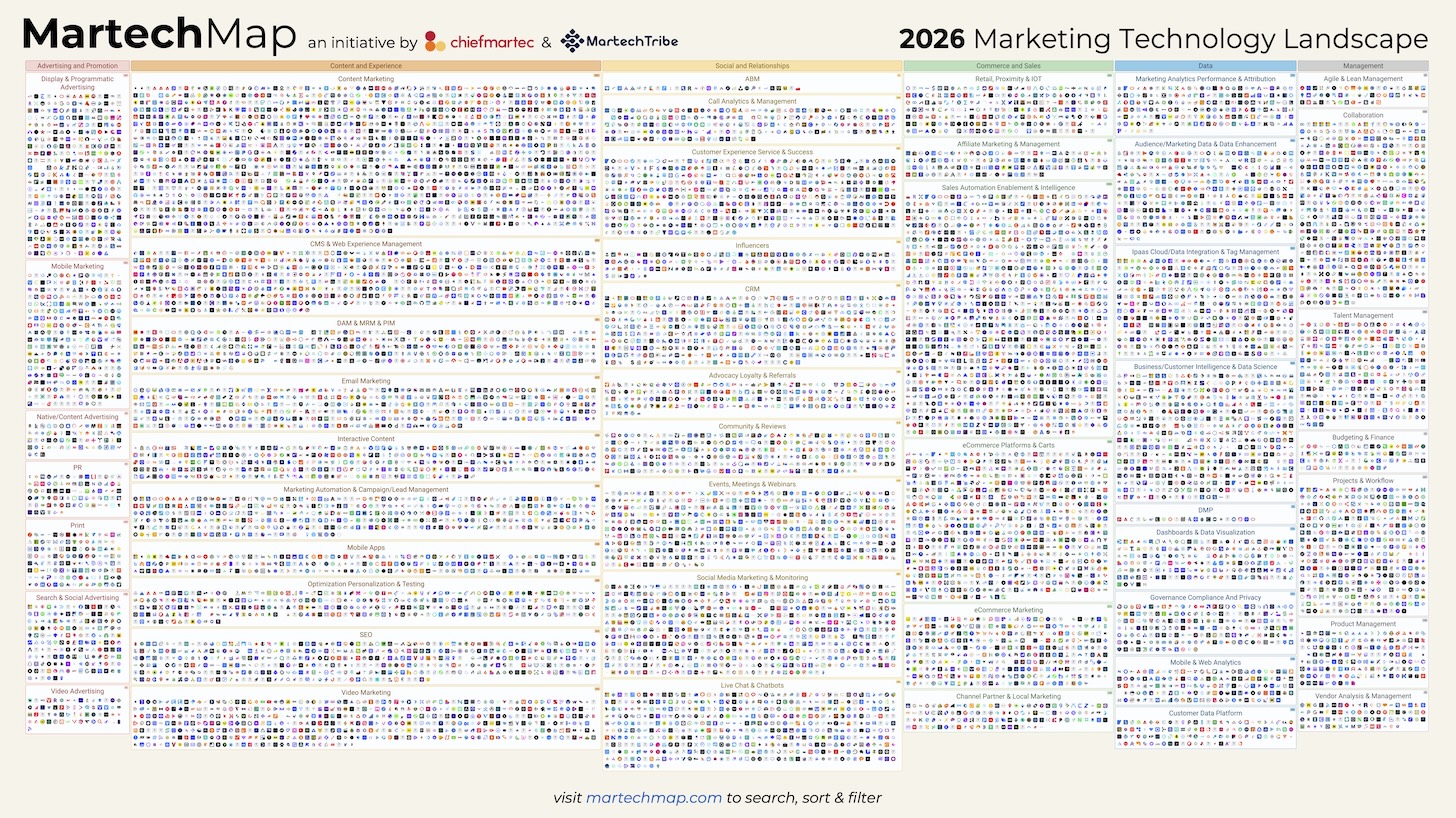
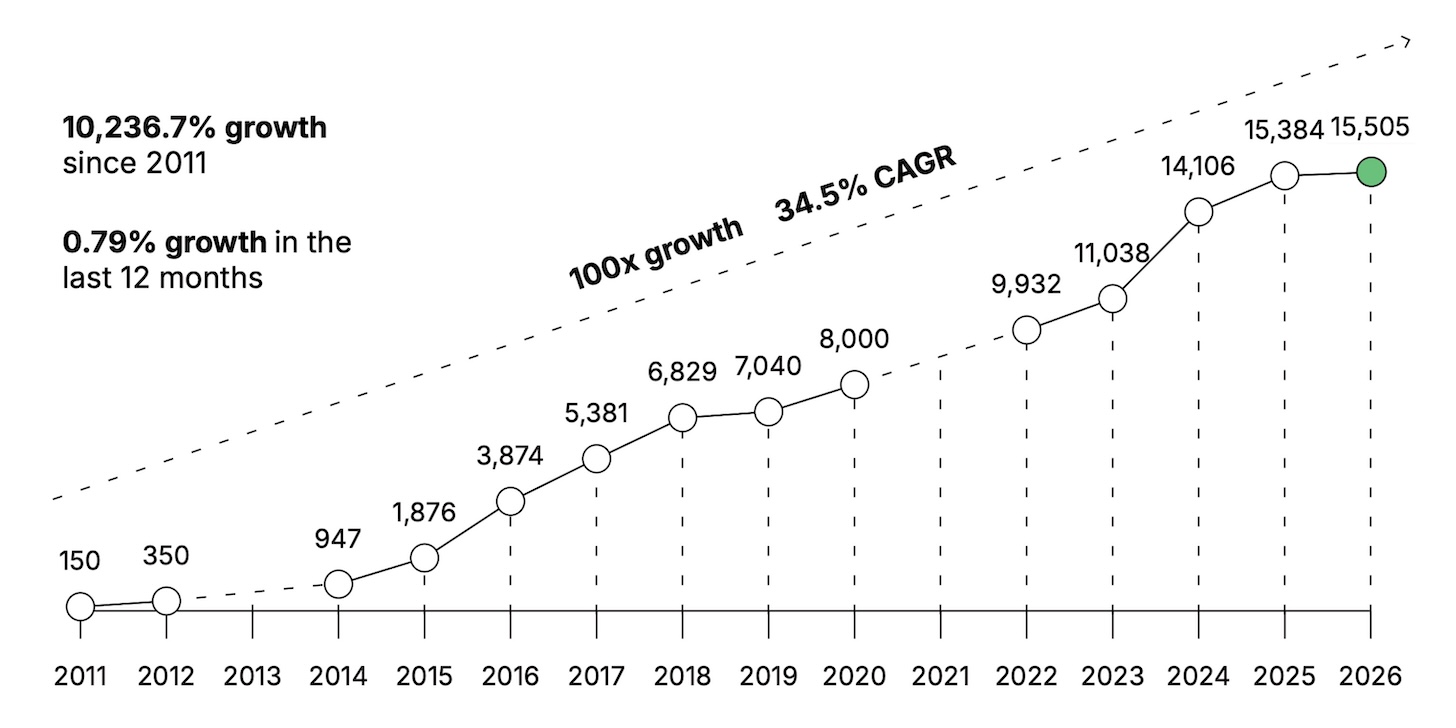
For fifteen years, the Marketing Technology (Martech) landscape has functioned as the industry’s version of the Big Bang—a relentless, exponential explosion of logos, categories, and venture-backed promises. Since 2011, when the landscape began with a modest 150 entries, it has grown by an astonishing 10,236%. For over a decade, the annual release of the "Martech Supergraphic" was a ritual of anticipation, marked by the inevitable question: How much larger can this possibly get?
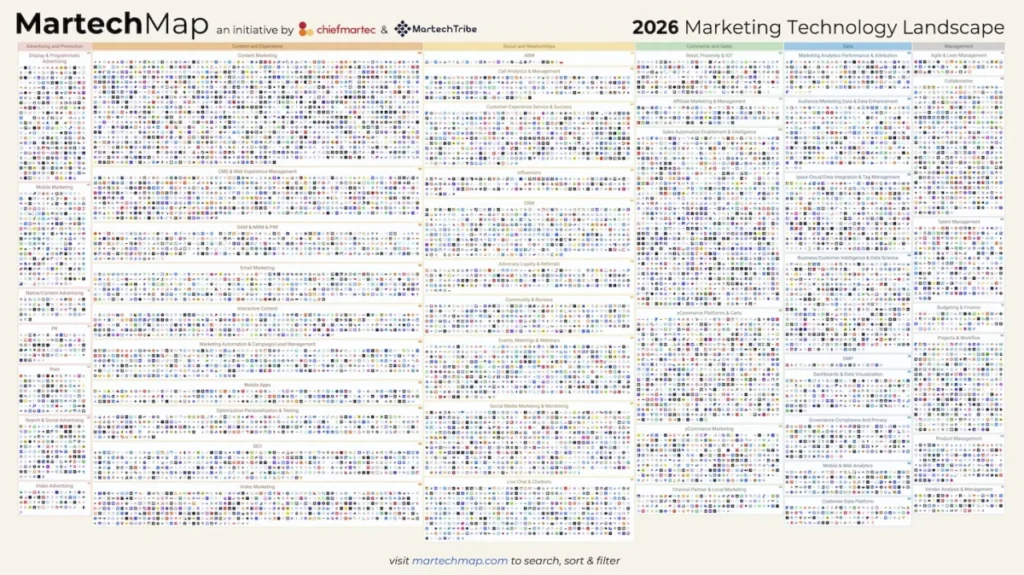
Today, that ritual has reached a historic inflection point. The release of the 2026 Marketing Technology Landscape reveals a market that has, for the first time, essentially stopped growing. With 15,505 products compared to last year’s 15,384, the industry has seen a net growth of just 0.79%. After years of unchecked expansion, we may have finally arrived at "Peak Martech."
The Great Plateau: A Statistical Snapshot
The headline figure—a mere 121 net additions—belies the profound turbulence occurring beneath the surface. To view this as a stagnant market would be a fundamental error. In reality, the industry is undergoing a violent, high-stakes churn.
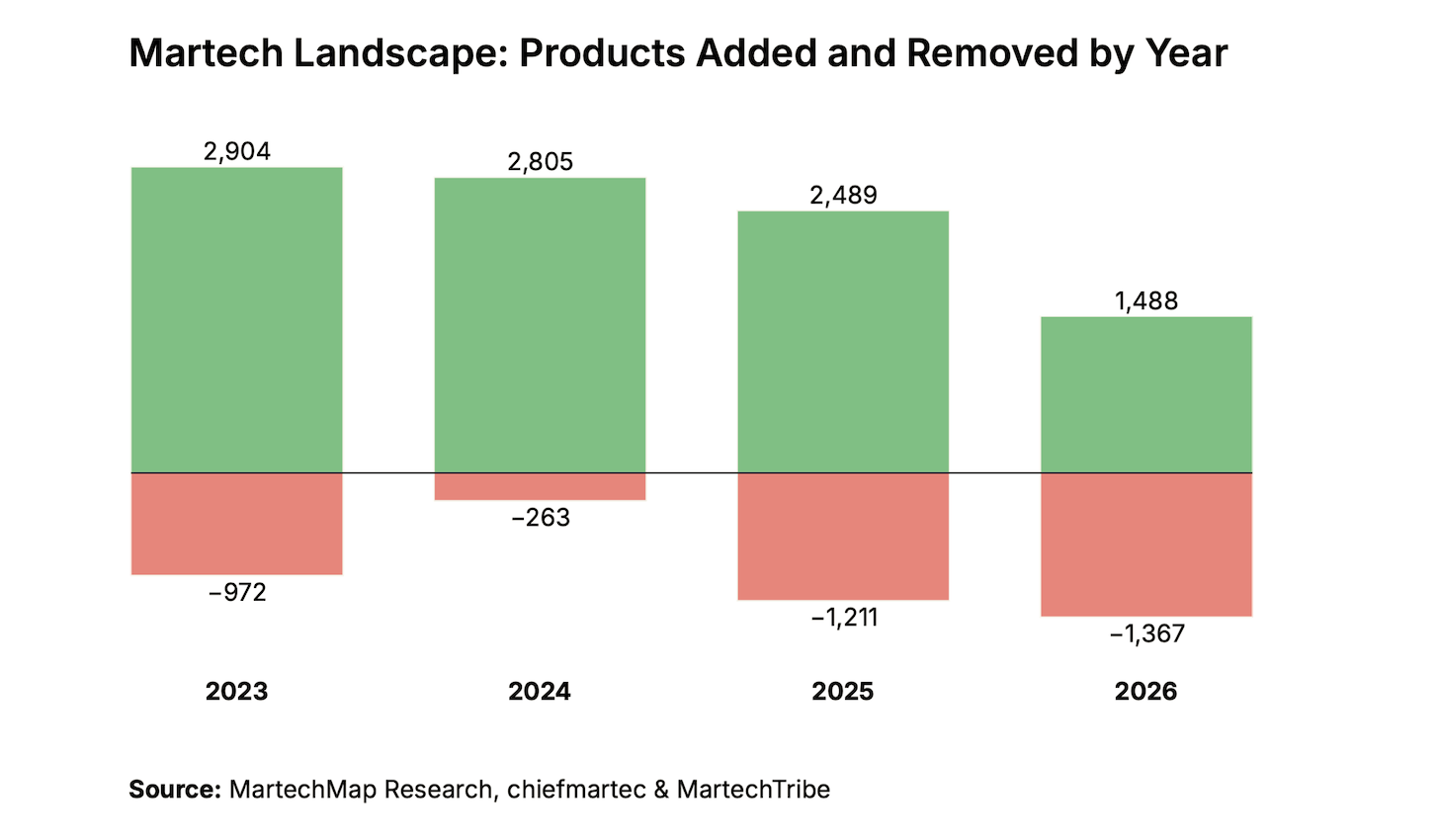
While 1,488 new products were added to the ecosystem, 1,367 were removed. This near-equilibrium suggests that the era of "easy" growth has concluded. The "Jurassic Park" effect—where martech always found a way to expand—has been superseded by the cold realities of market consolidation, buyer fatigue, and the brutal efficiency of the current AI-driven economy.
A Decade of Growth vs. The 2026 Reality
- 2011 Baseline: 150 products
- 2025 Total: 15,384 products
- 2026 Total: 15,505 products
- Net Growth: 0.79% (Effectively flat)
- New Entrants: 1,488 (Down 40% from the previous year)
- Market Exits: 1,367 (Up 13% from the previous year)
The Anatomy of the Exit: Who is Leaving the Landscape?
The most striking trend in this year’s data is the composition of the "departed." This is not merely a "bonfire of the vanities"—a clearing out of low-quality AI wrappers launched in the immediate aftermath of the Generative AI explosion. Instead, it represents a significant maturation of the market.
Over 51.7% of the products removed from the landscape belong to the SaaS wave of 2010–2019. These were once-promising companies that built real businesses with legitimate revenue, yet they failed to reach "inevitability."
The data on these exits is telling:
- Revenue Profile: 45.5% of removed products were in the $1M–$10M ARR range.
- Human Capital: 41.2% had 1–10 employees; 38.7% had 11–50.
These companies were squeezed by a classic "pincer movement." From above, large-scale incumbents are bundling AI capabilities directly into their existing platforms, making standalone niche tools redundant. From below, AI-native startups are disrupting workflows with faster, cheaper, and more autonomous solutions. For the middle-market SaaS firm, the "land and expand" strategy has become significantly harder as buyers focus on consolidating their tech stacks and reducing vendor sprawl.
The AI Paradox: Why Old Categories are Rebounding
If the total number of products is flat, where is the innovation? The answer lies in a surprising resurgence of "legacy" categories. While many predicted that AI would spawn entirely new, unrecognizable categories, the 2026 data shows that AI is instead reactivating the fundamentals.
CMS and Ecommerce: The New AI Frontier
- CMS & Web Experience Management: Grew by 21.4% (from 504 to 612).
- Ecommerce Platforms & Carts: Grew by 19.9% (from 547 to 656).
These categories are not growing because companies need new "web pages." They are growing because of the rise of the "Third Audience." For decades, the web was built for humans and search engines. Today, websites must be built for autonomous agents—AI search assistants, procurement bots, and answer engines.
These machines do not "browse" in the traditional sense. They extract, compare, summarize, and act. Consequently, companies are investing in CMS and ecommerce platforms that prioritize structured, machine-readable data. The quality of a brand’s AI-mediated experience is now entirely dependent on the quality of its "context engineering"—the ability of a platform to provide accurate, real-time data to an AI agent.
Implications for the Modern CMO
The shift toward "Peak Martech" carries profound implications for leadership. If the growth of the landscape has flattened, the era of "buying every tool" is officially over.
1. The Era of Rationalization
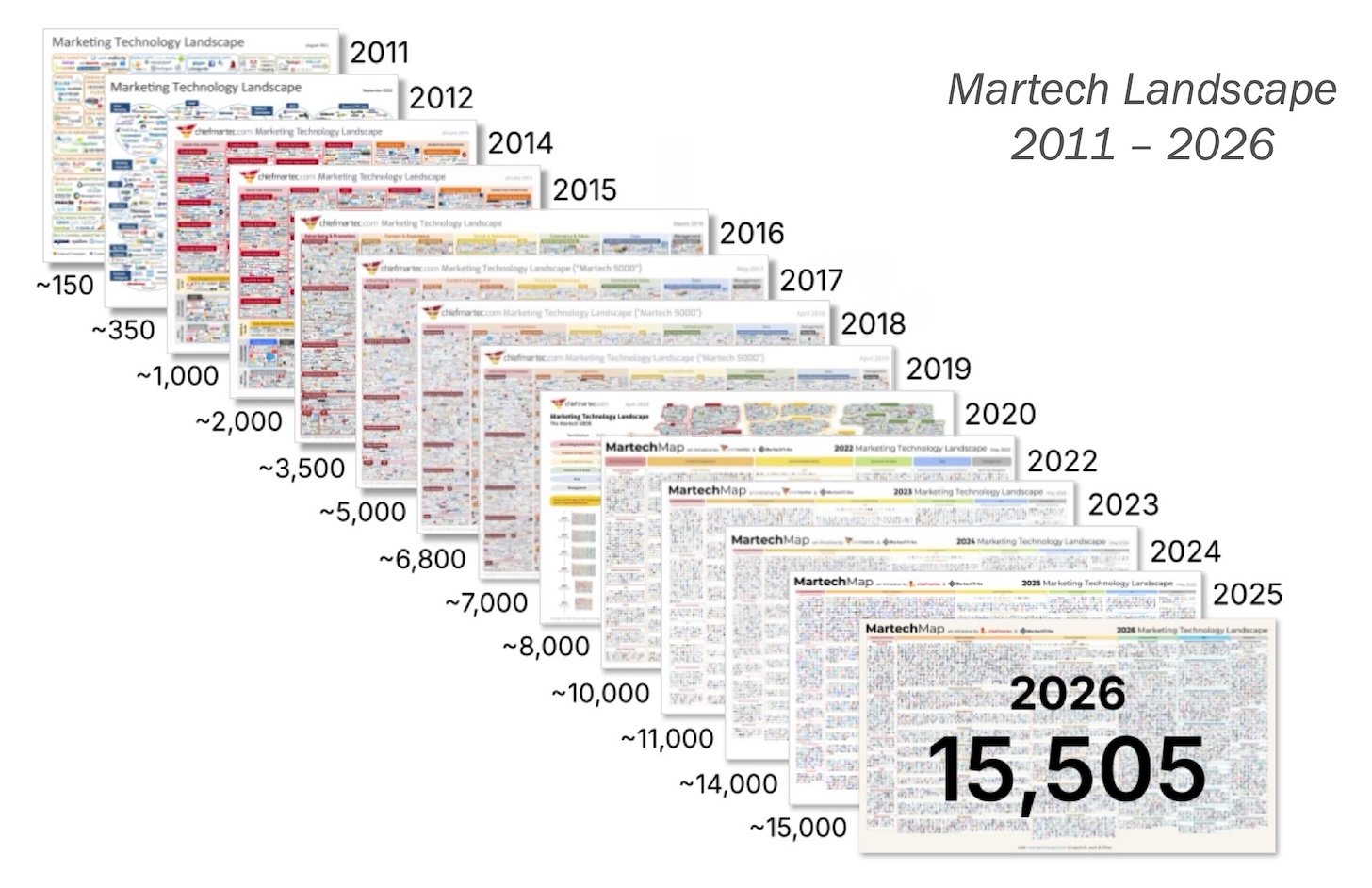
With 15,500 options available, the problem for a CMO is no longer finding a solution; it is eliminating the noise. The 13% increase in market exits suggests that vendor stability is becoming a primary KPI. Buyers are moving away from point solutions toward platforms that offer integrated governance, compliance, and cross-system data orchestration.
2. Context Engineering as Competitive Advantage
As the "State of Martech 2026" report highlights, the future of marketing is not about the model—it is about the context. Companies that invest in robust data architectures that can feed their own internal agents—guides, advisors, and sales assistants—will win. Those that continue to treat their martech stack as a collection of siloed, disconnected tools will find themselves unable to provide the seamless, intelligent interactions that customers now expect.
3. The Return of Orchestration
Categories like iPaaS/Data Integration (up 8.0%) and Marketing Automation (up 5.9%) are seeing renewed interest. As AI agents begin to perform complex tasks across systems, the "connective tissue" of the stack becomes the most valuable real estate. The ability to manage the flow of data between a CRM, an ecommerce engine, and an AI agent is now a strategic priority, not just a technical task.
Looking Ahead: The River, Not the Lake
While the headline—"Peak Martech"—may sound like the end of a story, it is more accurately a transition. If the last 15 years were about the accumulation of technology, the next five years will be about the refinement of it.
Martech is no longer a static lake where we can simply add more water to make it bigger. It is a river. The water is moving faster, the currents are stronger, and the channels are shifting. The 1,367 companies that left the landscape this year are a testament to the fact that innovation is a constant, unforgiving process.
For the marketers who survive this cycle, the prize is significant. By leveraging the new generation of CMS, analytics, and orchestration tools, they can move past the limitations of static websites and into an era of collaborative, agent-based commerce. The landscape may have stopped growing in size, but the opportunity for deep, transformative integration has never been greater.
For a deeper dive into the data, the 70+ AI use cases currently reshaping the industry, and a full analysis of the 15,505 products, you can download the full State of Martech 2026 report at MartechMap.com.
