
The Great Reset: Why Site Search and App Navigation Must Go Conversational—Or Face User Extinction
By Tech & Digital Transformation Desk
Published: October 2026
Main Facts: The Shift From Static Search Bars to Conversational Interfaces
As the digital landscape evolves under the heavy influence of generative artificial intelligence, a quiet crisis is brewing in the boardrooms of retailers, banks, insurers, and government agencies alike. While much of the current tech discourse centers on optimizing content for external discoverability—such as ranking within third-party answer engines like ChatGPT, Google Gemini, and Percep_AI—a critical blind spot remains. Organizations are overwhelmingly ignoring the "owned environment": their own proprietary websites and mobile applications.
For decades, the standard paradigm for finding information within a specific app or website has relied on the traditional search bar—a rigid box that demands precise keywords, boolean operators, or guesswork, often resulting in frustrating walls of blue links or "no results found" error pages. However, the widespread adoption of natural-language conversational interfaces has fundamentally altered user expectations.
Consumers, business buyers, patients, clients, subscribers, and constituents are no longer content with outdated UI patterns. Having experienced the frictionless, intuitive nature of AI chat agents that understand context, nuance, and intent, users now expect the same high-caliber, personalized conversational experiences everywhere they interact online.
According to upcoming industry research and strategic frameworks from leading advisory firms, site search and in-app navigation are headed for a massive, unavoidable reset. Digital leaders are being issued a stark ultimatum: evolve proprietary search and navigation into fluid, conversational engines, or watch as frustrated users abandon your digital properties entirely in favor of competing platforms that offer seamless, human-like interaction.
Chronology: How We Arrived at the Owned-Search Crisis
To understand why traditional site search is reaching its breaking point, it is helpful to trace the chronological evolution of digital discovery over the past two decades.
- The Early 2000s – The Keyword Era: The architecture of web search was built around indexing. Websites relied heavily on metadata, exact-match keywords, and rigid taxonomy trees. Users were expected to think like computers, feeding precise terms into search bars to unearth relevant documents or product pages.
- The 2010s – Mobile Apps and Siloed UX: As mobile applications proliferated, search fractured. Apps developed their own proprietary, often rudimentary internal search functions. While web search engines grew smarter through machine learning, in-app search remained largely primitive, relying on exact string matching and static filters.
- 2022–2024 – The Generative AI Explosion: The launch of consumer-facing large language models (LLMs) changed user behavior overnight. People grew accustomed to conversational queries. Instead of typing "low-interest auto loan rates 36 months," users began asking, "What kind of car loan can I get with a 720 credit score that won’t break my monthly budget?" The technology didn’t just look for words; it comprehended intent.
- 2025–2026 – The Disconnect Between External and Internal Tools: While enterprises rushed to optimize their SEO for external answer engines, they neglected their internal architectures. Users experienced a jarring whiplash: they could converse naturally with third-party AI assistants, but the moment they landed on a bank’s website or a retail app, they were forced back into 2010-era keyword matching.
- Late 2026 – The Ultimatum: Industry analysts began sounding the alarm. The tolerance for bad site search evaporated. Digital leaders realized that the chat bubble—while a useful innovation—was no longer enough. The conversational paradigm needed to migrate out of isolated pop-up chat widgets and directly into the primary search bar and onto the core page layout.
Supporting Data: The Rising Expectations of Modern Users
The push for a conversational overhaul of owned digital environments is not merely a stylistic preference; it is backed by shifting consumer demographics and behavioral data.
Recent benchmark surveys underscore a profound transformation in how digital audiences interact with technology. For instance, data from major digital consumer research initiatives highlights that nearly nine in 10 online adults in major Western markets are now intimately familiar with artificial intelligence tools. More importantly, their daily usage of these tools has conditioned them to expect zero friction when seeking information, comparing products, or resolving customer service issues.
- The Tolerance Gap: User testing data indicates that bounce rates on corporate websites skyrocket when a user’s initial search query fails to yield contextually relevant results within two seconds. Traditional site search algorithms fail approximately 30% to 40% of complex, multi-intent queries because they cannot parse context.
- The Rise of Agentic Commerce: The stakes are further raised by developments in agentic commerce—autonomous AI agents acting on behalf of users. Recent high-profile friction points, such as Amazon blocking Meta’s Muse AI agent from making marketplace purchases, demonstrate that third-party bots are aggressively attempting to intermediate the customer journey. When consumers deploy their own AI agents to shop, research, or manage accounts across the web, static websites that lack conversational API integration or machine-readable conversational architecture risk being locked out of automated transactions entirely.
- The Financial Services Trust Gap: Research into consumer sentiment—particularly within sensitive sectors like financial services—reveals a paradoxical trust gap. While consumers embrace AI for convenience, they demand absolute security and transparency. Financial institutions that fail to integrate trustworthy, context-aware conversational search on their portals risk losing tech-savvy demographics to fintech disruptors that prioritize fluid user experiences.
Official Responses and Strategic Frameworks: The ADVICE Model
As organizations grapple with the obsolescence of legacy site search, digital strategists are rallying around structured frameworks designed to bridge the gap between static design and dynamic conversation.
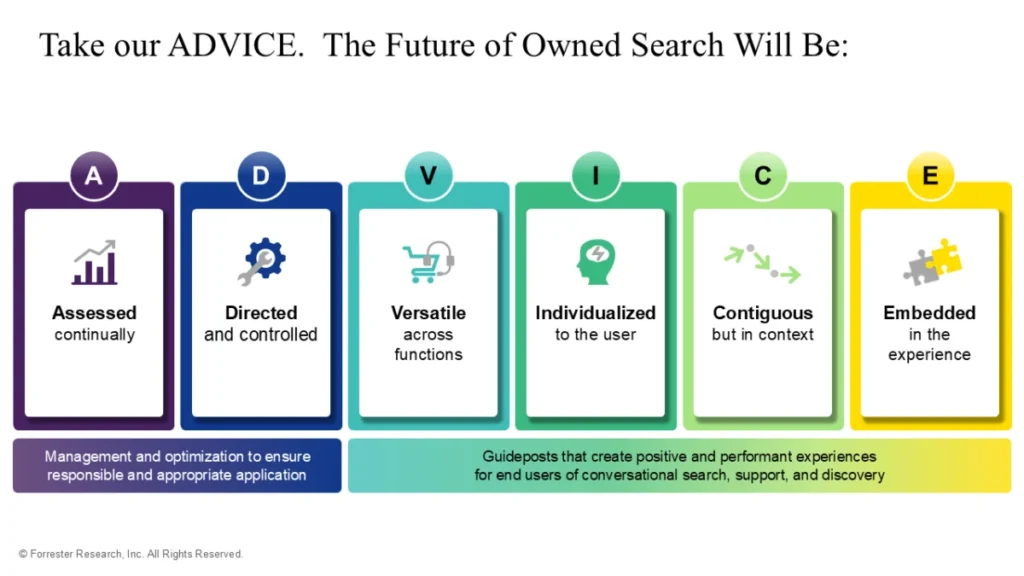
To help digital leaders navigate this transition without completely discarding legacy architectures that still serve core user segments, analysts have introduced the ADVICE framework. This strategic guide outlines six non-negotiable pillars for modernizing owned search and in-app navigation:
- Assessed: Conversational search systems must continuously evaluate user intent and feedback in real time, adapting their responses based on implicit behavioral cues rather than relying solely on explicit, typed-out keywords.
- Directed: While interactions should feel conversational, they cannot be chaotic. The experience must guide users efficiently toward their goals, blending open-ended dialogue with structured UI elements (such as carousels, filters, and quick-action buttons) to prevent conversational dead ends.
- Versatile: The search experience must transcend the traditional "chat box in the corner" paradigm. It needs to be versatile enough to manifest within the primary search bar, embedded directly into product description pages, and integrated throughout the transactional flow.
- Individualized: Personalization is no longer optional. Conversational search engines on owned properties must leverage first-party data securely—respecting privacy boundaries—to deliver tailored, context-aware recommendations for every distinct user, whether they are a retail shopper, a corporate buyer, or a healthcare patient.
- Contiguous: Users frequently switch devices and modalities—moving from a mobile browser app to a desktop site, or shifting from tapping a screen to voice commands. The conversational journey must remain seamless and uninterrupted across these touchpoints.
- Embedded: AI-driven search should not feel like an afterthought or a bolted-on widget. It must be deeply embedded into the DNA of the application or website, powering everything from content discovery to checkout workflows and customer support.
Industry events, such as Forrester’s upcoming webinar The Future Of Owned Search In Apps And On Websites, are drawing massive interest from enterprise executives eager to dissect the data behind these frameworks and operationalize the transition.
Implications: What This Means for Businesses and Digital Leaders
The transition from static keyword search to conversational owned search carries profound implications for organizational strategy, technical infrastructure, and competitive positioning.
1. The Death of Traditional SEO Silos
For years, digital marketing departments maintained a rigid wall between external SEO (optimizing for Google and Bing) and internal site search optimization. That wall is crumbling. Organizations must now treat their internal content architecture with the same semantic richness required by external LLM answer engines. If a company’s internal product descriptions, knowledge bases, and service terms are not structured for semantic comprehension, its owned conversational search will fail.
2. Redefining the User Interface (UI/UX)
Digital designers face a radical reimagining of screen real estate. The iconic, solitary search bar positioned at the top right of a webpage is giving way to dynamic, expansive input fields that invite natural language. However, designers are cautioned against over-correcting. The goal is not to replace every button and menu with a chat bubble, but rather to blend conversational intelligence with familiar, highly efficient UI patterns that users already understand.
3. Protecting Direct Customer Relationships
As agentic commerce and external AI intermediaries attempt to broker transactions between brands and consumers, owning the conversational interface on your own site becomes a matter of corporate survival. Brands that cling to static, frustrating site search will watch users delegate their shopping and research entirely to third-party AI agents, severing the direct line of sight between the enterprise and its customers.
4. Technical Debt and Infrastructure Overhaul
Implementing the ADVICE framework requires more than a superficial skin-deep UI update. It demands an underlying overhaul of content management systems (CMS), product information management (PIM) systems, and customer data platforms (CDP). Organizations must invest in retrieval-augmented generation (RAG) architectures and enterprise-grade vector search capabilities tailored specifically to their proprietary data silos.
Outlook: Adapt or Become Obsolete
The writing is on the wall for legacy site search. As user expectations continue to be shaped by hyper-intelligent, conversational AI assistants in their daily lives, patience for broken internal search engines and irrelevant search results has dropped to zero.
Digital leaders who recognize this shift—moving beyond isolated chat bubbles to embed versatile, individualized, and contiguous conversational search directly into their apps and websites—will secure higher engagement, stronger customer loyalty, and a distinct competitive advantage. Those who delay risk joining a growing list of digital dinosaurs whose properties users simply stopped visiting.
