
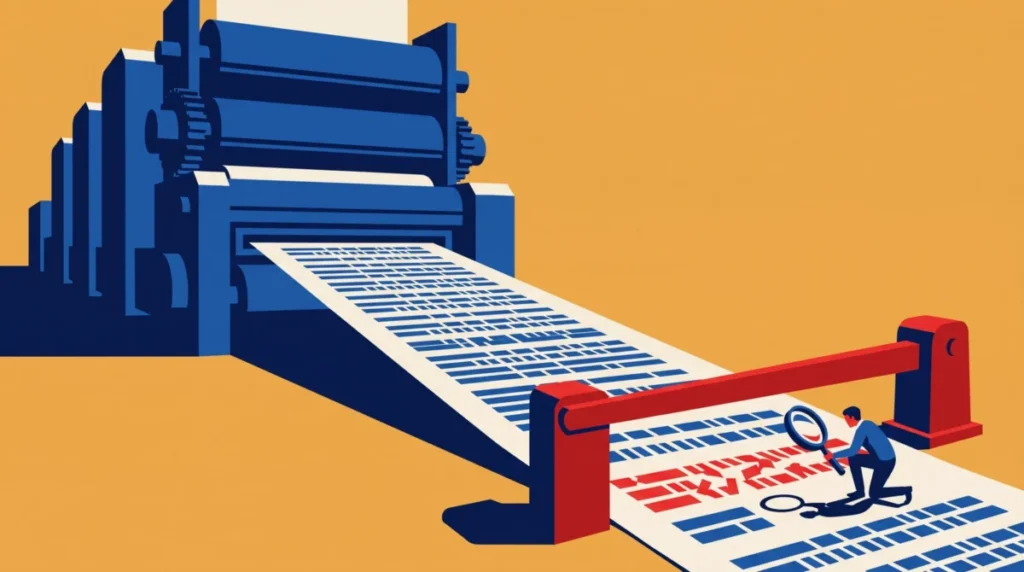
The "Critical" Pivot: Google Updates AI Guidance, Mandating Human Oversight for All Automated Content
In a significant shift for the digital publishing and e-commerce industries, Google updated its Search Central documentation on Thursday, October 1, 2026, to explicitly codify the necessity of human intervention in the AI content creation process. The update, which centers on the "Focus on accuracy, quality, and relevance" section of the site’s generative AI guidance, introduces a firm expectation: that site owners must manually fact-check and review all AI-generated output before it is pushed live to the web.
For website operators, agencies, and large-scale e-commerce platforms that have increasingly relied on automated tools to generate everything from long-form articles to technical metadata, this change serves as a definitive "stop and look" directive. While Google maintains that this update does not constitute an algorithmic change to search rankings, the language shift—specifically the inclusion of the word "critical"—marks a rare and pointed intervention in how site owners manage their AI workflows.
The Core Mandate: Why Machines Can’t Be Trusted Alone
The edit is concise but heavy with implications. Google’s new documentation explicitly demystifies how large language models (LLMs) operate, moving away from the "black box" marketing language often used by tech vendors.
The guidance now states: "Generative models don’t retrieve facts, but predict a likely sequence of words based on their training data." It follows this with the inevitable, and often problematic, conclusion: "Because of this, generative AI outputs may contain inaccuracies (also known as hallucinations)."
Crucially, the third sentence of this new triad establishes the new standard: "It is critical to manually factcheck and review all AI-generated content for accuracy and trustworthiness before publishing."
By extending this requirement to title elements, meta descriptions, structured data, and image alternate text, Google has closed a loophole that many content teams previously exploited. Often, teams would meticulously edit body copy while leaving machine-generated metadata to scale unchecked. Because these elements are frequently pulled directly into Search results, Google has made it clear that errors in these hidden fields are as detrimental to user trust as errors in the main article body.
Chronology: A Documentation Update Mid-Cycle
The timing of this update is particularly notable. It arrived on October 1, 2026, squarely in the middle of a major, two-week-long spam update that began on September 24.
- September 24, 2026: Google initiates its fourth spam update of the year. Historically, these updates have focused on refining the "SpamBrain" system to identify and suppress low-quality, mass-produced content.
- September 30 – October 2, 2026: Google hosts its "Search Central Live Deep Dive" in Barcelona. It is widely believed that the documentation update, pushed on October 1, was a direct reflection of discussions held during this event.
- October 1, 2026: The official "Last updated" stamp appears on the Search Central guidance page.
- October 2, 2026: Discrepancies in internationalization become apparent, with reports from agencies like Relevant Audience noting that non-English versions, such as the Thai-language site, had yet to reflect the new mandates.
While the changelog vaguely attributes the update to aligning documentation with presentations from developer events, the lack of transparency regarding which specific event or presentation triggered the change has left SEO professionals to draw their own conclusions about the urgency behind the shift.
Supporting Data: The Reality of AI Hallucination
The industry has been grappling with the "hallucination" problem since the widespread adoption of LLMs. Research continues to show that the reliance on AI without human intervention is a high-risk strategy.
A study from Stanford’s RegLab, which examined legal research tools, found hallucination rates between 17% and 33%. Meanwhile, in the commercial sector, a July 2025 report from NP Digital found that 25% of users had encountered errors in AI-generated answers, with inaccuracies accounting for over half of those reported issues.
The data suggests a deepening "trust gap." A survey from February 2026 revealed that nearly half of marketers (47.1%) encounter AI inaccuracies several times a week. Perhaps most alarmingly, nearly a quarter of respondents (23%) admitted to feeling "confident" using AI output without any human review—a practice Google has now explicitly categorized as a failure in quality control.
The case of ClickUp’s blog serves as a cautionary tale: the site lost 97.6% of its organic traffic due to a systemic, template-driven error in its structured data. While not a "hallucination" in the traditional sense, it demonstrates that at scale, even minor automation errors can destroy a domain’s search equity.
Official Responses and Documentation Ambiguity
Google’s communication regarding this change has been characterized by a notable degree of ambiguity. The official changelog states: "Updated the using generative AI content guide with information from the Search Quality Raters guidelines."
However, external audits by Search Engine Journal and Relevant Audience revealed that the specific paragraphs cited from the Rater Guidelines were already present in the documentation before the update. The three sentences regarding accuracy and the specific call-out of metadata appear to be entirely new, not merely "synced" with existing rater guidelines.
This creates a tension between Google’s public documentation and its enforcement mechanisms. While the documentation mandates human review, it provides no concrete metrics for what constitutes a "fact-check." There is no requirement for a record-keeping system, no defined role for the reviewer, and no clear explanation of how the search engine might algorithmically distinguish between a page that has been human-reviewed and one that has been mass-produced via AI.
Implications: The New Cost of Doing Business
For agencies and publishers, the implication is simple: the "move fast and break things" era of AI-generated content is being forcibly reined in by the need for institutional oversight.
1. The Cost of Production
A workflow that relies solely on AI generation is no longer compliant with Google’s stated expectations. Businesses must now account for a "human-in-the-loop" (HITL) cost. For e-commerce sites with thousands of product descriptions, this shift necessitates a total audit of metadata generation processes.
2. Legal and Liability Risks
The legal landscape is shifting alongside the documentation. In June 2026, a Munich court set a precedent by holding Google directly liable for the content generated by its own AI Overviews. While publishers are not Google, the precedent suggests that "the AI wrote it, not me" is becoming an increasingly thin legal defense for misinformation.
3. The "Quality" Trap
Google continues to warn against "scaled content abuse"—the practice of using automation to generate large amounts of content with little added value. By linking the new accuracy requirements to these existing spam policies, Google has effectively signaled that unreviewed, error-prone AI content is now a prime target for future spam updates.
Conclusion: A New Standard for the AI Era
The October 1 update is not a technical penalty; it is a declaration of maturity. By explicitly stating that generative models are word-prediction engines rather than fact-retrieval systems, Google is attempting to lower user expectations while raising the burden of proof for site owners.
For the SEO industry, the message is clear: the utility of AI lies in its ability to add structure and speed to content creation, but its inherent tendency to hallucinate makes it a liability when left unsupervised. As we head into the next cycle of search updates, the difference between sites that thrive and sites that are penalized may well come down to the presence of a human editor in the workflow.
Moving forward, site owners must view their content management systems not just as publishing platforms, but as quality assurance environments. The "critical" review stage is no longer a suggestion—it is a foundational component of modern digital operations.
