
Google Expands AI Mode Information Monitoring to Global Users: A New Era for Continuous Web Search
Global Availability Marks a Major Milestone for Google’s Agentic Search Capabilities
Google has officially begun rolling out its advanced information monitoring capabilities within AI Mode to all users globally, marking a significant transition from an exclusive, paid-tier feature to a mainstream search utility. Initially restricted to Google AI Ultra and Pro subscribers, the feature empowers users to set persistent monitoring tasks that autonomously track and update them on dynamic topics across the web.
The announcement, made by Robby Stein, Vice President of Product for Google Search, via a social media post on X, highlights Google’s rapid evolution toward agentic search—systems that do not just answer a single query, but actively work in the background to gather, synthesize, and deliver fresh information over time. As this feature reaches a worldwide audience, it introduces proactive task suggestions directly into the standard search interface, fundamentally shifting how consumers interact with search engines for local events, shopping trends, and real-time news.
Main Facts
The global rollout of AI Mode’s information monitoring brings several key capabilities to standard and premium users alike:
- Continuous Background Tracking: Users can instruct AI Mode to monitor specific topics, and the system will persistently scan changing web content—including news sites, niche forums, social media posts, real-time data sources, and the expansive Google Shopping Graph, which catalogs over 60 billion products.
- Proactive Task Suggestions: Beyond manual user prompts, Google Search will now actively suggest monitoring tasks based on ongoing search behavior, prompting users to stay updated on fast-moving subjects.
- Transition from Paid to Public: The feature was first introduced conceptually at Google I/O in May and later deployed exclusively to high-tier Google AI Ultra and Pro subscribers during the summer. This new phase brings the technology to a global user base.
- Primary Use Cases: Early demonstrations and rollout examples heavily emphasize dynamic, highly temporal categories such as local pop-up events, flea markets, regional holiday activities, back-in-stock notifications, and real-time price drops.
- Integration Points: The capability is accessible directly through the Google app, signaling deeper integration between mobile operating environments and proactive AI agents.
Chronology: From Concept to Global Release
The path to a global rollout for Google’s AI information monitoring has been steady, mapping directly against the company’s broader strategy to transition search from a passive lookup tool to an active assistant.
May 2026: The Google I/O Unveiling
During the annual Google I/O developer conference, executives detailed the company’s roadmap for AI-driven search agents. Google announced that "information agents" would represent the first wave of these capabilities, designed to help users track complex, changing datasets over time. The company confirmed at the time that the feature would debut exclusively for premium Google AI Pro and Ultra subscribers during the summer months.
June 2026: The Ultra Subscriber Debut
True to its roadmap, Google initiated a limited rollout in June. This initial deployment delivered information agents specifically to Google AI Ultra subscribers across multiple languages and markets. While it gave power users a first look at the technology, it remained locked behind the platform’s most expensive subscription tier, limiting widespread public testing and publisher observation.
September 2026: The Global Public Rollout
In a September announcement, VP of Product Robby Stein confirmed that the feature—now explicitly termed "information monitoring"—was expanding past subscription paywalls to a global audience. Alongside this broad release, Google introduced context-aware search suggestions that prompt users to turn one-off queries into ongoing monitoring tasks.
Supporting Data and Technical Mechanics
To understand the scale and ambition of Google’s information monitoring feature, one must examine the underlying data infrastructure that powers it.
According to product documentation and leadership statements, AI Mode monitoring does not merely rely on periodic re-indexing of static pages. Instead, it leverages a multi-layered data ingestion pipeline:
- Web and Social Scraping: The system continuously parses unstructured web data, pulling fresh updates from publisher websites, community forums, and public social media platforms where real-time conversations happen.
- Real-Time Data Feeds: Proprietary real-time data integrations allow the AI to cross-reference schedules, ticket sales, weather updates, and immediate announcements.
- The Google Shopping Graph: For commercial queries, the system taps directly into the Google Shopping Graph, which indexes more than 60 billion products. This massive database enables granular tracking of inventory levels, merchant pricing fluctuations, and promotional drops.
Practical Application: A Use-Case Breakdown
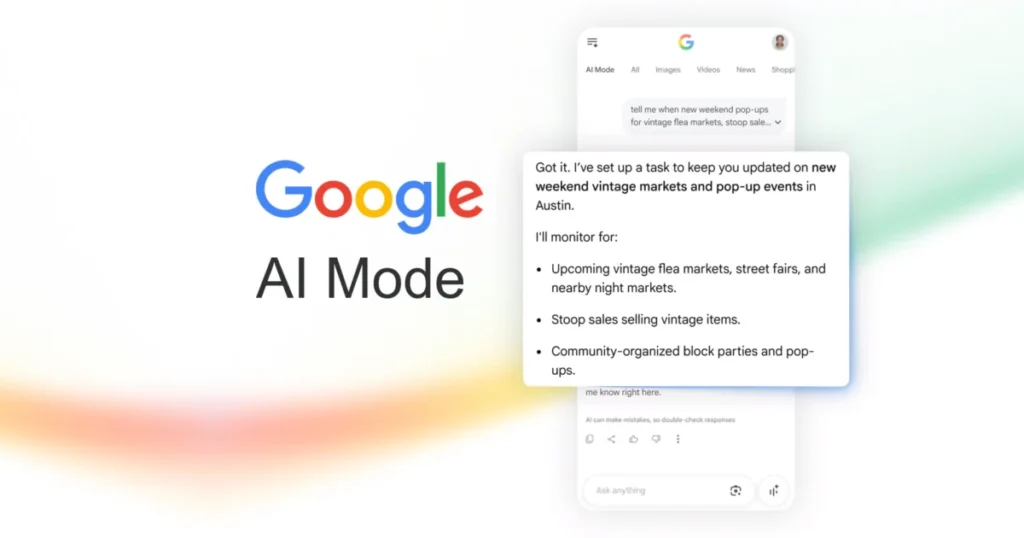
In demonstration materials provided during the rollout, a user interacting with AI Mode requests updates on weekend pop-up events in Austin, Texas. The AI responds by establishing a formal background task, explicitly detailing that it will monitor:
- Local flea markets
- Neighborhood stoop sales
- Independent block parties and temporary retail activations
Rather than requiring the user to execute new search queries every Friday afternoon, the agent compiles these updates proactively, delivering synthesized briefings directly to the user’s interface.
Official Responses and Industry Context
Google’s leadership has framed this rollout as a natural evolution of consumer search behavior. In his announcement post, Robby Stein emphasized the convenience of eliminating repetitive manual searches for volatile topics:
"Just tell AI Mode exactly what to look for & Search will continuously check across changing info on the web like sites, forums and social posts, our real-time data sources, and Shopping Graph of 60B+ products, so you can stay up-to-date with fresh info. And it’ll even suggest tasks when you’re searching so you can get the latest info when it happens."
Despite the enthusiasm from product teams, digital marketers, SEO professionals, and publishers have raised questions regarding transparency and traffic distribution.
In earlier June communications concerning agent updates, Google noted that monitoring summaries would include attribution links pointing back to source websites. However, the September global rollout announcement notably omitted explicit references to link structures or referral mechanics. Furthermore, Google has not yet detailed the exact algorithms or ranking signals used by AI agents to select which web sources feed into an update summary.
For local businesses, independent retailers, and content creators, this creates a temporary blind spot: while the promise of being surfaced by an AI agent is appealing, the operational mechanics of how those citations translate into organic web traffic remain unclear.
Implications for Users, Publishers, and the Future of Search
The widespread availability of AI information monitoring carries profound implications for multiple stakeholders within the digital ecosystem.
1. For Consumers: The Death of the "Check-Back" Habit
For everyday users, information monitoring reduces cognitive load. Historically, keeping track of fluctuating concert ticket prices, hard-to-find holiday gifts, or local event schedules required manual discipline—remembering to check back on specific sites daily. AI monitoring automates this friction, effectively turning Google Search into a personalized tracking secretary.
2. For Publishers and E-Commerce Brands: Navigating "Zero-Click" Intelligence
For content creators and web publishers, agentic search represents a double-edged sword. On one hand, being cited by an AI monitoring task as a primary source of local or niche data could drive highly qualified, high-intent traffic. On the other hand, if AI summaries satisfy user intent entirely within the Google interface (a classic zero-click scenario), downstream traffic to publisher websites could decline.
Retailers listed within the Shopping Graph must also adapt; as AI agents track price drops and inventory in real-time, merchants with optimized, clean structured data feeds will likely capture automated monitoring recommendations far more effectively than those relying on legacy SEO alone.
3. Looking Ahead: What Comes Next for AI Mode?
As Robby Stein concluded his update with the phrase "Lots more to come!", industry analysts anticipate rapid iteration on Google’s agentic framework. Future updates are expected to expand beyond localized and shopping tasks into more complex, multi-step professional workflows, research tracking, and proactive problem-solving.
For now, global users exploring the Google app will find a new paradigm of search—one where the engine no longer waits for a question to be asked, but quietly watches the web on the user’s behalf.
