
Beyond the Hype: How Global Enterprises Are Translating AI Momentum into Measurable Business Value
NEW YORK — Artificial intelligence is no longer a peripheral experiment confined to innovation labs or isolated proof-of-concept projects. Today, AI is weaving itself deeply into the architecture of technology organizations, core operational workflows, and everyday corporate tasks. Yet, as the initial wave of enthusiasm settles into the hard reality of execution, technology leaders face a far more complex hurdle: transforming raw momentum into meaningful, sustainable business outcomes.
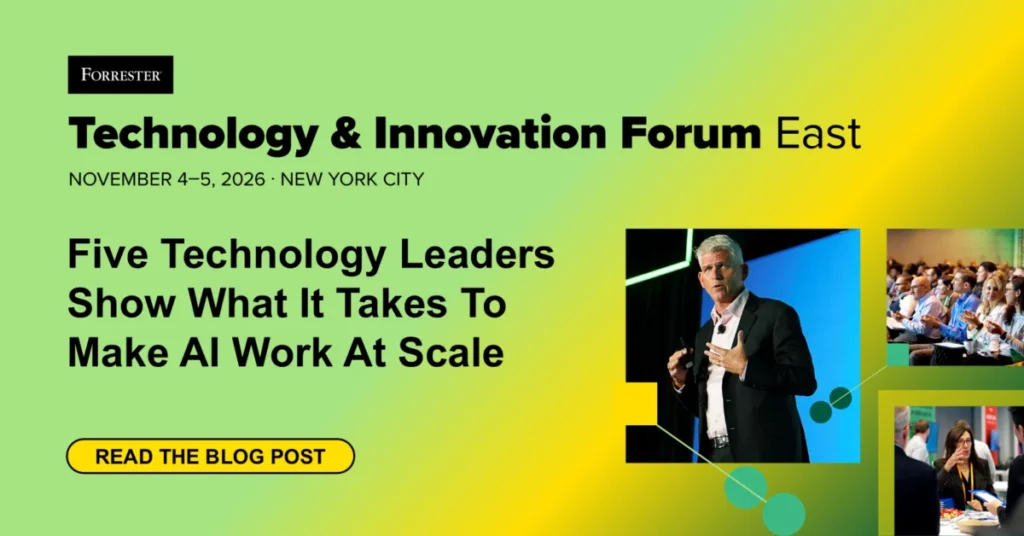
This pressing operational imperative will take center stage at the upcoming Forrester Technology & Innovation Forum East, scheduled for November 4–5 in New York City. Bringing together high-level decision-makers from diverse sectors—including energy, financial services, media, professional services, and insurance—the event aims to dissect the operational, cultural, and technical shifts required to move enterprises beyond mere experimentation.
Featured industry veterans from prominent organizations such as Moeve, TD Financial, the Associated Press, Genpact, and Erie Insurance are set to share frontline insights on overcoming the most friction-heavy roadblocks of the AI era. Their collective experiences highlight a universal corporate dilemma: How do organizations transition employees from casual, ad-hoc AI tinkering to consistent, value-driven daily usage? How must legacy IT operating models evolve to support autonomous systems? And what foundational engineering capabilities are necessary to scale AI responsibly and catalyze sweeping business transformation?
Main Facts
- The Core Challenge: Enterprises have successfully introduced AI tooling, but struggle to achieve permanent cultural adoption, optimize IT operating models, and scale engineering frameworks to drive true business transformation.
- The Event: The Forrester Technology & Innovation Forum East, taking place November 4–5 in New York City.
- Key Participating Organizations: Moeve, TD Financial, the Associated Press, Genpact, and Erie Insurance.
- Primary Themes:
- Turning AI experimentation into lasting behavioral change.
- Redesigning traditional IT operating models for an AI-first workforce.
- Leveraging AI engineering to accelerate overarching business strategy and enterprise transformation.
Chronology: The Evolution of Enterprise AI
To understand where technology organizations stand today, it is helpful to trace the rapid evolution of artificial intelligence in the corporate landscape over recent years.
Phase 1: The Novelty and Experimentation Era (2022–2023)
Following the public explosion of generative AI models, organizations rushed to secure access to powerful large language models and cognitive tools. During this initial phase, the primary objective was exploratory. Employees tested the waters with basic prompts, content generation, and code assistance. AI was frequently treated as a corporate "party trick"—fascinating and novel, but largely disconnected from core business metrics, stringent security frameworks, or daily operational workflows.
Phase 2: The Integration and Operational Reality (2024–Present)
As the novelty wore off, executive boards and chief information officers began demanding a return on investment. Organizations quickly realized that providing software licenses does not automatically translate to productivity gains. Tech leaders faced cultural resistance, workflow friction, and security risks. Enterprises began shifting their focus from broad, unstructured experimentation to targeted integration. This required re-evaluating how IT departments are structured, how software is engineered, and how human labor coexists with automated agents.
Phase 3: The Scaling and Transformation Horizon (Future Outlook)
The current juncture—the focal point of the upcoming Forrester Forum—represents a pivot toward enterprise-wide scaling. Companies are moving past isolated use cases to build robust AI engineering pipelines. The goal is no longer just doing existing tasks faster, but fundamentally redesigning business models, operational architectures, and industry value chains through the systematic application of artificial intelligence.
Supporting Data and Industry Context
The urgency surrounding enterprise AI adoption is underscored by extensive market research. Industry analysts consistently point to a widening gap between companies that successfully operationalize AI and those stalled in perpetual pilot phases.
- The Adoption Gap: While nearly 70% of enterprise leaders report active experimentation with generative AI tools, fewer than 25% have successfully embedded these technologies into core, day-to-day business processes across entire departments.
- Cultural Resistance: Employee hesitance and a lack of structured training remain the top barriers to digital transformation. Studies indicate that without deliberate, human-centric change management, up to 60% of enterprise software licenses for advanced AI tools remain underutilized or abandoned after initial deployment.
- Operating Model Strain: Over 50% of CIOs report that their current IT operating models—built on traditional software development lifecycles and siloed departmental structures—are fundamentally unequipped to manage the rapid iteration cycles and data governance demands of modern AI systems.
- Engineering Investment: Enterprise spending on AI engineering, infrastructure, and integration services continues to grow exponentially, as boards recognize that sustainable value requires deep architectural changes rather than superficial software add-ons.
Official Responses and Expert Insights
At the upcoming Technology & Innovation Forum East, a curated lineup of industry experts will unpack these complex themes through targeted sessions, offering actionable strategies drawn from real-world deployments.
1. Driving AI Use From Party Trick to Behaviors That Stick
Getting employees to try AI is a trivial hurdle compared to the challenge of permanently altering daily work habits.
In a dedicated session, Arturo Lopez-Brea Gimenez, head of digital and IT transformation and capabilities at Moeve, will join Forrester senior analyst Kim Herrington to explore the mechanics of sustained adoption. Lopez-Brea spearheads digital transformation and AI integration at Moeve, focusing heavily on human-centric change management at scale.
"Getting people to try AI is one thing. Changing how they work with it every day is much harder," notes the core premise of the session.
Lopez-Brea’s insights address the central question plaguing modern executives: How do you bridge the chasm between raw technological access and deeply ingrained behavioral change that continuously yields measurable corporate value?
2. Redesigning the IT Operating Model for the Age of AI
Artificial intelligence is fundamentally altering the nature of technology work itself. It is forcing enterprise leaders to aggressively rethink traditional job roles, cross-functional responsibilities, rigid governance processes, and the shifting symbiotic relationship between human workers and autonomous software systems.
Addressing this structural disruption, Sumee Seetharaman, vice president of the AI center of excellence and practice at TD Financial, and Troy Thibodeaux, director of AI products and services at the Associated Press, will participate in a panel moderated by Forrester principal analysts Jess Burn and Fiona Mark.
Seetharaman brings cross-industry expertise spanning digital product development, enterprise innovation, and AI scaling. Meanwhile, Thibodeaux leads pioneering initiatives designed to safely and ethically integrate AI capabilities into the fast-paced, high-integrity environment of modern journalism. Together, their perspectives represent a fascinating cross-section of regulated financial services and dynamic media operations, highlighting a shared struggle: how to evolve the IT operating model when AI completely redefines how work actually gets accomplished.
3. Driving Business Transformation with AI Engineering
Scaling artificial intelligence requires far more than assembling a growing portfolio of clever use cases. Technology leaders must systematically connect their AI capabilities to broader, long-term technology strategies and enterprise-wide business transformation priorities.
In a comprehensive session titled Generating Your Future: Successful Strategies For Driving Business Transformation With AI Engineering, Sanjeev Vohra, chief technology and innovation officer at Genpact, and Erica Shine, enterprise technology and AI vice president and corporate officer at Erie Insurance, will join Forrester principal analyst Ken Parmelee.
Vohra directs Genpact’s global technology strategy, overseeing the scaling of advanced technologies, the infusion of AI into complex client solutions, and the cultivation of continuous internal innovation. Shine oversees enterprise architecture, emerging technology portfolios, enterprise AI initiatives, and the office of the CIO at Erie Insurance.
Their combined expertise promises to fuse high-level corporate strategy with rigorous execution, providing technology leaders with blueprints on how modern AI engineering can directly power structural transformation and secure long-term business value.
Implications for Technology Leaders
The insights emerging from energy, financial services, media, professional services, and insurance point to a singular, undeniable truth: the honeymoon phase of enterprise artificial intelligence has officially ended.
For CIOs, CTOs, and digital transformation leaders, the implications moving forward are stark:
- Change Management is Paramount: Technology acquisition without cultural adaptation is a failing strategy. Enterprises must invest as heavily in human-centric change management, psychological safety, and continuous upskilling as they do in software licenses and cloud infrastructure.
- Architecture Must Evolve: Legacy IT operating models—characterized by rigid silos, waterfall development cycles, and sluggish governance—cannot keep pace with generative and autonomous systems. Organizations must adopt agile, fluid operating frameworks that treat AI not as an IT project, but as a core utility.
- Governance and Ethics Are Non-Negotiable: As organizations like the Associated Press and Erie Insurance demonstrate, scaling AI safely requires rigorous oversight, ethical boundaries, and robust product management. Trust must be engineered into systems from day one.
- Value Must Be Quantified: The pressure to prove return on investment will only intensify. Technology leaders must align every AI engineering initiative directly with overarching business metrics, shifting the conversation away from technical novelty and toward bottom-line transformation.
Conclusion
The challenges currently facing enterprise technology organizations are formidable, but they are no longer theoretical. By examining how forward-thinking leaders are tackling adoption barriers, reshaping operating models, and engineering scalable architectures, executives can glean invaluable, battle-tested strategies.
For those eager to move past the noise and witness firsthand how global enterprises are putting artificial intelligence into actionable practice, the Forrester Technology & Innovation Forum East—running November 4–5 in New York City—offers an essential roadmap for navigating the next frontier of business transformation.
