
The 2026 Dropshipping Showdown: An In-Depth Industry Analysis of Doba vs. Spocket
Main Facts: Navigating the 2026 Dropshipping Landscape
As the global dropshipping market surges toward a staggering valuation of $543.53 billion, the digital retail sector finds itself at a familiar crossroad: record market interest brings unprecedented competition. For independent e-commerce operators, success increasingly hinges on strategic infrastructure rather than mere product selection. In this competitive climate, choosing the right backend partner is the single most critical decision an online store owner can make.
At the forefront of this ecosystem are two prominent platform solutions: Doba and Spocket. While both platforms integrate seamlessly with dominant storefront builders like Shopify, their core philosophies diverge significantly.
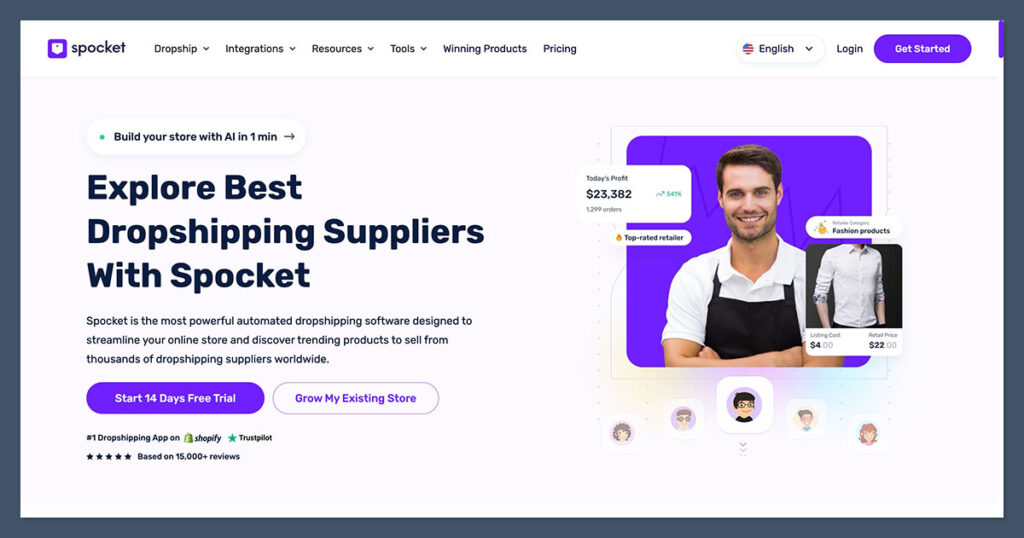
- Spocket emphasizes curation, localized quality, and streamlined simplicity, catering heavily to boutique stores and beginners prioritizing product vetting and EU/US suppliers.
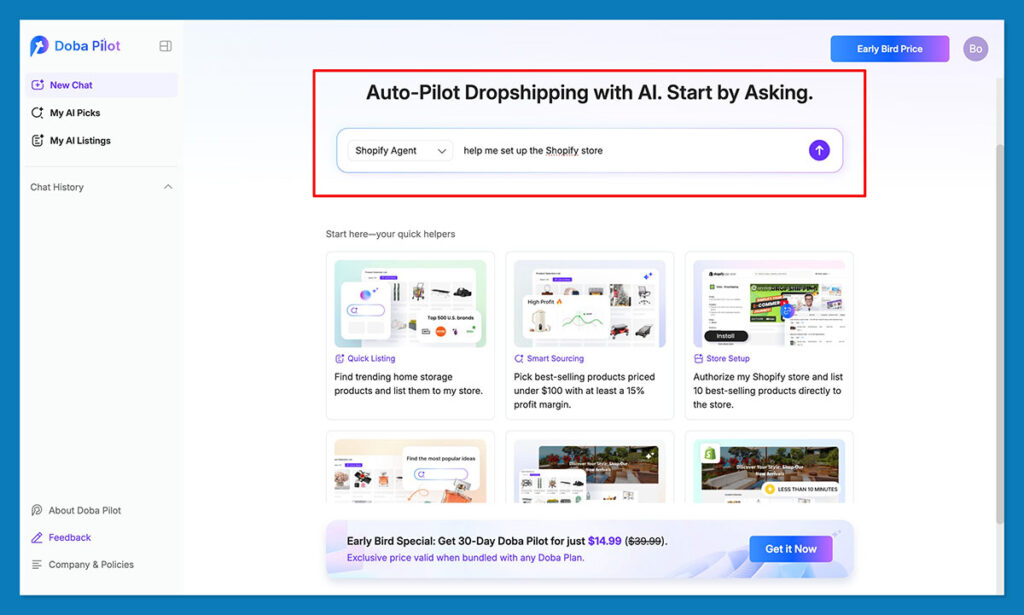
- Doba functions more like a central operations hub, offering a catalogue exceeding one million SKUs, aggressive multi-channel integration (spanning Amazon, Walmart, and TikTok Shop), and an upgraded AI agent, Doba Pilot, designed to automate everything from market research to after-sales fulfillment.
Chronology: The Evolution of Modern Dropshipping Hubs
To understand why platforms like Doba and Spocket are positioned as they are in 2026, it is helpful to look at how the industry has matured over the past decade.
- The Early Era (Pre-2018): Dropshipping was widely synonymous with overseas directories, long shipping times, high friction, and minimal quality control. Platforms served merely as passive yellow pages connecting retailers with raw suppliers.
- The Curated Boom (2018–2022): As consumer expectations rose, platforms like Spocket entered the market to champion local sourcing—focusing heavily on North American and European suppliers to drastically cut down delivery windows and enforce baseline quality metrics.
- The Automated & Multi-Channel Era (2023–2025): E-commerce splintered across social commerce and major marketplaces (TikTok Shop, Walmart, Amazon). Managing inventory manually across multiple channels became unsustainable, prompting platforms to develop robust synchronization tools.
- The Autonomous AI Era (2026 and Beyond): The industry has shifted toward operational automation. Doba’s recent upgrade of its AI agent, Doba Pilot, transforms conversational AI from a mere search assistant into a full-scale operational manager capable of executing complex logistics workflows, stock interventions, and automated cross-channel publishing.
Supporting Data: Feature-by-Feature Comparison
When evaluating total cost of ownership, operational capacity, and scalability, key structural differences emerge between the two platforms.
| Comparison Point | Doba | Spocket |
|---|---|---|
| Best Fit | Growing dropshippers, multi-channel marketplace sellers (US-focused) | Beginners focused on curated sourcing and simplicity |
| Monthly Starting Price | $29.99 (Limited plan) | $39.99 (Starter plan) |
| Catalog Scale | Over 1 million SKUs (heavy US warehouse presence) | Nearly 1 million curated products (US/EU focus) |
| Store Connections | Up to 15 stores (dependent on plan tier) | Multi-store capable, but requires a paid subscription per store |
| Sample Ordering | Supported via individual supplier coordination | Dedicated one-click sample button |
| Branded Invoicing | Blind shipping standard; supplier-dependent branding | Built-in branded invoices on higher tiers |
| Key Sales Channels | Shopify, Amazon, Walmart, eBay, TikTok Shop, WooCommerce | Shopify, Wix, WooCommerce, BigCommerce, Squarespace, Amazon, eBay |
| Advanced Controls | Doba Pilot AI Agent, automated rules, API, FTP, bulk downloads | Supplier chat, premium product tiers, bulk checkout options |
| Primary Drawback | Steeper learning curve due to expansive feature set | High cumulative cost when managing multiple independent stores |
Pricing Structures and Financial Realities
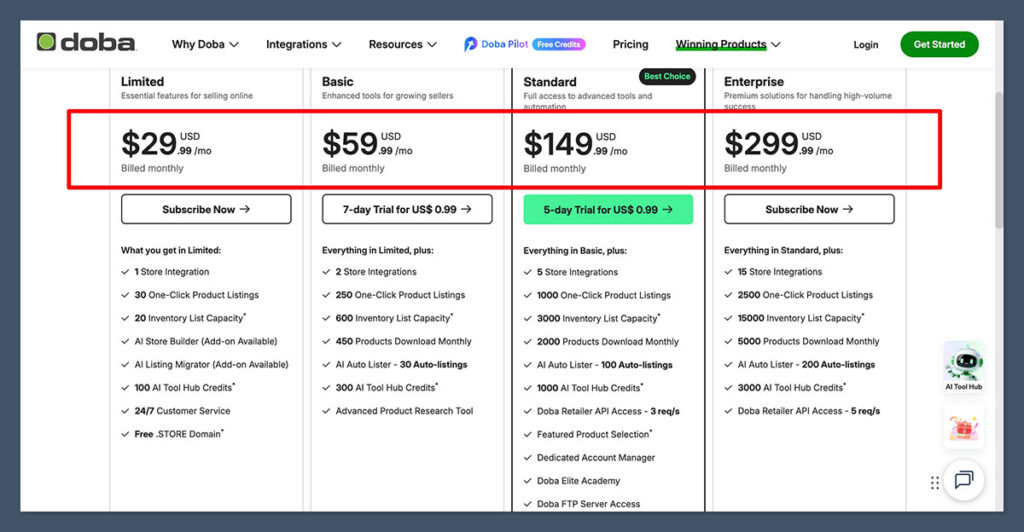
Entry-level pricing favors Doba, whose Limited plan begins at $29.99 per month (offering discounts for quarterly or annual commitments) and includes a store integration, product listing allowances, and inventory list capacities. Doba scales up to a Standard plan at $149.99 per month, unlocking API and FTP access alongside dedicated account management.
Spocket starts at $39.99 per month, offering full catalog access and multi-store visibility. However, retail operators must account for a hidden operational cost: Spocket requires a separate paid subscription for every newly connected store managed under an account. Consequently, scaling a multi-brand or multi-store portfolio becomes significantly more expensive on Spocket compared to Doba’s tier-based store allocations.

Official Platform Responses and Operational Frameworks
Both networks enforce strict behavioral codes to maintain marketplace integrity, though their enforcement mechanisms vary.
Supplier Vetting and Compliance
- Doba’s Operational Guarantee: Doba requires suppliers to automatically refund any order not dispatched within the stated processing window. Damaged goods require prepaid return labels upon submission of evidence, and invalid tracking numbers trigger automatic refunds if uncorrected by the vendor. Doba also offers optional After-Sales Protection Services to absorb losses from non-defective remorse returns or transit discrepancies.
- Spocket’s Curation Standard: Spocket maintains stringent entry requirements, demanding that suppliers either physically manufacture or hold their own inventory and provide retailers with a minimum 25% discount off public retail pricing. Suppliers must maintain a 95% order success rate and answer inquiries within 24 to 47 hours. However, individual Spocket suppliers retain the autonomy to set independent return policies, meaning some may occasionally refuse returns entirely.
The Rise of AI Automation
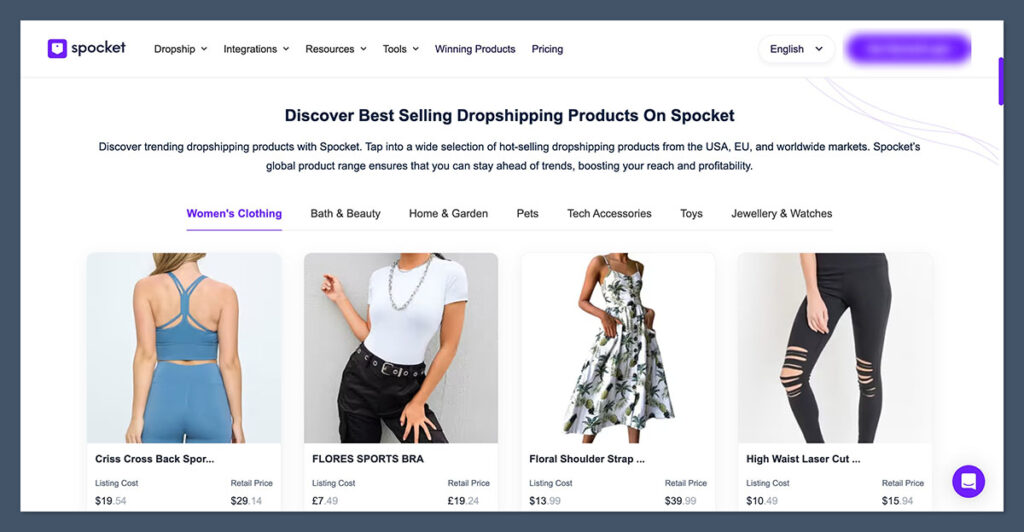
The inclusion of artificial intelligence marks a distinct operational divide. While Spocket relies on robust traditional filters (sorting by origin, destination, price tier, and best-seller status), Doba has integrated Doba Pilot to act as an end-to-end operational agent.
Doba Pilot covers Market Scout (demand, competition, and seasonality analysis), Smart Sourcing (natural language product retrieval), multi-channel listing migrations, and active fulfillment monitoring. The system can even attempt to intercept unshipped purchase orders when a corresponding store-front order is canceled—a level of backend automation previously restricted to enterprise-level ERP software.
Implications for E-commerce Entrepreneurs
Choosing between Doba and Spocket ultimately depends on an operator’s business model, current scale, and growth trajectory.
When to Choose Spocket
Spocket remains the premier recommendation for absolute beginners, boutique curators, and single-store operators who value speed-to-market and simplicity. Its curated catalog of localized U.S. and European suppliers, combined with intuitive sample-ordering workflows and branded invoicing capabilities, drastically lowers the friction of launching a professional storefront. For merchants focusing heavily on aesthetic branding and localized shipping without the complexity of multi-channel synchronization, Spocket’s streamlined environment is ideal.
When to Choose Doba
Conversely, Doba is the superior strategic choice for ambitious retailers aiming to scale aggressively across multiple sales channels. By functioning as a central operations hub, Doba handles the administrative complexities of syncing inventory across Shopify, TikTok Shop, Walmart, and Amazon simultaneously. While its feature-rich environment introduces a steeper learning curve, the integration of Doba Pilot softens this barrier, allowing merchants to leverage conversational AI to automate sourcing, listing, and fulfillment tasks.
As the 2026 digital retail marketplace rewards efficiency and multi-channel reach, Doba provides the robust infrastructure necessary for businesses transitioning from boutique experiments to high-volume commercial enterprises.
