
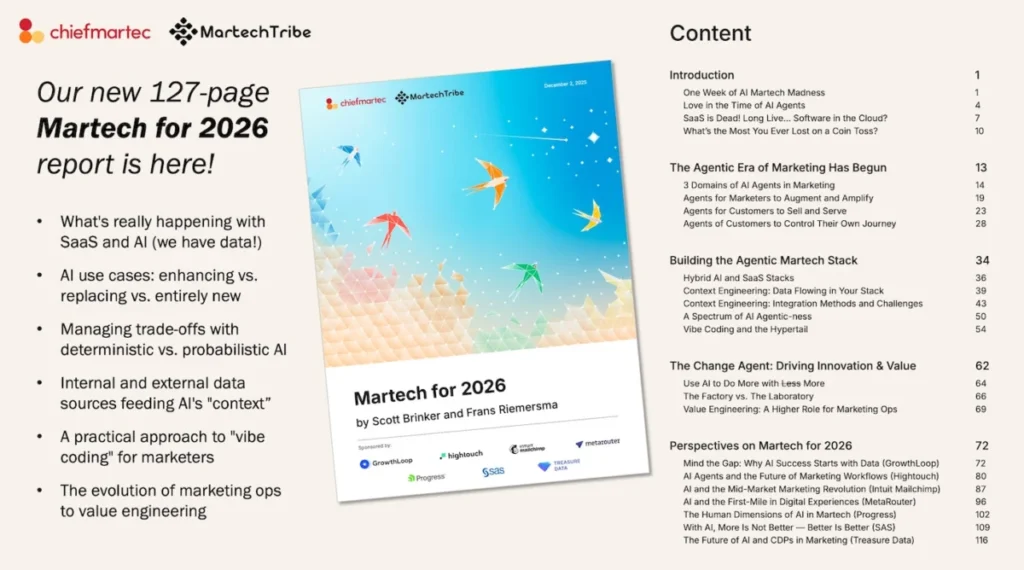
The Roadmap to 2026: Unveiling the Future of Marketing Technology
As the marketing landscape undergoes a seismic shift driven by the rapid maturation of artificial intelligence and data infrastructure, industry professionals are increasingly seeking clarity amidst the noise. Addressing this demand, a comprehensive new industry report, Martech for 2026, has been released, offering a definitive guide for navigators of the modern digital ecosystem. Spanning 127 pages, the report serves as a critical pulse-check on where the industry stands and, more importantly, where it is heading as we approach the next biennial cycle.
Unlike many industry publications that utilize "gated content" strategies, the authors have opted for a transparent, barrier-free distribution model. There are no forms to fill, no social media engagement requirements, and no paywalls. The full document is available for immediate download, a move that underscores the authors’ commitment to fostering industry-wide knowledge sharing.
Main Facts: A Comprehensive Deep Dive
The Martech for 2026 report is not merely a collection of trends; it is an extensive analysis of the intersection between human marketing strategy and machine-learning execution. Authored by industry stalwarts, the report synthesizes months of rigorous research, including primary data collected through the AI & Data in Marketing survey conducted earlier this year.
The document is designed for accessibility, intentionally avoiding the obfuscating jargon that often plagues technical reports. Instead, it employs plain language and detailed visual illustrations to demystify complex concepts such as AI-driven workflows, data hygiene, and the evolving role of the Chief Marketing Technologist. By providing a synthesis of 127 pages of analysis, the report functions as a strategic playbook for CMOs, marketing operations leads, and technical architects alike.
Chronology: From Concept to Publication
The journey to Martech for 2026 began months ago with the initiation of the AI & Data in Marketing survey. The authors, including industry thought leader Scott Brinker and collaborator Frans Riemersma, spent the intervening months aggregating survey data, conducting expert interviews, and synthesizing findings into a cohesive narrative.
- Phase 1: Data Collection: The team surveyed thousands of marketing professionals to identify the specific pain points and successes associated with current AI implementation.
- Phase 2: Editorial Synthesis: The authors spent the late summer and autumn translating raw data into actionable insights, ensuring that the findings remained grounded in reality rather than theoretical hype.
- Phase 3: The Sponsor Partnership Model: To ensure the report remained free of charge, the team partnered with seven industry leaders. Crucially, the editorial integrity was maintained by keeping these partnerships separate from the core analysis. The sponsors were granted access to the final report only after its completion, ensuring that their perspectives were presented as "added value" chapters rather than editorial mandates.
- Phase 4: Publication: The report was officially released in mid-December 2025, providing the industry with a roadmap to guide their 2026 strategic planning.
Supporting Data: The Pulse of the Industry
At the heart of the report lies the data gleaned from the AI & Data in Marketing survey. While the full scope of the findings is vast, several key trends emerge:
- The AI Integration Gap: While adoption rates of AI tools are at an all-time high, the report highlights a significant "success gap." Many organizations have implemented AI but struggle to integrate it into their core business workflows.
- Data Quality as a Prerequisite: A recurring theme throughout the data is that AI is only as effective as the underlying data architecture. The report notes that organizations prioritizing "data hygiene" are seeing significantly higher returns on their AI investments compared to those that simply deploy off-the-shelf generative AI models.
- Human-in-the-Loop Necessity: Despite the fears of automation replacing marketing staff, the data suggests that the most successful companies are those that use AI to augment human creativity, not replace it. The report provides evidence that "human-centric" AI strategies lead to more consistent brand voice and improved customer engagement.
Official Perspectives: The Sponsor Contributions
A unique feature of this report is the inclusion of dedicated chapters featuring insights from industry leaders. By conducting interviews with these executives, the authors provided a platform for deeper industry analysis. The participating organizations and their focus areas include:
- GrowthLoop: Focused on the critical importance of data architecture, emphasizing that AI success is inherently linked to the quality and accessibility of underlying customer data.
- Hightouch: Explored the shift toward AI agents—autonomous or semi-autonomous entities that manage complex marketing workflows with minimal human oversight.
- Intuit Mailchimp: Examined the specific needs of the mid-market, highlighting how AI is democratizing high-level marketing analytics for smaller, resource-constrained teams.
- MetaRouter: Addressed the "first-mile" of digital experience, arguing that data collection at the source is the most vital step in the modern martech stack.
- Progress: Provided a philosophical look at the human dimensions of technology, arguing that AI adoption must be managed with a clear understanding of company culture and employee morale.
- SAS: Offered a sobering look at metrics, advocating for a "quality over quantity" approach where better data and better models are prioritized over simply increasing the sheer volume of AI output.
- Treasure Data: Analyzed the evolving role of Customer Data Platforms (CDPs) as the central nervous system for AI-driven marketing campaigns.
Implications for 2026 and Beyond
The release of this report comes at a pivotal time. As we look toward 2026, the implications for the industry are clear: the "honeymoon phase" of generative AI is over. The coming year will be defined by integration, optimization, and the difficult task of proving ROI.
The Shift Toward Operational Maturity
For organizations, the report implies that the "experimental" phase of AI must transition into an "operational" phase. This means moving away from point solutions and towards cohesive systems where data flows seamlessly between tools. The reliance on fragmented, siloed platforms will likely become a competitive disadvantage.
Redefining the Marketing Role
The role of the marketer is also set to evolve. As AI handles more of the tactical, repetitive labor, the human element of marketing will shift toward strategy, ethics, and the nuance of brand storytelling. The report underscores that the "marketing technologist" of 2026 will be part strategist, part data scientist, and part orchestrator of autonomous agents.
The Importance of Ethical Data Practices
Finally, the report hints at the growing importance of transparency. As AI becomes more deeply embedded in consumer-facing marketing, the pressure on brands to maintain ethical data practices—and to be transparent about the role of AI in their communications—will only increase.
Conclusion
Martech for 2026 is more than just a summary of current tools; it is a vital document for any professional looking to remain relevant in an increasingly automated world. By removing financial barriers to entry and providing a rigorous, research-backed perspective, the authors have provided a public service to the marketing community.
As the industry prepares for the challenges of 2026, the guidance provided in this report offers a steady hand. Whether it is refining data infrastructure, navigating the world of AI agents, or balancing the human-machine relationship, the message is clear: the future belongs to those who prioritize deep integration and thoughtful, data-driven strategy over the transient allure of the latest "shiny object."
For those ready to dive deeper, the full report is available for immediate, open-access download, marking a significant step forward in the collective professional development of the global marketing community. As the authors themselves noted, the goal is not just to provide data, but to foster a community of informed professionals who can steer the future of marketing with confidence and clarity.
