
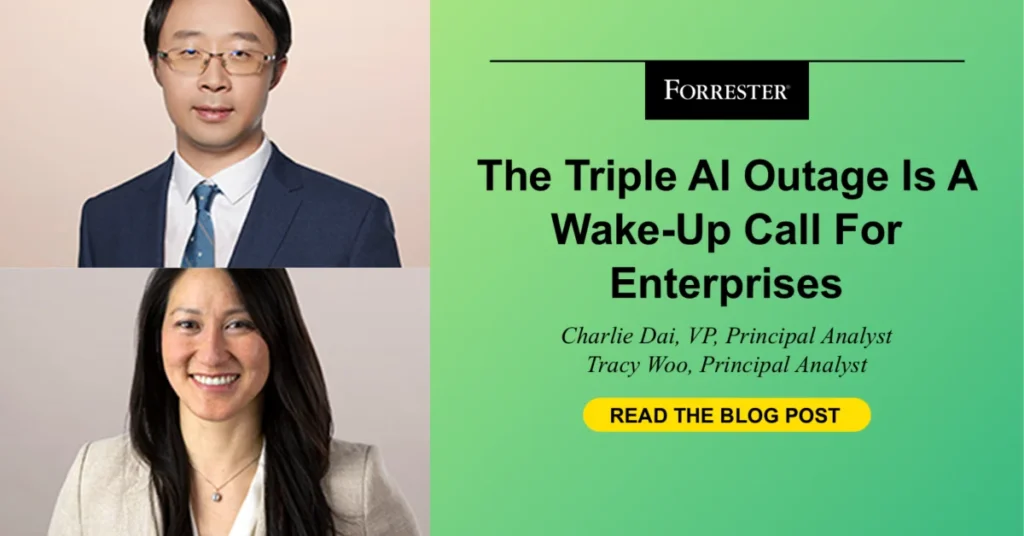
The Fragility of the Silicon Spine: Anatomy of the Near-Simultaneous AI Outages and the Hidden Interconnections Threatening Global Enterprise
Last week, the global digital economy received a stark, high-stakes wake-up call. In a rare and unsettling convergence of technical failures, major artificial intelligence flagships—including OpenAI’s ChatGPT and Codex, Anthropic’s Claude family of models, and xAI’s Grok—suffered near-simultaneous system outages. The disruption instantly cascaded across the broader technology ecosystem, crippling downstream applications, crippling software development environments, and paralyzing enterprise workflows.
While the incident was brief in duration, its shockwaves reverberated across corporate boardrooms, developer communities, and cloud infrastructure operations centers worldwide. The simultaneous failure of competing proprietary platforms laid bare an uncomfortable truth: the modern artificial intelligence landscape, marketed as a decentralized and redundant marketplace of competing tech giants, is in reality built upon a fragile, deeply intertwined foundational web.
As enterprises increasingly transition generative AI from a novelty productivity chatbot into core operational infrastructure, these cascading outages expose critical blind spots in risk management, multi-provider strategies, and business continuity planning.
1. Main Facts: The Anatomy of a Broad-Spectrum Collapse
The disruption, which unfolded mid-week, affected virtually every major commercial frontier of large language model (LLM) deployment. Millions of individual consumers, enterprise developers, and automated systems found themselves locked out of vital tools simultaneously.
- OpenAI Incidents: Users attempting to access ChatGPT, OpenAI’s flagship consumer and enterprise chat interface, alongside its developer-centric Codex models, were met with persistent error screens and connection timeouts.
- Anthropic Disruption: Anthropic’s Claude ecosystem—encompassing various tiers of its foundational models—experienced severely elevated error rates, rendering API calls unstable and web interfaces unresponsive for extensive periods.
- xAI & Grok Outages: Elon Musk’s xAI platform suffered direct availability failures. The disruption was potent enough to bleed outward, severely degrading Grok-powered capabilities embedded within third-party environments, most notably impacting GitHub Copilot users who rely on the integration for code completion and debugging.
- Ecosystem Spillovers: Specialized AI development platforms and orchestration environments, such as Cursor, reported immediate downstream service degradation. These platforms were forced to scramble as upstream model providers choked off data pipelines, illustrating how deeply dependent secondary tooling is on the primary foundational monoliths.
Despite the near-identical timing of the failures, initial post-mortems from the major players pointed toward distinct, localized operational hurdles. OpenAI attributed their specific downtime to a critical routing error that paralyzed traffic distribution. Meanwhile, xAI pointed the finger at an isolated infrastructure failure rooted directly inside its massive Memphis compute facility—home to some of the densest GPU clusters on the planet. Anthropic acknowledged elevated error rates across its network infrastructure but refrained from naming a singular root cause or pointing to an external catalyst.
To date, no official shared root cause has been confirmed by industry bodies or the individual firms involved. Yet, the statistical improbability of these systems failing within minutes of one another has fueled intense speculation regarding shared unseen network nodes, cloud-service bottlenecks, and upstream data center dependencies.
2. Chronology: How the Outages Unfolded
While individual telemetry data from the companies remains closely guarded, enterprise monitoring services and developer logs paint a clear chronological picture of how the collapse propagated through the digital supply chain.
- T-Minus Zero (The Trigger): Latency spikes began registering across North American server nodes. According to system logs, the anomalies appeared within a narrow fifteen-minute window, with xAI’s Memphis data center reporting localized power or networking strain, while OpenAI systems experienced sudden internal Border Gateway Protocol (BGP) or DNS routing malfunctions.
- The Cascade (Minutes 15–45): As primary API endpoints for OpenAI and Anthropic began dropping requests, enterprise applications configured with automatic fallback systems initiated failover sequences. However, because auxiliary providers were experiencing parallel strain, these secondary calls failed. This created a stampede of retry requests that further saturated buckling server gates.
- Downstream Impact (Minutes 45–120): Developer ecosystems felt the pinch. Platforms like Cursor and GitHub Copilot—which abstract away the underlying model provider to offer seamless multi-model support—began throwing cascading exceptions. Software engineers worldwide found their AI-assisted autocomplete environments freezing mid-keystroke. Customer service chatbots powered by Claude or GPT architectures stalled, abandoning customer queries mid-conversation.
- Mitigation and Recovery (Hour 3 to Hour 6): Engineers at OpenAI and xAI implemented emergency traffic-shrouting protocols and restarted affected server racks. Gradual recovery was signaled by descending error rates. By the end of the business day, core API connectivity was largely restored, though lingering latency and rate-limiting side effects persisted for developers cleaning up the backlog of failed asynchronous jobs.
3. Supporting Data and Technical Context: The Illusions of Multi-Provider Redundancy
To understand why a failure at one company can so easily coincide with or mimic a failure at another, one must examine the physical and logical layers underpinning the generative AI boom.
The Infrastructure Bottleneck
Building, training, and running frontier LLMs requires specialized, hyper-scarce physical assets. The industry is bottlenecked by access to extreme-scale GPU clusters (primarily NVIDIA H100 and Blackwell architectures), ultra-high-speed networking fabrics (InfiniBand and specialized Ethernet), and immense utility-scale power supplies.
Because very few entities on Earth possess the capital required to build these facilities, the AI ecosystem is heavily concentrated. Major tech conglomerates lease out data center space, power capacity, and hardware arrays to various AI labs simultaneously. A localized cooling failure, fiber optic cut, or power grid fluctuation near major tech hubs in Northern Virginia, Oregon, or Memphis can indirectly handicap ostensibly competing AI companies that happen to share adjacent co-location facilities or cloud-service providers.
The Myth of Diversification
For the past two years, enterprise risk management teams have championed a "multi-model strategy" as the ultimate insurance policy against vendor lock-in and platform outages. The logic was simple: if your primary application relies on OpenAI, and OpenAI goes down, your system should dynamically pivot to Claude or a locally hosted open-source model.
Last week’s events shattered the conceptual safety net of this strategy. The outages proved that multi-provider deployment does not equal multi-infrastructure resilience.
Even when enterprises contract with distinct AI companies, those companies frequently rely on the exact same underlying hyperscale cloud infrastructure providers (such as Microsoft Azure, Amazon Web Services, or Google Cloud Platform). They often utilize overlapping Content Delivery Networks (CDNs), identical API gateway providers, and shared transit networks. When an upstream core routing error or a regional power anomaly strikes, it sweeps across multiple tenants indiscriminately, rendering the "diversified" multi-model architecture a house of cards.
Furthermore, modern enterprise software rarely calls an AI model directly. It passes requests through complex dependency chains:
- The end-user application interface.
- Enterprise internal middleware and orchestration layers (such as LangChain or custom internal wrappers).
- Third-party monitoring, guardrail, and security compliance wrappers (e.g., content moderation APIs).
- Developer platforms or API aggregators.
- The foundational model provider.
- The upstream cloud infrastructure and compute partner.
A break at any point in this sprawling chain halts the entire operation, regardless of how robust the foundational AI model itself might be.
4. Official Responses and Industry Reactions
The collective near-miss prompted defensive, measured responses from the corporate architects of the AI revolution, contrasted with mounting alarm from the enterprise clients footing the bill.
- OpenAI’s Perspective: Communications from OpenAI engineering leads emphasized the operational complexity of managing planetary-scale transformer models. The routing error cited was characterized as an internal software configuration glitch rather than a malicious cyberattack or structural hardware deficiency, reassuring markets that data security and model integrity were never compromised.
- xAI’s Transparency: Elon Musk’s xAI pointed directly to physical compute bottlenecks at their flagship Memphis installation, highlighting the brute-force physical reality of running massive neural networks. The admission underscored a broader industry anxiety: as models grow larger, the physical infrastructure required to sustain them becomes increasingly unwieldy and prone to catastrophic localized stress.
- Anthropic’s Stance: Anthropic maintained a cautious posture, acknowledging elevated error rates while avoiding speculation about systemic or shared ecosystem vulnerabilities. This silence reflects the fiercely competitive nature of the AI race, where acknowledging shared structural dependencies with rivals is often viewed as a corporate vulnerability.
Independent industry analysts, however, were quick to connect the dots. Technology advisory firms and risk assessors pointed out that the incident should force a permanent pivot in how organizations conceptualize cloud architecture. The era of treating AI as an easily swappable software plug-in is officially over; AI must now be treated as critical, high-stress heavy industrial infrastructure.
5. Strategic Implications: Resilience, Governance, and Business Continuity
As artificial intelligence rapidly transitions from a novelty productivity tool into the invisible connective tissue of the global enterprise—embedded deeply in software development lifecycles, automated customer service, knowledge management repositories, financial analytics, and real-time operational workflows—the cost of failure has skyrocketed.
When an AI service experiences downtime today, the damage extends far beyond a user staring at a frozen chatbot window. The systemic impact includes:
- Paralyzed Software Engineering: Development pipelines grind to a halt when automated code-generation companions and debugging agents go dark.
- Customer Service Gridlock: Automated tier-1 support agents drop off, flooding human call centers with backlogged inquiries and crashing response-time metrics.
- Halting Automated Business Processes: Autonomous agents tasked with data entry, invoice processing, and supply-chain monitoring fail silently or throw exceptions, requiring costly human intervention to untangle.
To survive and thrive in an environment where AI infrastructure is inherently volatile, enterprise leaders must fundamentally overhaul their continuity strategies. CIOs, CTOs, and Chief Risk Officers must move beyond superficial redundancy and implement a rigorous, structural resilience framework.
Actionable Roadmap for Enterprise AI Resilience
To insulate organizations from future cascading ecosystem failures, leadership teams should immediately execute the following strategic mandates:
-
Comprehensive Dependency Mapping:
Organizations must inventory every single business process, software application, and data pipeline that relies on an external model, API, copilot, or autonomous AI agent. Teams must map out the exact dependency chains—identifying not just the immediate AI provider, but the underlying cloud regions, orchestration layers, and upstream services they depend on. -
Define Tolerance and Maximum Allowable Downtime:
Establish clear Recovery Time Objectives (RTO) and Recovery Point Objectives (RPO) for AI-dependent workflows. Leadership must determine precisely how long a specific business process can tolerate an AI blackout before severe financial or reputational damage occurs. -
Establish Robust Fallbacks and Manual Workarounds:
Never design a business-critical workflow that relies solely on an automated AI decision without a graceful degradation path. If an API drops, systems must automatically downgrade to deterministic rule-based logic, cached responses, or route traffic to a truly isolated backup environment (such as a localized, open-source model running on private bare-metal servers). -
Invest in AI Observability and Cost Management:
Enterprises must gain real-time visibility into their AI consumption, latency metrics, and error rates. Deploying dedicated AI observability tooling allows organizations to detect upstream degradation before it crashes entire applications, enabling proactive traffic rerouting and automated incident management. -
Rethink Multi-Vendor Architecture:
When designing redundant AI stacks, engineering teams must audit their providers to ensure they do not share the same underlying cloud regions, physical data centers, or network bottlenecks. True diversification requires infrastructure independence.
Conclusion
The simultaneous outages affecting ChatGPT, Claude, and Grok were more than a temporary inconvenience for developers and enthusiasts; they were a systemic preview of the vulnerabilities inherent in our AI-driven future. As artificial intelligence cements its place as the silicon spine of the global economy, the illusion of effortless, infinite availability is fading.
For enterprises, the path forward requires a sober acknowledgment of these hidden interconnections. By prioritizing rigorous resilience, deep dependency mapping, and robust business continuity frameworks, organizations can transform their AI strategies from fragile experiments into hardened, mission-critical operational assets capable of weathering the inevitable storms of a hyper-connected digital world.
