
Beyond the Algorithm: How Forrester’s "AI + HI" Strategy Aims to Redefine Enterprise Technology and Decision-Making
SAN FRANCISCO — As technology, data, and security leaders converge at Forrester’s Technology & Innovation Forum Central, an overarching tension dominates the keynote halls and breakout sessions alike. The race to deploy generative artificial intelligence at scale has matured; enterprises are no longer wondering if they should adopt AI, but rather how to harness its unprecedented speed and operational scale without sacrificing the crucial context, specialized expertise, and moral accountability that only human professionals can provide.
In an era where foundational AI models are commercially ubiquitous, mere automation is no longer a viable market differentiator. According to industry analysts, a firm’s true competitive advantage now stems from its ability to harmoniously blend artificial and human intelligence, driving measurable business value while mitigating the compounding risks of unmonitored machine-driven decision-making.
Forrester, a preeminent global research and advisory firm, is addressing this duality head-on. The organization is not only advising its enterprise clientele on how to strike this delicate equilibrium but is actively restructuring its own operational and delivery models to mirror the philosophy. By marrying the lightning-fast data processing capabilities of generative AI with the nuanced judgment of human analysts, Forrester aims to establish a new paradigm for how complex enterprise advisory services are consumed and operationalized.
Main Facts: The Core Pillars of Forrester’s Evolution
The contemporary enterprise landscape is characterized by a collective realization: AI alone is incomplete. While algorithms excel at pattern recognition, rapid summarization, and high-volume data synthesis, they frequently lack the situational awareness and organizational empathy required to execute high-stakes business strategies.
- The Strategic Shift: Enterprises are transitioning away from viewing AI as a standalone novelty and are instead treating it as an accelerator. True value generation relies on an integrated approach termed AI + HI (Artificial Intelligence + Human Intelligence).
- Technological Expansion: Forrester is aggressively expanding its proprietary AI research delivery ecosystem. Originally launched as Izola (now rebranded as Forrester AI) in 2023, the tool has steadily integrated into dominant enterprise workflows, expanding today to include native support for Anthropic’s Claude, alongside existing integrations with Microsoft Teams and Microsoft Copilot.
- The Human Safeguard: Despite the sophistication of large language models (LLMs), human analysts remain the cornerstone of trusted validation. They provide historical context, industry-specific intuition, and the necessary friction to challenge executive assumptions when leadership teams are steering toward miscalculated technological strategies.
- Broader Industry Impacts: The intersection of AI, cost management, and data privacy is fundamentally altering specialized sectors, forcing Chief Information Security Officers (CISOs) and B2B marketing leaders to fundamentally rewrite their strategicplaybooks.
Chronology: Tracing the Evolution of GenAI in Advisory Services
The trajectory of generative intelligence within professional services has moved at a blistering pace over the last three years, fundamentally reshaping how organizations consume research and formulate strategies.
Late 2022: The Catalyst of Change
The public debut of OpenAI’s ChatGPT in late 2022 served as an industry-wide awakening. For research and advisory institutions like Forrester, the development signaled an immediate, irreversible shift in client expectations. It became transparently clear that legacy formats—static PDF reports, lengthy email newsletters, and scheduled advisory calls—would no longer suffice in a market demanding instant, synthesized answers.
2023: The Birth of Izola
Recognizing the necessity to adapt, Forrester responded proactively in 2023 by launching the research industry’s first proprietary generative AI experience, initially known as Izola (and subsequently integrated into the broader Forrester AI framework). Built to deliver fast, highly trusted advice, the tool was intentionally grounded not in the chaotic expanse of the open internet, but exclusively within Forrester’s decades-long repository of proprietary research, empirical data, established methodologies, and analyst insights.
2024–2025: Workflow Integration and Multi-Model Expansion
Moving beyond a standalone web interface, Forrester recognized that enterprise users do not want to toggle between disparate applications to find answers. The organization systematically embedded its trusted insights directly into the daily operational workflows of its clients. Integrations with Microsoft Teams and Microsoft Copilot brought advisory data straight to corporate chat interfaces.
Today: Embracing Claude and Solidifying AI + HI
In a major expansion announced at the Technology & Innovation Forum Central, Forrester has officially integrated Anthropic’s Claude into its technological ecosystem. This multi-model approach ensures that clients can access Forrester’s intelligence layer using the specific conversational AI platforms they already rely on internally. Simultaneously, the firm is formalizing its overarching philosophy under the banner of AI + HI, explicitly cementing the reality that technological scale must be anchored by human expertise.
Supporting Data & Sector-Specific Realities: Security and Marketing
The tension between technological capability and practical application is nowhere more evident than in specialized enterprise departments, particularly within cybersecurity and B2B marketing.
CISOs: Shifting the Debate from Capability to Cost
Last year, Forrester’s security leadership took the stage at the Security & Risk Forum to dismantle the optimistic, yet often misleading, narratives leadership teams were constructing around artificial intelligence. That keynote has since materialized into a comprehensive report titled Resetting Security’s AI Narrative With Boards And Executives.
Forrester notes that Chief Information Security Officers (CISOs) frequently approach advisory sessions weighed down by a persistent frustration: executives demanding aggressive AI integration without understanding the underlying mechanics, while simultaneously dismissing security concerns. Forrester’s guidance to security leaders is explicit: Stop arguing that AI doesn’t work, and start arguing about what it costs.
As generative tools scale across the enterprise, the financial overhead—encompassing token consumption, secure data ingestion, compute infrastructure, and latent security vulnerabilities—creates a staggering total cost of ownership (TCO). CISOs must pivot their board-level conversations away from abstract capabilities and focus squarely on budget realities, risk mitigation, and structural governance.
B2B Marketing: Why Private AI Will Outpace Public Models
Concurrently, the marketing sector faces its own distinct reckoning. In the realm of B2B marketing, professionals are inundated with conversations regarding chatbots, dynamic prompts, high-volume content generation, agentic workflows, and model selection.
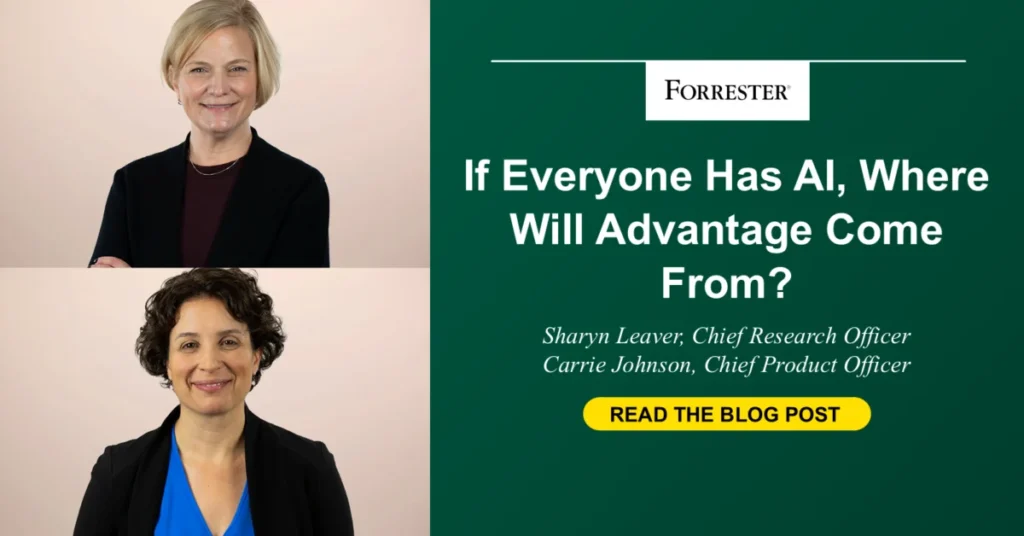
However, Forrester’s research highlights a foundational paradox: When everyone has access to increasingly capable public AI models, where does your competitive differentiation lie?
The answer, according to recent advisory insights, points toward data sovereignty. Private AI will inevitably beat public AI for B2B marketing use cases. Enterprises that rely solely on generic public models risk homogenizing their brand messaging, as competitors leverage identical underlying weights and parameters to craft campaigns. True marketing advantage in the AI era requires proprietary data lakes, custom-trained private models, and human creative oversight that transforms algorithmic outputs into distinct brand narratives.
Official Perspectives and Expert Commentary
As organizations grapple with these transformations, industry leaders emphasize that the integration of artificial intelligence must be viewed as an augmentation of human intellect rather than a wholesale replacement.
"AI alone is no longer a differentiator," noted leadership during the opening sessions at the Technology & Innovation Forum Central. "True competitive advantage comes from how effectively firms blend artificial and human intelligence to deliver compounding value for customers and the broader business."
This sentiment is echoed across Forrester’s advisory network. While algorithms can rapidly digest vast datasets, they operate within a vacuum of lived experience. Analysts possess the contextual awareness required to understand why an organization makes specific structural choices—and, crucially, they possess the professional courage required to intervene.
"Analysts add perspective shaped by rigorous research, continuous client engagement, and deep market observation," industry advisors emphasize. "They understand the organizational and political context behind corporate decisions—and they know precisely when to challenge clients who may be heading down the wrong strategic path."
This dynamic underpins the core philosophy of AI + HI. Trusted artificial intelligence handles the velocity, scale, and heavy lifting of information retrieval, while human intelligence, judgment, and emotional resonance interpret those insights to execute sound, ethical business decisions.
Enterprise Implications: Navigating the Road Ahead
The codification of the AI + HI strategy carries profound implications for technology and data leaders navigating the remainder of the decade. As businesses map out their operational budgets and technological roadmaps, several strategic imperatives emerge:
- Abandoning the "AI-Only" Fallacy: Organizations must formally evaluate their software vendors and internal automation projects to ensure that human-in-the-loop validation is not merely an afterthought, but a mandatory compliance and quality-assurance gate.
- Prioritizing Financial and Operational Governance: As underscored by Forrester’s directives for CISOs, technology leaders must institute rigorous frameworks to monitor the compounding costs and security vectors of widespread AI adoption. Unchecked scaling can rapidly erode profit margins without delivering proportional productivity gains.
- Investing in Proprietary Data Assets: For marketing, product, and strategy teams, generic AI tools offer table stakes, not differentiation. Enterprises must curate secure, proprietary data repositories and embrace private AI environments to protect intellectual property and maintain a distinct market edge.
- Redefining Employee Skill Sets: As routine information processing is increasingly absorbed by tools like Forrester AI, Claude, and Microsoft Copilot, the value of the human workforce shifts toward critical thinking, cross-functional collaboration, empathetic leadership, and strategic oversight.
Ultimately, the goal for modern enterprises is clear: capture the undeniable velocity and scale of artificial intelligence, while actively elevating the human intelligence that translates raw data into meaningful, sustainable, and responsible business outcomes.
